
Why Community Science Matters for Land-Use Projects

Research-driven community engagement (the practice public-affairs professionals call “community science”) materially reduces permitting risk, compresses project timelines, and protects ROI on land-use and infrastructure development. Three outcomes define its value:
Social license to operate: Documented stakeholder support gives regulators and elected officials the political cover to approve projects on schedule.
Risk mitigation: Early, structured outreach reduces the likelihood of litigation, organized opposition, and costly redesigns during permitting review.
Design optimization: Genuine two-way feedback loops surface siting, screening, and setback adjustments that make projects more implementable and defensible.
“Stakeholder engagement strategies shall be integrated into project Communication Plans and used to reduce controversy and litigation risk.” — U.S. Army Corps of Engineers EP 1105-2-57
Table of Contents
Why strategic community engagement protects your project
Social license to operate is not the same as public approval. It is the ongoing, earned legitimacy that allows a project to proceed without organized resistance, even when some stakeholders disagree. Developers and local governments that treat engagement as a one-time public hearing rarely achieve it.
USACE guidance frames outreach explicitly as a risk management practice: the goal is legitimacy and reduced litigation, not universal agreement. The Bipartisan Policy Center reached the same conclusion, with roundtable participants noting that early engagement reduces permitting delays and recommending policy reforms to encourage third-party stakeholder education. When engagement is treated as iterative research rather than a messaging campaign, it also feeds better project design: siting shifts, vegetative screening, and increased setbacks that reduce formal objections during agency review.
“When done well, engagement reduces permitting timelines and litigation risk and helps projects deliver tangible benefits to host communities.” — Clean Air Task Force, The Power of Engagement
Pro Tip: Frame every community meeting as a research session, not a presentation. Assign someone to capture verbatim concerns and track how each one influenced a project decision. That documentation becomes your administrative record.
When to begin engagement and why timing is everything
The practitioner consensus points to a strategic window: after land control is secured but before the formal permit application is filed. Starting too late locks in opposition; starting too early, before project parameters are defined, can generate organized resistance to a project that does not yet exist in its final form.
The most effective campaigns align outreach to permitting milestones. Pre-land control is the relationship-building phase: identify key landowners, tribal governments, and local officials. Pre-permit application is the listening phase: conduct baseline research, run listening sessions, and document community priorities. During agency review, maintain transparency and respond to formal comments. Post-construction, sustain relationships for long-term social license.
Bipartisan Policy Center participants noted that early, transparent outreach often recoups its initial time cost by avoiding expensive delays and legal challenges. A Lawrence Berkeley National Laboratory study found that solar developers reported average engagement spend of roughly a few hundred dollars per MW and wind developers somewhat more, representing a very small fraction of typical capital expenditure, yet both groups credited engagement with fewer project cancellations and meaningful design changes.
“Iterative campaigns timed to project milestones are the most effective way to avoid both engagement fatigue and premature opposition.” — CATF, The Power of Engagement
Pro Tip: Build a milestone-aligned engagement calendar into your project schedule before the first permit application is drafted. Retrofitting outreach after opposition forms costs far more in time and legal fees than the calendar itself.
How to design an effective engagement campaign
A five-step framework keeps campaigns focused and auditable:
Plan: Define clear objectives, success metrics, and a feedback-response protocol before any outreach begins.
Map: Identify every stakeholder category, including landowners, tribal governments, local officials, NGOs, labor organizations, media, and vulnerable or environmental-justice communities.
Listen: Run structured listening sessions and field outreach before presenting project details. Capture input systematically.
Test: Pilot key messages and design alternatives with representative community segments before committing to a final approach.
Iterate: Refine outreach channels, messages, and project features based on documented feedback at each permitting milestone.
Channel selection follows transparent marketing strategies aligned with stakeholder geography and trust levels. In-person listening sessions and town forums work for engaged civic groups. Field outreach at places of worship, community markets, and neighborhood hubs reaches residents who never attend formal meetings. Digital dashboards and targeted social outreach extend reach and create a transparent public record. ASCE practitioner guidance recommends bilingual representatives and partnerships with trusted community organizations, because standard public meetings consistently surface only the loudest perspectives.
Channel | Best for | Trust signal |
In-person forums | Civic groups, local officials | Impartial facilitation |
Field outreach | Underrepresented residents | Bilingual, culturally competent staff |
Digital dashboards | Broad public transparency | Real-time documentation |
Targeted social outreach | Younger demographics, dispersed stakeholders | Consistent, responsive messaging |

DEI is not a compliance checkbox here. Privileging the loudest voices over quieter ones produces a skewed administrative record and leaves projects vulnerable to later claims that engagement was not meaningful. The Udall Center’s principles call for mutual education, tailored information, and deliberate inclusion of stakeholder knowledge to improve decision quality. A well-designed community engagement strategy builds that record from day one.
How to measure community engagement outcomes
Track both process metrics and outcome metrics. Process metrics tell you whether the campaign is reaching the right people; outcome metrics tell you whether it is moving the project forward.
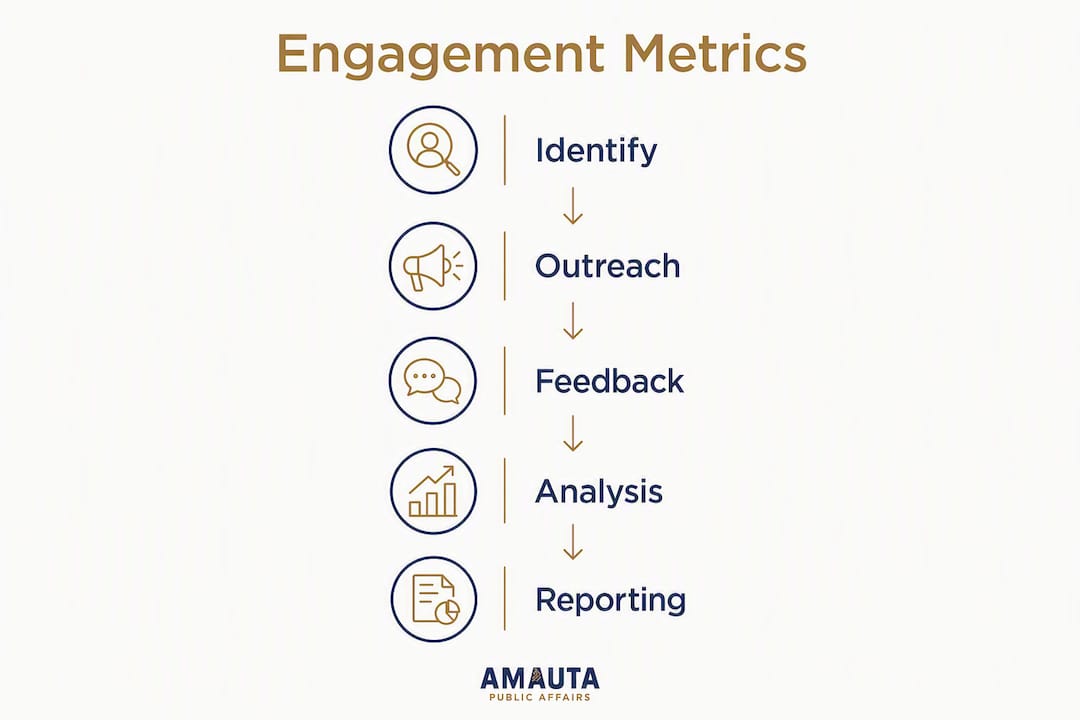
KPI Type | Metric | What it signals |
Process | Number of unique touchpoints | Breadth of outreach |
Process | Participation diversity (demographics) | Representativeness |
Process | Survey response rate | Depth of engagement |
Outcome | Permit milestones achieved on schedule | Reduced regulatory friction |
Outcome | Substantive design changes adopted | Genuine two-way exchange |
Outcome | Formal oppositions converted to neutral or supportive | Social license progress |
Systematic documentation is the connective tissue between outreach activity and permitting outcomes. USACE EP 1105-2-57 identifies documented two-way exchange as a direct protection against controversy and litigation. Weekly internal updates, public-facing dashboards, and post-milestone summaries create a layered record that satisfies agency reviewers and demonstrates good-faith engagement to courts if challenged.
Pro Tip: Use targeted sentiment surveys at 60-day intervals alongside social media monitoring to triangulate community attitude. A gap between survey results and online sentiment often signals an underrepresented group that field outreach has not yet reached.
Common pitfalls and how to avoid them
The most common failure modes in community engagement share a root cause: treating outreach as a formality rather than a research function. The risks and their mitigations follow a predictable pattern.
Tokenism: Holding one public meeting and calling it engagement. Mitigation: establish clear objectives, documented feedback loops, and impartial facilitation before any meeting is scheduled.
Wrong channels: Relying solely on formal hearings that exclude shift workers, non-English speakers, and residents without transportation. Mitigation: deploy field outreach and bilingual staff in community hubs.
Engagement fatigue: Asking for input repeatedly without demonstrating that feedback influenced decisions. Mitigation: publish a “you said, we did” summary after each milestone.
Undocumented process: Verbal commitments and informal conversations that leave no administrative record. Mitigation: document every interaction, including why certain recommendations could not be implemented.
“The absence of public outreach in the planning of a project leads to substantially greater challenges during agency review.” — FERC Stakeholder Outreach Best Practices
Transparent communication practices throughout the engagement process are what convert a documented record into a litigation shield.
How AMAUTA Public Affairs structures a community science campaign
Amautapublicaffairs operates on a campaign model: research-driven, milestone-aligned, and continuously refined through real-time feedback. Each engagement begins with a landscape assessment that maps the political, regulatory, and community environment before a single outreach contact is made.
From that baseline, the firm builds a stakeholder map, designs a channel strategy, and deploys field and digital outreach in parallel. Public dashboards and weekly reporting keep clients informed and create the transparent record that agency reviewers and courts expect. Post-approval, Amautapublicaffairs maintains community relationships to protect long-term social license, particularly for projects with multi-year construction timelines.
In one infrastructure engagement, a developer facing organized opposition at the pre-permit stage retained Amautapublicaffairs to conduct baseline research and redesign its outreach approach. Structured listening sessions identified two specific siting concerns that, once addressed through design modifications, converted the most vocal opposition group into a neutral stakeholder. The permit application proceeded on the original schedule. Specific case study details and client references are available upon request.
Legal and ethical considerations in data collection and community involvement
Community engagement generates data: contact lists, survey responses, recorded comments, demographic information, and sentiment analysis. How that data is collected, stored, and used carries legal and ethical obligations that project sponsors often underestimate.
Under U.S. privacy frameworks, personally identifiable information collected during outreach must be handled with explicit consent protocols, particularly when digital tools or third-party platforms are involved. Engagement campaigns that use social media analytics or targeted advertising must comply with platform terms of service and applicable state privacy laws, several of which impose opt-in requirements stricter than federal baselines.
Ethically, the standard is higher than the legal minimum. Communities that share concerns in good faith expect those concerns to be treated confidentially when requested and to see a documented response. Publishing aggregated feedback without attribution protects participants while maintaining transparency. When third-party technical education is used to build trust, its funding sources must be disclosed to avoid the appearance of a conflict of interest, a point the Bipartisan Policy Center raised explicitly in its permitting roundtable findings.
Tribal consultation carries additional legal requirements under Section 106 of the National Historic Preservation Act and the federal trust responsibility. Treating tribal engagement as equivalent to general public outreach is both legally insufficient and a significant reputational risk.
This article provides general information on engagement practices and is not legal advice. Confirm current regulatory requirements with qualified legal counsel and the relevant federal or state agency.
Key Takeaways
Strategic community engagement is the single most cost-effective risk management tool available to developers, local governments, and nonprofits navigating U.S. land-use and infrastructure permitting.
Point | Details |
Start before the permit application | Engagement launched at pre-permit scoping reduces opposition and costly late-stage redesigns. |
Fund research, not just meetings | Baseline stakeholder mapping and sentiment tracking produce the data that drives defensible design decisions. |
Document every feedback loop | A systematic administrative record showing how input influenced decisions is the primary litigation shield. |
Measure process and outcome KPIs | Track participation diversity and permit milestones together to demonstrate both reach and impact. |
Amautapublicaffairs | Delivers campaign-style engagement with milestone-aligned outreach, public dashboards, and post-approval relationship management for land-use and infrastructure projects. |
What actually moves projects forward
The conventional wisdom treats community engagement as a communications problem: craft the right message, hold the right meetings, and approval follows. That framing misses the point almost entirely.
The projects that clear permitting on schedule are the ones where the developer genuinely changed something in response to community input, and then documented that change. Not because regulators demanded it, but because that documented responsiveness is what converts a skeptical agency reviewer into an approver and a vocal opponent into a neutral party. Credibility is the currency of infrastructure development, and it is earned through demonstrated responsiveness, not polished presentations.
The other lesson practitioners learn quickly: the communities most affected by a project are rarely the ones showing up to public hearings. Effective engagement requires going where people already are, in their language, through voices they already trust. That is not a soft, feel-good practice. It is the difference between a defensible administrative record and a litigation target.
AMAUTA Public Affairs: built for exactly this challenge
Developers and project sponsors who need a faster path through permitting and a stronger community record have a clear alternative to generic communications firms: Amautapublicaffairs’s land-use services built specifically for the stakeholder complexity of infrastructure and energy projects.
Amautapublicaffairs combines baseline landscape research, stakeholder mapping, field and digital outreach, and real-time reporting into a single campaign structure. The result is a documented engagement record that satisfies USACE, FERC, and local agency standards while protecting your project schedule. For developers and local governments ready to move from planning to permitting, the next step is a scoping call to assess your project’s stakeholder environment and define an engagement timeline. Review AMAUTA’s full service offering or reach out directly to request a tailored cost estimate.
Useful sources and further reading
The following authoritative documents underpin the guidance in this article. Project sponsors and procurement teams can use them when drafting SOWs for engagement work or building an internal case for engagement investment.
Udall Center: Principles for Effective Stakeholder Engagement in Infrastructure Permitting — Practical principles for mutual education, DEI, and two-way feedback; useful when designing listening sessions and evaluating facilitation approaches.
Bipartisan Policy Center: Empowering Communities while Streamlining Clean Infrastructure Permitting — Roundtable findings on early engagement, third-party education, and policy reforms; valuable for framing the ROI case internally or in procurement documents.
CATF: The Power of Engagement — Sector-specific guidance on clean energy project engagement, trust-building, and community benefits; directly applicable to solar, wind, and transmission projects.
FERC: Suggested Best Practices for Industry Outreach Programs — Federal Energy Regulatory Commission guidance on stakeholder outreach for FERC-jurisdictional projects; reference when scoping engagement for transmission or natural gas infrastructure.
Agencies and developers drafting SOWs for engagement work should reference USACE EP 1105-2-57 and the Udall principles as the baseline standard, then layer in sector-specific guidance from CATF and the Bipartisan Policy Center to address project-type nuances.
Recommended
Comments