
The Community Liaison Role in Land Use Projects

A community liaison is a professional who serves as the two-way conduit between an organization and the communities affected by its decisions, translating technical plans into accessible language while channeling ground-level concerns back into project design. For land use projects, this role is not optional when opposition is likely: it is the prerequisite for a permit timeline that holds. JobDescription.org documents the core tasks, the National Association of Social Workers frames the professional standards, and Amautapublicaffairs applies both within a campaign-style public affairs model built for entitlement environments.
Table of Contents
What does a community liaison actually do day to day?
The role operates at the organizational and community level, not the individual case-management level. A liaison does not manage client files; they manage relationships, information flows, and sentiment at scale.
Core community liaison responsibilities include:
Attending community events, neighborhood association meetings, and public hearings to represent the project
Translating technical plans, environmental documents, and zoning language into plain terms residents can act on
Gathering structured and informal feedback and routing it to project leadership
Tracking engagement metrics and documenting community sentiment for reporting and compliance
Coordinating with program staff, legal counsel, and government liaisons on community-facing communications
Maintaining accurate records and databases of all interactions
In a land use context, daily tasks look like this: preparing testimony summaries before a planning commission hearing, conducting door-to-door outreach in neighborhoods adjacent to a proposed development, and facilitating small-group briefings for residents who will not attend a formal public meeting. The work is granular and relational, not broadcast.
Pro Tip: Consistent informal presence, attending a neighborhood council meeting, stopping by a community center, outperforms a single polished town hall. Trust builds over months, not events.
What skills and competencies predict liaison success?
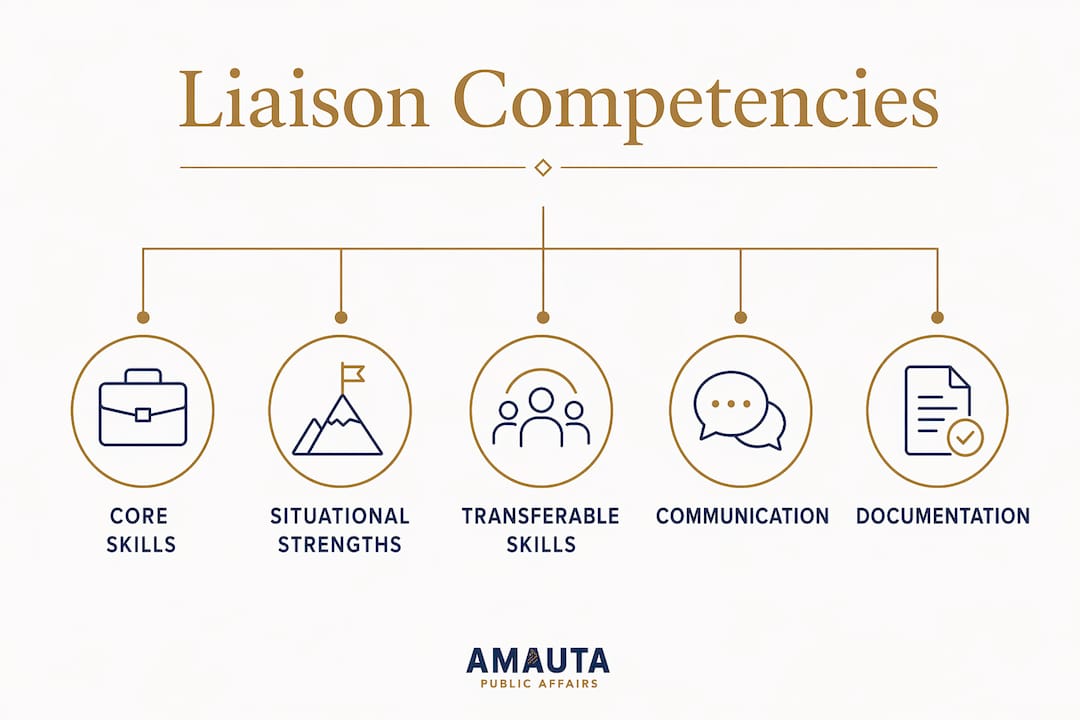
Strong interpersonal skills and rapport-building ability are the baseline. Beyond that, the competencies that separate effective liaisons from ineffective ones fall into two categories.

Situational strengths are context-specific: fluency in the languages spoken in the project area, existing relationships with local faith leaders or neighborhood associations, and familiarity with the specific regulatory environment (CEQA, NEPA, local zoning codes). These cannot be trained quickly and should be weighted heavily in hiring.
Transferable competencies include stakeholder mapping, structured documentation, written and verbal translation of technical content, and grievance mediation. JobDescription.org identifies clear persuasive communication as a defining trait, noting that liaisons are often the first point of contact for community members with questions or concerns. Cultural competency and emotional intelligence round out the profile: a liaison who cannot read a room during a tense public meeting will make opposition worse, not better.
When building interview prompts, ask candidates to describe a specific instance when community feedback changed an internal decision. That question separates genuine two-way advocates from outward-only communicators.
Pro Tip: Ask for a writing sample: a plain-language summary of a technical document the candidate has actually produced. Communication skill is easy to claim and easy to verify.
How does a community liaison add value in land use projects?
The liaison’s value in land use is measurable and specific. Organizations viewed with suspicion by affected communities often lack a credible internal advocate for community perspectives; those with effective liaisons tend to see materially different public sentiment and more productive public processes.
Concrete use cases by project phase:
Pre-entitlement: Stakeholder mapping to identify organized opposition, informal leaders, and potential allies before the first public notice goes out
Public hearing preparation: Coaching applicants on community concerns, preparing plain-language FAQs, and coordinating supporter attendance
Neighborhood benefit design: Translating community priorities into mitigation measures or community benefit agreements that reduce formal objections
Construction phase: On-site informal engagement to manage noise, traffic, and dust complaints before they become code complaints or media stories
Grievance triage: Logging, routing, and resolving resident concerns within defined response windows
Projects with active liaison programs tend to see higher attendance at informational meetings, a shift in public comment tone from opposition to conditional support, and shorter permit timelines. The NASW frames this directly: liaisons help institutional policies align with ground-level realities, which is precisely what planning commissions and city councils want to see demonstrated before approving a contentious project.
When should you hire a community liaison?
The right window is earlier than most project teams expect. By the time a project faces organized opposition at a public hearing, a liaison hired that week cannot repair six months of absent engagement.
Optimal hiring windows:
Pre-application due diligence: Before any public notice, to map the community and identify fault lines
Before formal notifications: At least 60–90 days before the first required public notice, to establish presence
During permit submission: To manage the comment period and coordinate with planning staff on community concerns
During construction: For grievance management and ongoing neighbor relations
Specific triggers that justify immediate hiring include contentious zoning changes or upzonings, projects adjacent to schools, parks, or environmental justice communities, required community benefits negotiations, and active misinformation circulating in local social media groups or neighborhood forums.
On contract structure: a short-term contract liaison works well for discrete entitlement phases on smaller projects. A full-time embedded liaison, or a retained agency, is appropriate for multi-phase developments, projects with multi-year permit timelines, or sites with documented community opposition history.
Pro Tip: Community outreach before project launch is not a soft investment. It directly affects whether your first public hearing is a productive conversation or a recorded opposition rally.
How do you evaluate candidates and agencies?
Use this checklist before shortlisting:
Demonstrated experience in land use, development, or infrastructure projects specifically
Verifiable local relationships in the project’s geography (ask for names and references, not descriptions)
Bilingual or multicultural reach matched to the project area’s demographics
Documented metrics tracking: past engagement logs, sentiment summaries, or KPI reports
References who can speak to specific project outcomes, not just general satisfaction
Sample interview questions that reveal real capability:
Describe a public hearing where community sentiment shifted between the notice period and the hearing date. What did you do, and what changed?
Give an example of community feedback that led you to recommend a change to the project design or mitigation plan.
How do you document informal conversations, and who receives that documentation?
What is your approach when a community member asks you to take a position your client has not authorized?
Red flags to disqualify candidates early: proposals that emphasize media coverage over community relationships; no evidence of physical presence in the target geography; inability to name specific community organizations in the project area; no method for documenting or reporting community sentiment to the project team.
Sample job description and U.S. compensation ranges
Scope of work (adaptable for RFP or internal hire):
The Community Liaison will serve as the primary point of contact between [Project Name] and affected neighborhoods. Core deliverables include a stakeholder map within 30 days of engagement, weekly engagement logs, monthly sentiment summaries, public hearing preparation support, and a grievance tracking database. The liaison will attend all public meetings, coordinate with legal and planning staff on community-facing communications, and report directly to the project’s public affairs lead.
Engagement Model | Typical Weekly Hours | Typical U.S. Compensation Range | Key Rate Drivers |
Part-time contract liaison | 10–20 hrs/week | $40–$75/hr | Local market, bilingual premium |
Full-time project liaison (FTE) | 40 hrs/week | $55,000–$90,000/year | Seniority, metro cost of living |
Retained agency support | Variable | $8,000–$20,000/month | Scope, team size, reporting depth |
Rates at the higher end reflect bilingual skillsets, senior-level experience, and high-cost metros such as Los Angeles, San Francisco, or New York. Public-sector job templates from school districts provide useful benchmarks for duties and confidentiality expectations that translate directly to private development contexts.
How do you measure a liaison’s impact?
KPI | Definition | Reporting Cadence |
Engagement volume | Number of unique community contacts per week/month | Weekly operational log |
Sentiment index | Ratio of supportive to neutral to opposed contacts, tracked over time | Monthly dashboard |
Event attendance | Headcount at project-sponsored meetings vs. opposition-organized meetings | Per event |
Grievance resolution time | Average days from complaint receipt to documented resolution | Monthly |
Comment quality | Ratio of substantive/conditional comments to blanket opposition in public record | Per hearing |
Weekly operational notes should capture contacts, topics raised, and any emerging concerns. Monthly KPI dashboards tie those notes to project milestones. Milestone summaries, prepared before each entitlement event, give decision-makers a snapshot of community sentiment and outstanding issues. The minimum data sources a liaison should maintain: a contact database, an interaction log, a grievance tracker, and a sentiment trend file updated monthly.
Common pitfalls, ethical concerns, and legal boundaries
The most common mistake is treating outreach as a one-way broadcast. Liaisons who attend meetings to deliver information but do not document or route community feedback back to the project team provide almost no value and often increase distrust.
Other pitfalls: over-promising community benefits the project cannot deliver; inconsistent presence that signals the project only cares about the community during permit review; and poor documentation that leaves the organization exposed when community members dispute what was said.
On compliance: in U.S. land use work, distinguish clearly between permitted community engagement and activities that trigger lobbying registration requirements under state or local law. Coordinating community members to contact elected officials, for example, may require registration in some jurisdictions. When in doubt, route policy asks through formal channels and consult legal counsel before organizing any direct-advocacy campaign. Confidentiality boundaries matter too: interaction logs should be maintained internally and not shared with third parties without appropriate authorization.
Pro Tip: Document every significant interaction in writing within 24 hours. A well-maintained interaction log protects both the organization and the community, and it is the foundation of any credible KPI report.
Key Takeaways
A community liaison embedded early in a land use project, with clear KPIs and a documented feedback loop, is the single most effective tool for converting community opposition into conditional support before a public hearing.
Point | Details |
Hire before public notice | Engage a liaison at least 60–90 days before the first required public notice to establish credibility. |
Demand documented metrics | Require weekly engagement logs, monthly sentiment summaries, and a grievance tracker from day one. |
Screen for two-way advocacy | Reject candidates who cannot cite a specific instance where community feedback changed a project decision. |
Match contract model to scale | Use short-term contracts for discrete entitlement phases; retain an agency for multi-year or contested projects. |
Amautapublicaffairs approach | Amautapublicaffairs embeds liaisons within a campaign-style public affairs model, tying every engagement activity to measurable project milestones. |
A practitioner’s perspective on what the role actually demands
The community liaison role is consistently misunderstood by project teams, and that misunderstanding is expensive. The most common version of the mistake: a developer hires someone personable, sends them to a few neighborhood meetings, and calls it community engagement. When the planning commission hearing arrives and the room is full of organized opposition, the team is genuinely surprised.
What actually works is bidirectional feedback with teeth. A liaison who attends meetings but cannot change anything internally is a messenger, not an advocate. The highest-value liaisons are the ones who bring community concerns back to the project team and get something changed: a truck route, a construction hours policy, a park improvement commitment. That internal influence is what builds credibility in the community, because residents eventually learn whether their input matters.
Amautapublicaffairs approaches liaison work as part of a broader community engagement strategy where every touchpoint is documented, every concern is routed, and every KPI is tied to a project milestone. The measurement-first mindset is not bureaucratic overhead; it is what allows the team to demonstrate to a planning commission that community input shaped the project, not just informed it.
The firms and candidates who treat this role as a PR function will keep losing hearings they should have won.
What Amautapublicaffairs offers for land use community engagement
Amautapublicaffairs designs and staffs community liaison programs for land use projects across the United States, from pre-application stakeholder mapping through post-permit construction engagement. The difference from a generalist hire: every liaison engagement is structured around a public affairs campaign model, with defined KPIs, weekly reporting, and direct integration into entitlement strategy.
Land management expertise covers the full project lifecycle. Specific services include:
Stakeholder mapping and opposition research before public notice
Liaison staffing matched to project geography, language needs, and timeline
Scope development and KPI dashboard design
Grievance tracking systems and monthly sentiment reporting
Strategic messaging aligned with planning commission and city council priorities
To discuss liaison design or retained community engagement support for your project, visit the AMAUTA services page and request a consultation.
Authoritative sources and recommended reading
Community Liaison Job Description, Salary & Career Outlook | JobDescription.org: Start here for role templates, core responsibilities, and KPI benchmarks.
What Does a Community Liaison Do? | NASWWI: Professional standards and career pathway context from the National Association of Social Workers.
Community Liaison Job Description (Updated 2026 With Examples) | NASWWA: Role importance in diverse communities and alignment with professional practice standards.
Position: Community Liaison | PGCPS: Public-sector job template with duties, confidentiality expectations, and time-commitment benchmarks.
Community Liaison Job Description Template | Recooty: Practical template for outreach to underserved populations and interaction record-keeping.
AMAUTA Public Affairs: Campaign-style community engagement and public affairs services for U.S. land use projects.
Recommended
Comments