
Land Use Communication Strategy Guide for Planners

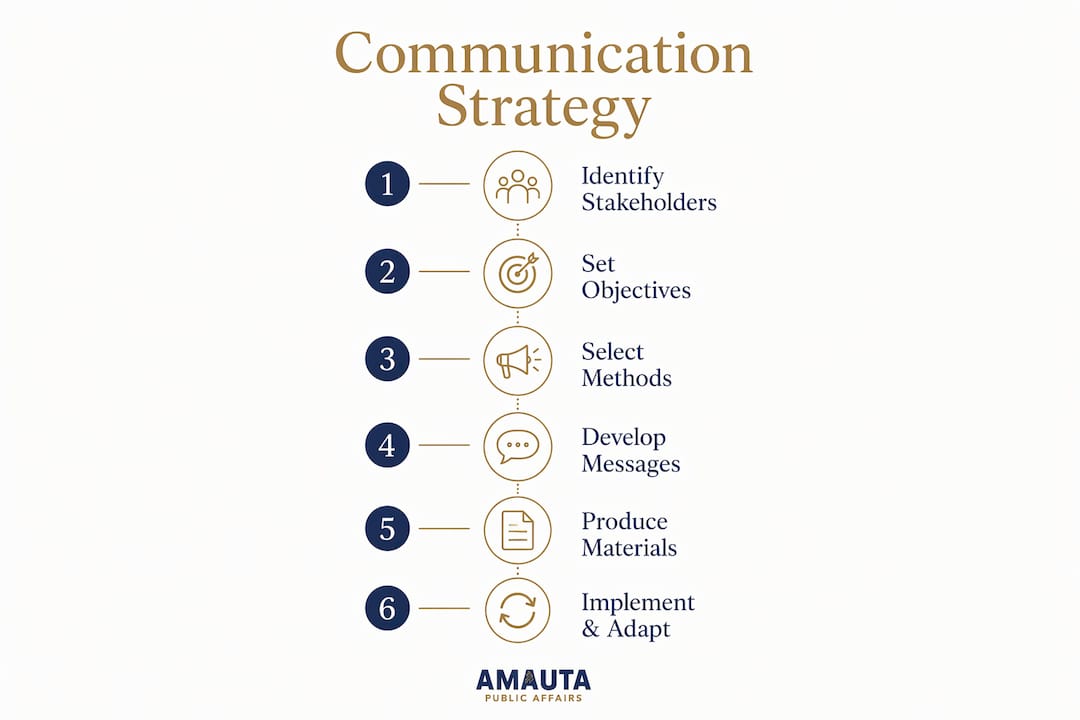
A well-built land use communication strategy guide gives local officials, planners, and community engagement professionals a structured pathway to connect with the right people, deliver clear messages, and adapt in real time when conditions shift. At its core, the guide organizes work into four phases: Assessment, Planning, Production, and Action & Reflection. Each phase builds on the last, creating iterative learning loops rather than a one-time rollout. The framework draws from authoritative models including the IAP2 Spectrum of Public Participation and the CARB Community Engagement Model, both of which set the standard for how public agencies approach community dialogue on land use.
The essential components of any effective plan include:
Stakeholder identification and mapping to clarify who is affected, who holds decision-making authority, and whose trust must be earned early
Clear communication objectives tied to measurable changes in community knowledge, attitudes, or practices
Message development that accounts for cultural context, literacy levels, and the specific concerns of each audience segment
Media and channel selection matched to stakeholder preferences and accessibility needs
Feedback mechanisms that document public input transparently and close the loop with communities on how their input shaped decisions
Monitoring and evaluation protocols to track whether communication is producing the intended outcomes
Transparency and genuine public participation are not optional features of this process. They are the conditions under which land use decisions earn legitimacy. When planners treat communication as a campaign rather than a compliance exercise, the results are measurably better: fewer delays, less organized opposition, and communities that feel ownership over outcomes.
How do you identify stakeholders and set communication objectives?
Stakeholder mapping is the prerequisite step that determines the quality of everything that follows. Before drafting a single message or booking a single meeting room, planners need a granular picture of who is affected by the land use decision, who influences others’ opinions, and who has been historically excluded from these conversations. A useful mapping exercise segments stakeholders by interest level, influence, and proximity to the project area, then flags which groups require dedicated outreach rather than general notification.

Setting communication objectives follows directly from that map. Objectives should specify the change you are trying to produce: a shift in awareness, a change in attitude toward a proposed zoning amendment, or an increase in participation rates at public comment sessions. Vague goals like “inform the community” give planners no way to measure success and no basis for adjusting tactics mid-course. Concrete objectives, by contrast, create accountability and make evaluation straightforward.
Situational analysis matters here too. The history of a neighborhood’s relationship with local government, the presence of active advocacy groups, and the political salience of the land use question all shape what communication approaches will work. A community that has experienced broken promises from prior planning processes requires a different opening posture than one engaging with government for the first time. Planners who skip this contextual read often find themselves managing conflict that was entirely predictable.
Inclusivity is not a checkbox. Recognizing that different community groups hold different priorities, speak different languages, and access information through different channels is the foundation of effective stakeholder communication strategies. Competing interests are real and should be mapped explicitly rather than papered over with optimistic language about “shared goals.”
Pro Tip: Build trust early, long before the formal planning process begins. Non-transactional relationships developed months in advance create the goodwill that prevents organized opposition from forming once a project goes public.
How do you select communication methods and test core messages?
The planning phase is where strategy becomes concrete. Planners choose which channels to use, at what level of engagement, and with what core messages. Getting these choices right requires matching the method to the audience and the engagement level to the actual degree of influence the community will have.
The IAP2 Spectrum provides the most widely recognized framework for this decision. Its five levels, Inform, Consult, Involve, Collaborate, and Empower, each carry a distinct “public promise” about how much influence participants will have. Selecting the wrong level creates a mismatch between what communities expect and what they receive. That mismatch is one of the most common causes of eroded trust in public planning processes.
Message development at this stage should prioritize simplicity, cultural sensitivity, and audience specificity. A message designed for a neighborhood association meeting will not land the same way in a written public notice or a social media post. Planners should draft core messages and then test them with representative members of each target group before broad release. Focus groups, small-group workshops, and brief online surveys all work well for this purpose. The goal is to catch misunderstandings, unintended connotations, and accessibility gaps before they become public problems.
Channel | Best suited for | Engagement level | Key consideration |
Public meetings | Broad community input, formal record | Consult / Involve | Accessibility of venue and time |
Online surveys | Reaching dispersed audiences at scale | Consult | Digital equity and language access |
Social media | Rapid updates, two-way dialogue | Inform / Consult | Platform demographics vary by community |
Printed materials | Low-connectivity or older populations | Inform | Translation and reading level |
Focus groups | Message testing, nuanced feedback | Involve | Requires skilled facilitation |
Community workshops | Co-design, collaborative problem-solving | Collaborate / Empower | Time and resource intensive |
Logistics and timing deserve as much attention as message content. A well-designed engagement event scheduled during a weekday afternoon will exclude working residents. Materials released without adequate lead time prevent meaningful participation. Planners who treat logistics as an afterthought consistently underperform on participation rates, which then gets misread as community apathy.
Align channel choices with where target audiences already gather, not where planners find it convenient to hold meetings
Provide multiple formats for the same core information: short summaries, detailed documents, and visual explainers
Test survey questions with members of the target group to confirm they generate the information you actually need
Budget for translation and interpretation from the outset, not as an afterthought
What does the production phase involve for communication materials?
Production is where planning decisions become tangible deliverables: fact sheets, presentation decks, website content, social media graphics, translated materials, and event facilitation guides. The quality of these products determines whether your carefully developed messages actually reach and resonate with the intended audiences.
Effective production starts with a clear brief that connects each deliverable back to a specific communication objective and a specific audience segment. A fact sheet for property owners adjacent to a rezoning proposal needs different content, tone, and visual complexity than a briefing document for city council members. Conflating these audiences into a single document is a common mistake that produces materials too dense for residents and too thin for decision-makers.
Pre-testing is non-negotiable before full rollout. Distribute draft materials to a small representative sample of the target audience and ask direct questions: What is the main message? What is unclear? Is anything offensive or confusing? Surveys, brief interviews, and pilot events all work. The feedback loop at this stage is inexpensive compared to the cost of correcting a message failure after wide distribution.
Accessibility standards should be applied systematically. This means plain language at an appropriate reading level, high-contrast visuals, alt-text for digital images, and materials available in the languages spoken by affected communities. The CARB Community Engagement Model explicitly requires translation of materials and interpretation at events as part of its implementation guidance, reflecting a recognition that accessibility is a precondition for genuine participation.
Design visuals that reinforce rather than contradict the written message
Maintain consistent terminology across all materials to avoid confusion about project scope or intent
Establish a review process that includes both technical accuracy checks and plain-language review
Archive all production versions to support transparency and legal defensibility
Pro Tip: Use iterative feedback loops during production, not just at the end. Catching a culturally insensitive phrase or a confusing diagram in draft form costs far less than managing the fallout from a public misstep.
How do you implement, monitor, and adapt your communication strategy?
Execution is where plans meet reality, and reality rarely cooperates perfectly. Effective implementation requires both disciplined follow-through on the planned activities and genuine openness to changing course when community feedback signals that something is not working.
Event hosting sets the tone for the entire engagement process. Meetings should open with a clear statement of purpose, the scope of community influence on the decision, and how input will be documented and used. This transparency prevents the most common source of community frustration: the sense that participation is performative. The CARB model is explicit on this point: agencies must provide a public record of all comments received and explain which comments were not incorporated and why. That level of accountability builds legitimacy even when the agency cannot act on every piece of feedback.
Conflict management during land use discussions requires a specific skill set. Neutral facilitation, accurate repetition of community concerns back to the group, and a genuine absence of predetermined outcomes are the three practices that prevent dialogue from collapsing into adversarial exchanges. Planners who enter community meetings with a “decide, announce, and defend” posture consistently generate opposition that could have been avoided. Remaining open to ideas that were not in the original plan is not a sign of weak leadership. It is the condition under which communities develop genuine ownership of outcomes.
Monitoring should be built into the implementation schedule, not treated as a post-project review. Useful metrics include participation rates across demographic groups, the ratio of new voices to repeat participants, sentiment analysis of public comments, and whether the range of concerns raised in early sessions is narrowing or widening over time. These indicators tell planners whether the communication strategy is reaching the right people and whether trust is building or eroding.
Adaptive management is the practice of treating community feedback as real-time data that shapes the next phase of work, not as input to be acknowledged and filed. Planners who budget for adaptability rather than rigid timelines consistently achieve more genuine community influence and better project outcomes.
Document all public input in a centralized, accessible format
Share interim summaries of what has been heard and how it is shaping decisions
Follow up individually with stakeholders who raised concerns that required further investigation
Evaluate each engagement event immediately after it occurs, before memory fades and before the next event is designed
What frameworks and expert insights shape effective land use communication?
The most durable land use communication strategies are grounded in recognized frameworks rather than improvised from scratch. Two models stand out for their practical applicability and their adoption by public agencies across the United States.
The IAP2 Spectrum in practice
The IAP2 Spectrum’s five levels of public participation, Inform, Consult, Involve, Collaborate, and Empower, are not a hierarchy where higher is always better. They are a menu of appropriate approaches depending on the scope of the decision, the degree of community impact, and the genuine latitude available for community influence. A routine infrastructure maintenance decision may warrant Inform-level communication. A general plan update that will shape land use for a generation warrants Collaborate or Empower-level engagement.
The critical discipline is matching the promised level of influence to the actual level of influence. Using a consultative approach when stakeholders expect collaboration causes conflict and erodes trust in ways that are difficult to repair. Planners should state clearly, at the outset of any engagement process, exactly where on the spectrum the project sits and why.
The CARB Community Engagement Model
California’s CARB model offers one of the most detailed operational frameworks available for public agencies. Its emphasis on transparency, feedback documentation, and the explicit avoidance of “decide, announce, and defend” approaches reflects lessons learned from decades of community engagement failures in environmental and land use contexts. The model’s requirement that agencies explain which comments were not incorporated, rather than simply acknowledging receipt, sets a standard that builds legitimacy even in contentious processes.
Contemporary expert guidance
Recent CDC guidance marks a significant shift in how institutions are expected to approach community engagement. The move from a top-down model to a genuine partnership model requires institutions to prepare to share or release control, a posture that demands internal cultural change as much as process redesign. This shift is not rhetorical. It has practical implications for how planners frame their role, how they structure decision-making authority, and how they communicate the limits of community influence honestly.
Terminology is a subtler but equally consequential dimension of effective communication. Terms like “land stewardship” may resonate more positively in certain communities than “land use,” which carries associations with bureaucratic control and historical displacement. The choice of framing language is often the first variable that determines whether a community opens up or shuts down. This connects directly to the role of community engagement strategy in shaping how projects are perceived from the first public touchpoint.
Ethical and legal considerations run through all of this. Public notice requirements, environmental justice mandates, tribal consultation obligations, and open meeting laws set the floor for what planners must do. Effective communication strategy aims well above that floor, treating legal compliance as the minimum rather than the goal.
Pro Tip: Build flexibility into both budget and timeline from the start. Adaptive engagement that can respond to unanticipated community priorities produces more durable outcomes than a plan locked to a fixed schedule.
What do successful land use communication strategies look like in practice?
Real-world examples illustrate how the phased approach and framework principles translate into outcomes. Three cases, drawn from different project types and scales, show what works and why.
Urban infill rezoning in a historically underserved neighborhood
A mid-sized California city faced significant community resistance to a proposed mixed-use rezoning in a neighborhood with a documented history of displacement. The planning department’s initial approach, a single public hearing followed by a comment period, generated organized opposition and media coverage that threatened to derail the project entirely.
The department reset its approach using the CARB model as a guide. It conducted a listening tour across six community locations over three months, with bilingual facilitation and childcare provided at each session. All comments were compiled into a public summary document that explained which concerns had been incorporated into the revised proposal and which had not, along with the reasons. The revised plan included affordable housing provisions that had not been in the original draft. The rezoning passed with broad community support at the subsequent hearing.
What made the difference was not the volume of outreach but the quality of the feedback loop. Communities that had been skeptical became advocates once they saw their specific concerns reflected in the revised proposal.
Rural land management plan in a tribal consultation context
A federal land management agency developing a new resource management plan for a large tract of public land initiated tribal consultation eighteen months before the formal comment period opened. Rather than treating tribal governments as one stakeholder category among many, the agency co-designed the engagement process with tribal representatives, including the framing of the land use questions themselves.
The agency adopted the terminology preferences of the tribal nations involved, using “stewardship” and “traditional use areas” rather than the standard regulatory language. This adjustment, small in isolation, signaled a genuine shift in posture that opened dialogue on substantive issues that had been blocked in prior planning cycles. The resulting plan incorporated traditional ecological knowledge in ways that strengthened the scientific basis of the resource management decisions.
Regional transportation and land use corridor study
A metropolitan planning organization conducting a corridor study that would shape land use decisions across multiple jurisdictions used a tiered communication approach calibrated to the IAP2 Spectrum. General public outreach operated at the Inform and Consult levels, using online surveys, open houses, and a project website with regular updates. A technical advisory committee of local planners, developers, and community organizations operated at the Collaborate level, with direct influence over the alternatives analysis.
The organization published quarterly summaries of what it had heard and how that input was shaping the study’s direction. Participation in the second round of public engagement was substantially higher than the first, a pattern that planners attributed directly to the visible responsiveness of the process. When the final recommendations were released, organized opposition was minimal because the range of concerns had been addressed transparently throughout the study period.
Key Takeaways
A land use communication strategy succeeds when it combines a clear phased structure, honest engagement level-setting, and genuine responsiveness to community input at every stage.
Point | Details |
Use the IAP2 Spectrum deliberately | Match the promised level of community influence to the actual decision-making latitude available before engagement begins. |
Build trust before the formal process | Non-transactional relationship-building prior to official planning reduces opposition and creates space for genuine dialogue. |
Document and explain all feedback | The CARB model requires a public record of comments and clear explanations when input is not incorporated, which builds legitimacy. |
Budget for adaptability | Plans locked to rigid timelines cannot respond to unanticipated community priorities; adaptive management produces more durable outcomes. |
Terminology shapes participation | Adjusting language, such as “land stewardship” over “land use,” can meaningfully change community openness and engagement rates. |
How Amautapublicaffairs supports your land use communication work
Amautapublicaffairs brings a campaign-style discipline to land use communication that most planning departments cannot build in-house. The team conducts granular community landscape assessments, develops messaging strategies tailored to each stakeholder segment, and manages the full arc from early trust-building through post-decision follow-up. Services span community engagement design, media relations, and digital advocacy, all calibrated to the specific political and community context of each project.
For planners and local officials who need to move a land use decision forward without generating unnecessary opposition, Amautapublicaffairs offers the expertise to design processes that communities trust and decision-makers can defend. Explore the full range of land management services or review the firm’s broader public affairs capabilities to find the right fit for your project.
Recommended
Comments