
Transparent Communication in Business Development Plans

Transparent communication in business development plans means openly sharing the why behind decisions, the process for achieving goals, and the criteria guiding choices, without necessarily exposing every sensitive commercial detail. When stakeholders understand the reasoning, not just the outcome, they become participants rather than observers. Research shows that 44.2% of employees want more insight into organizational goals to feel fully engaged, which points directly to a gap that transparent communication closes. For public affairs consultants managing land use projects, that gap carries real consequences: community opposition, permitting delays, and eroded credibility.
The foundational elements of open communication in this context include:
Clarity: Messages are specific, free of jargon, and tied to concrete outcomes stakeholders can visualize.
Consistency: Every channel, every spokesperson, and every update reflects the same core narrative.
Openness: The rationale behind decisions is shared proactively, not defensively after opposition forms.
Governance framework: Defined ownership of who communicates what, when, and through which channel.
Feedback mechanisms: Structured channels for stakeholders to respond, ask questions, and see their input acknowledged.
Curated transparency, a concept well established in public affairs practice, threads the needle between full disclosure and strategic silence. It means sharing purpose and community benefit while protecting sensitive legal or commercial data that, if misused, could harm the project or the client.
Why leading with “why” builds more stakeholder trust than announcing outcomes
The instinct in most business development plans is to announce results: approvals secured, timelines confirmed, economic projections delivered. That instinct is understandable, but it consistently produces the wrong reaction from community stakeholders. Communication experts emphasize that transparency focused on underlying reasons and ongoing processes builds more durable trust than polished outcome announcements alone.
When a community learns a project has been approved before understanding why it was pursued, skepticism fills the information vacuum. Defensive reactions follow. Explaining the rationale first, the problem the project solves, the community benefit it creates, and the process used to evaluate alternatives, gives stakeholders a framework for interpreting every subsequent update.
Lead every stakeholder presentation with the purpose, not the plan.
Explain what criteria shaped key decisions before presenting the decision itself.
Acknowledge trade-offs openly; pretending none exist destroys credibility faster than any opposition campaign.
Frame the process as ongoing, not concluded, so stakeholders feel they are joining a conversation rather than receiving a verdict.
Pro Tip: Structure your 30-minute stakeholder sessions with the first third devoted entirely to “why this project, why now.” Audiences who understand purpose before detail are measurably more receptive to the specifics that follow, and far less likely to anchor on a single objectionable element.
Sequencing communication with purpose first and details second is not a soft communication preference. It is the prerequisite for securing buy-in, particularly in land use contexts where community members arrive with pre-existing concerns about traffic, environmental impact, or neighborhood character.
Best practices for stakeholder communication in land use projects
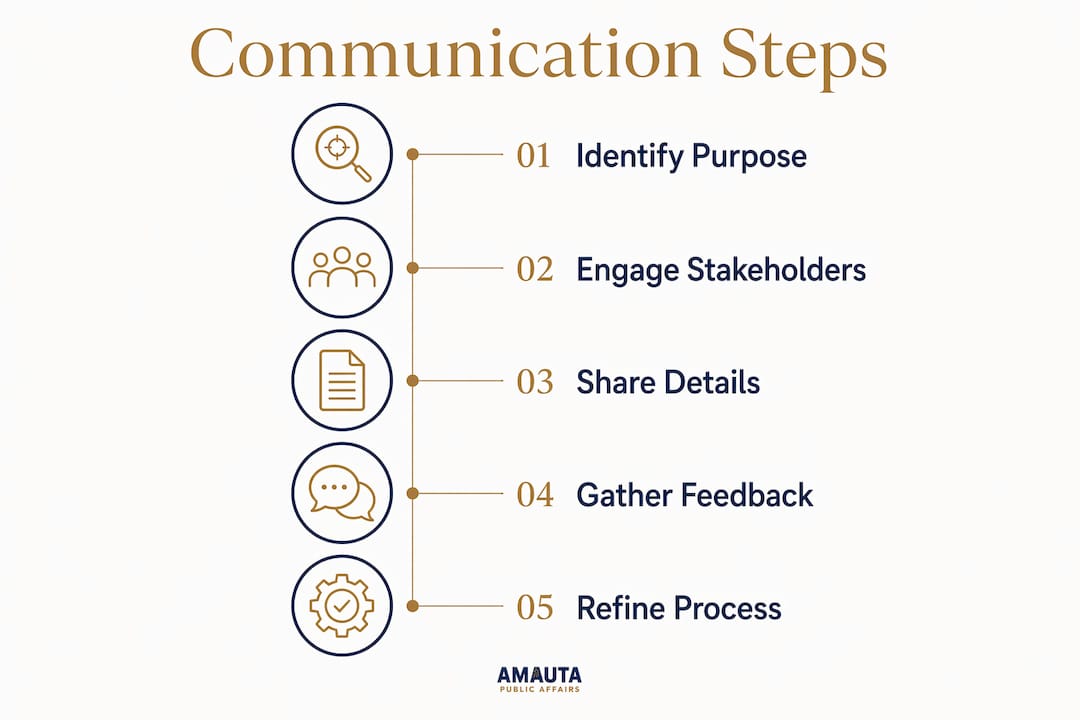
Land use projects present a specific challenge: the stakeholder map is wide, the interests are often competing, and the timeline for public comment is fixed. Surgical precision in timing and content, not volume of information, determines whether a community engagement effort succeeds.
Curated transparency in land use projects means sharing the project’s purpose and community benefits openly while protecting sensitive commercial or legal details that could be misused or misrepresented. The goal is credibility, not comprehensiveness.
Releasing information before it is accurate, or withholding it until opposition has already organized, are equally damaging errors. The most effective approach sequences disclosure by stakeholder group and by project phase, giving elected officials and agency staff early access to technical detail while framing community-facing communication around benefit and process.
Proven practices for stakeholder communication in land use engagements include:
Map stakeholders by influence, interest, and likely concern before drafting a single message.
Develop a tiered information architecture: full technical detail for regulatory audiences, benefit-focused narratives for community groups, and economic framing for local government.
Release information proactively at defined project milestones rather than reactively in response to opposition.
Maintain a single, centralized update repository so no stakeholder group receives a contradictory version of the project status.
Document every public commitment and follow through visibly, since inconsistent messaging is the primary mechanism through which stakeholder trust erodes.
A solar development project in the mid-Atlantic region illustrates the difference this approach makes. The development team released a community benefit summary, including local hiring commitments and land lease terms, before the first public hearing. Opposition at that hearing was minimal compared to a comparable project in the same state where community members learned the same details from a local news report the week before the hearing. Timing and framing, not the substance of the project, drove the difference in reception.
How to embed transparency in your organization’s digital communication model
Treating transparency as part of a digital operating model means building it into the architecture of how your organization communicates, not leaving it to individual judgment on a project-by-project basis. The organizations that communicate consistently across complex, multi-stakeholder projects do so because they have defined governance, not because they have talented communicators who happen to get it right.
A governance framework for digital communication in public affairs consulting covers four areas:
Ownership: Every communication channel has a named owner responsible for accuracy and timing.
Standards: Message templates, approved terminology, and tone guidelines are documented and accessible to the full team.
Channel policies: Which platforms carry which types of information, and which audiences they serve, is defined in advance, not improvised.
Retention rules: Records of public commitments, meeting summaries, and stakeholder responses are archived systematically.
Clear communication channels and shared goals are consistently shown to improve both internal alignment and external credibility. For consultants managing advocacy communications across multiple client projects simultaneously, standardized platforms prevent the fragmented messaging that erodes trust. A project team using three different messaging tools with no defined protocol will inevitably produce contradictory public statements. That contradiction, not any single error, is what communities remember.
Technology integration should follow governance, not precede it. Selecting platforms before defining ownership and standards produces the same fragmentation the technology was meant to prevent.

How Amautapublicaffairs applies transparent communication to deliver client results
Amautapublicaffairs approaches each land use engagement with a campaign-style framework that treats transparent communication as a prerequisite for measurable outcomes, not a courtesy extended to communities after decisions are made. The firm’s method combines curated transparency with real-time feedback loops, adjusting messaging as community sentiment evolves rather than locking in a static narrative at project launch.
Feedback loops where organizations openly acknowledge limits and course corrections build more authority and trust than presenting only polished success stories. Admitting what is not yet known, and explaining how the gap will be closed, is itself a form of transparency that communities recognize and respect.
In practice, Amautapublicaffairs tracks stakeholder sentiment through structured feedback mechanisms at each project phase, from pre-application community outreach through post-approval implementation. When a concern surfaces repeatedly across community meetings, the messaging framework is updated to address it directly, not deflected. This approach to community engagement has produced measurably faster permitting timelines for clients in contested land use categories, including data centers, renewable energy facilities, and mixed-use developments.
The firm’s land management expertise extends to navigating the specific communication demands of regulatory processes, where the audience shifts from community members to planning commissioners to elected officials within weeks. Each audience requires a different framing of the same core narrative, and maintaining consistency across those framings is where most development communication efforts fail.
Key takeaways for mastering open communication in development plans
Transparent communication in business development plans, executed well, is a competitive advantage in land use consulting. The core principles that separate effective practice from generic advice:
Center every stakeholder communication on the “why” before the “how” or the “what.”
Use curated transparency to protect sensitive data while maintaining credibility on purpose and process.
Build governance into your digital communication model before selecting platforms or drafting messages.
Maintain a single source of truth for project updates to prevent the inconsistent messaging that erodes trust across stakeholder groups.
Treat feedback loops as a trust-building mechanism, not a compliance exercise.
Sequence information release by stakeholder group and project phase, not by what is most convenient to share.
Training teams to adopt transparent communication practices
The gap between knowing transparent communication matters and executing it consistently is a skills problem. 46% of business leaders consider clear communication critical for success, yet only 8% believe their teams have the execution skills to deliver it. That gap does not close through policy documents or one-time workshops.
Effective team training for open communication practices in public affairs consulting focuses on three areas. First, message construction: teams need practice building communications that lead with purpose, acknowledge uncertainty honestly, and avoid the defensive framing that triggers community opposition. Programs like the Effective Business Communication program at Chicago Booth use evidence-based frameworks and live practice to build exactly these habits. Second, channel discipline: every team member must understand which platform carries which type of information and why, so that governance becomes instinct rather than a checklist. Third, feedback literacy: teams trained to read stakeholder responses, identify recurring concerns, and translate them into messaging adjustments are far more effective than those who treat community input as noise.
Consulting firms that address common communication mistakes early in team development avoid the reactive posture that characterizes most failed land use campaigns. Building these skills before a project enters the public comment phase, rather than during it, is the practical prerequisite for consistent execution.
Key Takeaways
Transparent communication in business development plans succeeds when it centers on purpose and process, is governed by clear standards, and uses curated disclosure to protect sensitive data while building lasting stakeholder trust.
Point | Details |
Lead with “why” | Stakeholders who understand the rationale before the decision are more receptive and less likely to organize opposition. |
Curated transparency | Share project purpose and community benefits openly; protect sensitive legal or commercial details that could be misused. |
Governance first | Define channel ownership, message standards, and retention rules before selecting platforms or drafting communications. |
Single source of truth | Consistent messaging across all channels prevents the contradictions that erode stakeholder trust over time. |
Skills gap is real | Only 8% of business leaders believe their teams can execute clear communication effectively, making structured training a prerequisite. |
Additionally, 46% of business leaders consider clear communication critical for success, underscoring why development teams must be equipped with the right skills. |
Amautapublicaffairs brings a campaign-style discipline to land use communication that most development teams cannot replicate internally. From pre-application community outreach through post-approval stakeholder management, the firm’s public affairs services are built around the principle that transparent, well-governed communication is the fastest pathway to project approval and community trust. If your next land use project requires a communication strategy that holds up under scrutiny, explore Amautapublicaffairs’s approach to see how curated transparency translates into measurable client outcomes.
Recommended
Comments