
Developers Avoid $20M Weekly Delays With a Campaign Land Use Strategy
A campaign-style land use strategy combines public affairs, community engagement, permitting coordination, and targeted messaging into one coordinated effort to win approvals and avoid delays. Medium and high-stakes projects, or any project facing a tight permitting timeline, should scope or retain a consultant before entitlement work begins. Opposition and unresolved community concerns, not agency review, caused delays in 62% of cited project cases, and a land use consulting practice can be built around exactly this problem with a campaign-style approach tailored to each project’s political and community landscape.
TL;DR:
A campaign-style land use strategy should include stakeholder analysis, tiered public engagement, permitting coordination, targeted messaging, digital outreach, and coalition building to effectively manage opposition.
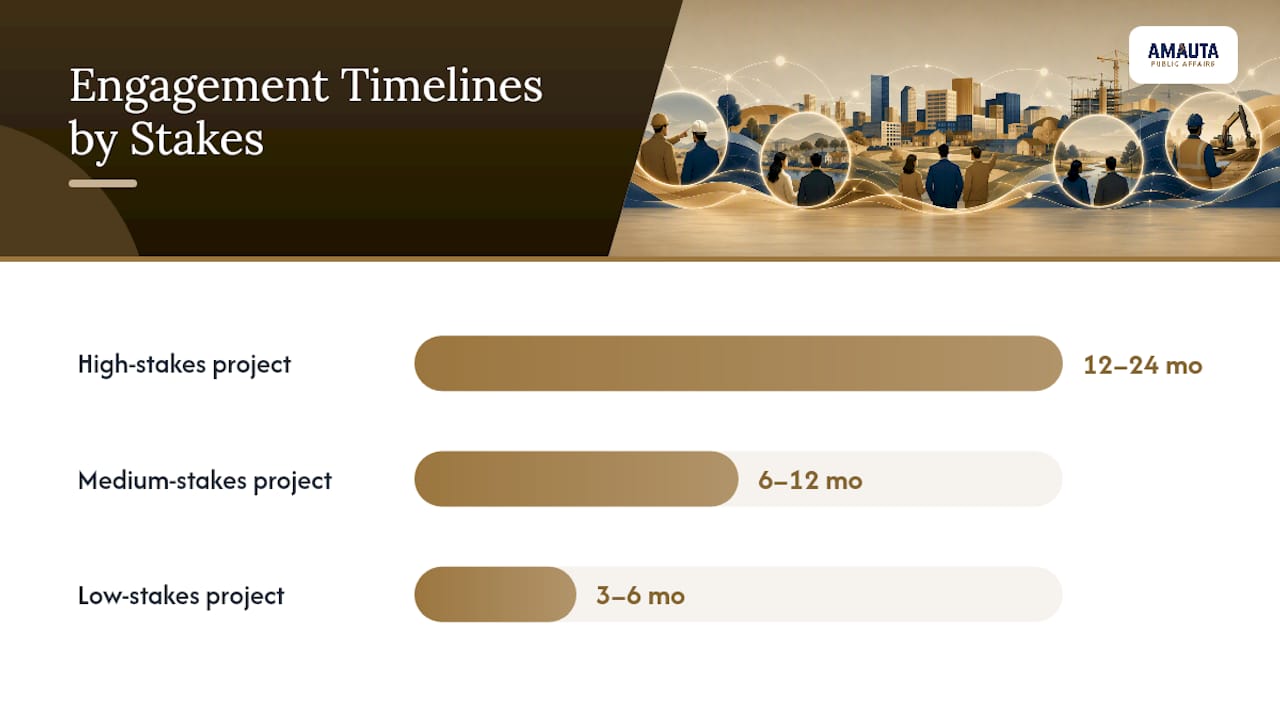
High-stakes projects typically require 12 to 24 months of active engagement, whereas lower-stakes developments can be managed in three to six months with appropriate staffing and tactics.
Early, well-scoped engagement efforts cost more upfront but significantly reduce risks of delays and opposition costs, especially for controversial or contested projects.
Using a tailored, real-time adaptive plan improves community trust and avoids credibility problems caused by vague scopes, poor outreach to underrepresented groups, or lack of established relationships with permitting agencies.
Red flags in hiring include vague scopes, no clear strategies for reaching marginalized residents, and no experience working with relevant permitting authorities.
Table of Contents
What Makes Up a Campaign-Style Land Use Strategy?
A land use strategy built like a campaign has six working parts, and decision-makers should require each one in an RFP or scope of work so proposals can be compared apples to apples. Vague scopes are how projects end up paying for a generic outreach plan that never accounts for who actually shows up to the planning commission meeting.
Stakeholder analysis and mapping identifies who is affected, who holds decision-making power, and where interests align or conflict, often before a single public meeting is scheduled.
A tiered public engagement plan matches outreach intensity to project stakes, spanning everything from a mailed notice to a standing advisory committee.
Permitting coordination and government liaison work builds relationships with the authorities having jurisdiction and keeps timelines synced with agency review cycles, a factor international evaluations tie directly to project viability.
Public messaging and media relations establish a consistent message set, trained spokespeople, and a plan for earned and paid media.
Digital advocacy and reporting cover the project website, dashboards, and feedback loops that keep the process visible between meetings.
Coalition building and community benefits planning formalize commitments that address specific neighborhood concerns, which funders increasingly expect to see documented in writing.
Skipping any one of these usually surfaces later as a credibility problem, not a cost savings.
How Do You Scope and Build a Land Use Strategy?
Building the strategy follows a predictable sequence, whether the project is a 40-unit infill development or a regional energy corridor. Rushing past the early steps to get to public meetings faster almost always backfires.
Intake and risk screening. Define the project, jurisdiction, and known sensitivities.
Stakeholder mapping. Identify affected residents, elected officials, advocacy groups, and business interests.
Goals and KPIs. Set measurable targets for participation, sentiment, and permitting milestones.
Engagement plan design. Match tactics and timing to the stakeholder map and project tier.
Permitting liaison setup. Establish contact protocols with the relevant agencies early, not after an objection is filed.
Execution. Run the engagement calendar, media outreach, and digital campaign in parallel.
Monitoring and reporting. Track KPIs and report findings back to both the client and the community.
Timelines scale with project stakes. A high-stakes project, such as a contested rezoning or a large energy facility, typically runs 12 to 24 months of active engagement. A medium-stakes commercial or mixed-use project usually needs 6 to 12 months. A lower-stakes project, like a modest residential subdivision in a receptive jurisdiction, can often be managed in 3 to 6 months.
Staffing typically includes a campaign lead overseeing strategy, a community liaison handling day-to-day relationships (see the community liaison role for what that job actually covers), a permitting coordinator tracking agency milestones, a media lead managing press and messaging, and analytics support monitoring sentiment and turnout data. Cost mainly tracks engagement intensity: the number of venues, translation needs, and digital ad spend move the budget more than headcount does.
Pro Tip: Ask any prospective consultant to price two scenarios, a base case and a high-conflict case, before you sign. Projects that hit organized opposition midstream need budget flexibility built in from day one, not a change order negotiated under pressure.
Which Engagement Tactics Work for Different Communities?
The right mix of tactics depends on who lives in the affected area and how they prefer to engage, not on which tools a vendor happens to prefer. Toolkits built for public agencies consistently recommend tailoring participation methods to community characteristics like language, income, homeownership rate, and physical accessibility.
In-person tactics still carry weight for trust-building. Town halls work for broad awareness, listening sessions surface nuanced concerns from smaller groups, standing stakeholder advisory groups keep engagement going over a multi-year timeline, and pop-up events at farmers markets or transit stops reach residents who would never attend a scheduled hearing.

Digital tactics extend reach without replacing the in-person work. A project website with a running FAQ, webinars for residents who can’t attend in person, online surveys for structured feedback, and social listening to catch emerging concerns early all belong in a modern plan, though combining experiential engagement with digital reporting tends to outperform either approach alone.
Accessibility determines whether any of this actually works. Translation services, childcare during meetings, travel stipends, varied meeting times, and partnerships with trusted local intermediaries close the gap for residents who would otherwise be locked out of the process entirely. A copyable list of community partnership ideas offers a useful starting point for practitioners building these relationships from scratch. Pairing a well-attended in-person session with a digital survey open for two weeks afterward typically captures both the depth of live dialogue and the breadth of residents who couldn’t make it that night.
How Do You Measure Success and Spot Warning Signs Early?
Track five KPIs from day one: participation diversity across demographic groups, sentiment trend over time, regulatory milestones hit on schedule, tone of local media coverage, and the number of stakeholder commitments secured in writing. A strategy that looks fine on turnout numbers but shows sentiment trending negative for three straight months is a strategy that needs adjusting now, not after the next hearing.
A weekly conflict-driven delay on a major project can cost roughly $20 million, according to Resources for the Future’s analysis of stalled infrastructure projects. That figure alone justifies most engagement budgets several times over.
Watch for these red flags, all of which point to under-resourcing rather than bad luck:
Low turnout concentrated among the same small group of attendees at every meeting.
Repeated negative local news coverage without a public response from the project team.
Rising formal objections filed with the permitting authority late in the process.
Messaging that shifts from one spokesperson or channel to the next.
No visible loop closing what residents said back to what the project changed.
The fix is rarely a bigger ad budget. It’s usually reallocating staff time toward the specific stakeholder group that’s been missed, and doing it before the next public hearing rather than after.
What Does a Campaign-Style Approach Look Like in Practice?
A land use consulting firm may build its practice on the premise that no two land use fights look alike, which is why a generic engagement template rarely survives contact with a real project. The campaign-style approach starts with a meticulous read of the community landscape, then assesses opportunities and sets priorities specific to that project’s politics, geography, and history before a single tactic gets deployed.
Clients typically receive a documented engagement plan, a stakeholder register, a permitting process map, briefing memos for spokespeople, a media strategy, and a real-time reporting cadence that tracks sentiment and milestones as the project moves forward. None of that sits static once delivered. Tactics are refined based on real-time feedback from the field, adjusting outreach and messaging as community response shifts rather than running the same plan from month one to month twelve regardless of what’s actually happening on the ground.
— Ignacio
How to Start a Land Use Strategy Engagement
Before signing anyone, request a scope of work covering the specific services included, deliverables and their format, staffing by role, a phased timeline, a reporting cadence, and a budget range tied to project tier, not a flat number that hides what you’re actually paying for. Making that scope of work enforceable in the contract, rather than treating it as a loose proposal, protects you if priorities shift midstream.
Ask prospective consultants directly: What comparable projects have you run in this jurisdiction? What relationships do you already have with the permitting authorities involved? How do you reach residents who don’t show up to public meetings? And how will you show me the engagement is actually working, not just that it happened?
AMAUTA Public Affairs answers those questions with a campaign-style strategy built around your project’s specific stakeholders and permitting timeline, not a template pulled from the last client. If your project is heading into entitlement review with unresolved community questions, review AMAUTA’s services and request a scoped proposal before your first public hearing gets scheduled.
Where to Find Deeper Playbooks and Templates
For teams building their own scope internally, three documents are worth downloading directly. The Udall Institute’s stakeholder engagement principles lay out how to institutionalize engagement funding and staffing. The FMSIB toolkit offers tiered engagement templates and community benefits language. The IFC’s public consultation manual provides a framework for timing disclosure and consultation that maps cleanly onto US permitting processes.
Sources
Public engagement is how projects get built — Resources for the Future
Doing Better Business Through Effective Public Consultation and Disclosure — IFC
Principles for effective stakeholder engagement in infrastructure permitting — Udall/DOI
Toolkit and best practices for integrating community considerations — FMSIB
FAQ
What Is a Campaign-Style Land Use Strategy?
It’s an integrated approach combining stakeholder analysis, tiered public engagement, permitting coordination, and targeted media and digital messaging into a single managed campaign rather than separate, uncoordinated efforts.
When Should a Developer Hire a Land Use Strategy Consultant?
Hire before entitlement filings begin on any medium or high-stakes project, since early, staffed engagement tends to shorten net project timelines despite the upfront cost.
How Long Does a Typical Engagement Take?
Timelines scale with stakes: roughly 3 to 6 months for lower-stakes projects, 6 to 12 months for medium-stakes projects, and 12 to 24 months for contested, high-stakes projects.
What Should Be in a Land Use Strategy RFP?
Require a defined scope of services, named deliverables, staffing by role, a phased timeline, a reporting cadence, and a budget range tied to project tier rather than a flat fee.
What Are the Biggest Red Flags When Hiring a Consultant?
Watch for vague scopes without named deliverables, no stated method for reaching underrepresented residents, and no track record with the specific permitting authority involved in your project.
Recommended
Comments