
Campaign-Style Development Outreach: A 2026 Guide
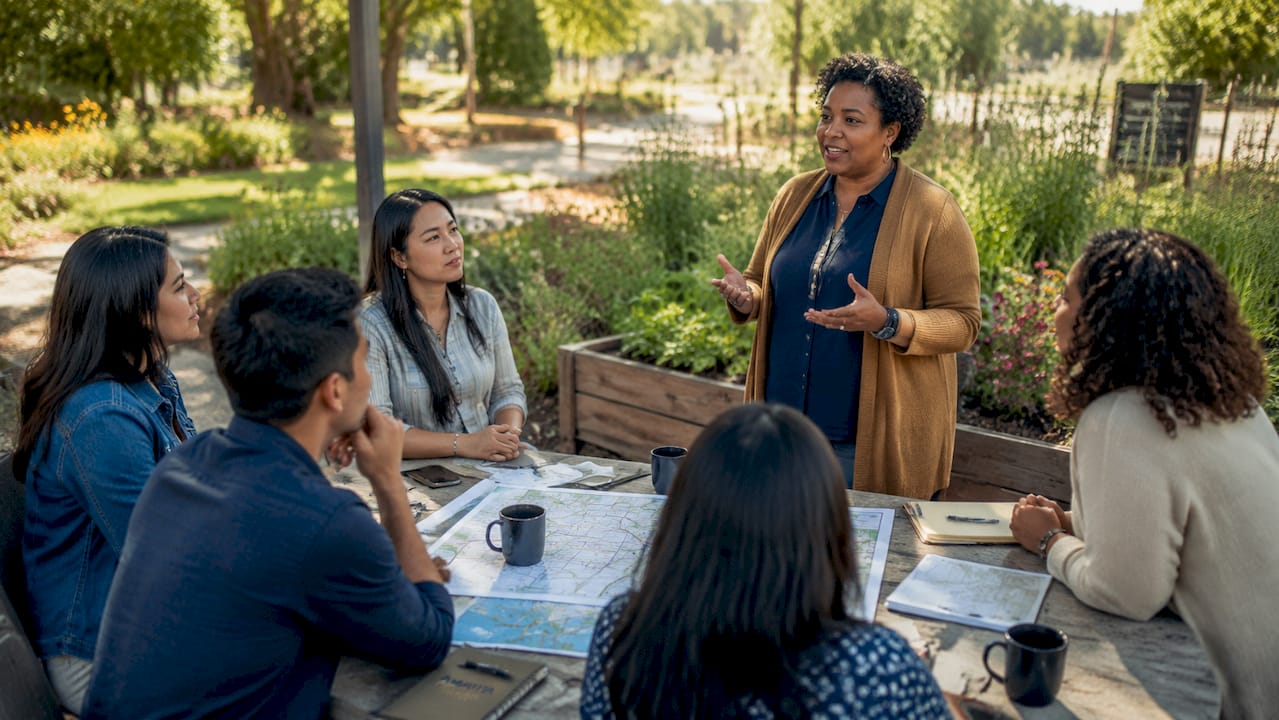
Campaign-style development outreach is defined as a coordinated, multi-channel public engagement process that layers relational organizing, digital communication, and personal follow-up into a sequenced strategy to build community trust and drive project support. Unlike one-off public meetings or mass mailers, this approach borrows directly from political field organizing, where contact sequencing and trusted-source messaging consistently outperform volume-based tactics. For local government officials and community stakeholders, understanding what is campaign-style development outreach means recognizing that public support is earned through repeated, layered contact, not announced through a single press release. Amautapublicaffairs applies this model to land use and development projects, combining stakeholder mapping, multi-channel communication, and real-time feedback to generate durable community buy-in.
What is campaign-style development outreach and why does it work?
Campaign-style development outreach works because it sequences contact methods in a deliberate order, starting with trusted relationships and scaling outward. The standard industry term for this approach is “integrated community engagement,” and it draws on frameworks from public health outreach, political organizing, and participatory development practice. The core insight is simple: layered contacts from trusted sources matter more than raw contact volume. A neighbor asking you to attend a community meeting carries more weight than a city-wide email blast.
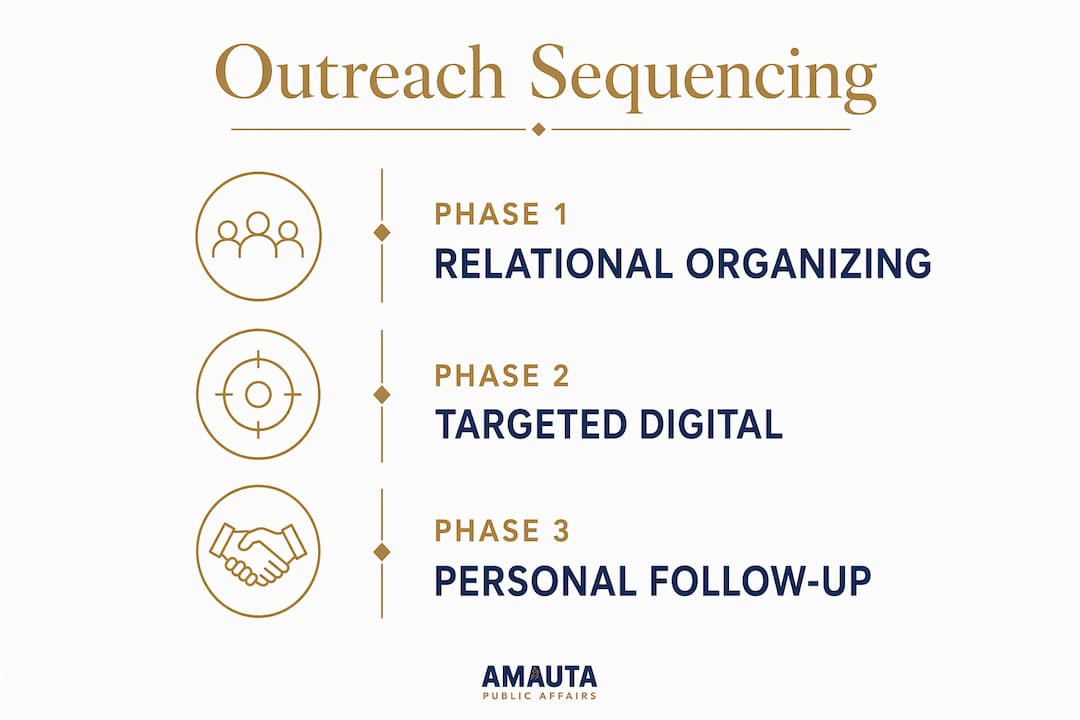
The sequencing model follows three phases. First, organizers activate existing trusted networks through relational organizing, which means personal conversations with neighbors, faith leaders, or local business owners. Second, digital outreach scales the message to broader audiences once a credible foundation exists. Third, personal follow-up calls or door visits convert interest into commitment. Each phase reinforces the last, creating a pathway to implementation that isolated outreach methods cannot replicate.
This model also addresses a persistent failure in public engagement: communities disengage when they feel informed at rather than consulted with. Community outreach shifts from one-way information delivery toward collaborative partnerships built on mutual benefit. That shift is not cosmetic. It changes how projects are perceived, how opposition forms, and whether long-term support holds.
How do sequencing and layering tactics improve development outreach effectiveness?
Multi-component outreach strategies consistently achieve higher engagement and conversion rates than single-method approaches. One case study found that follow-up visits led 80% of initially resistant families to accept services. That figure illustrates a principle every local government official should internalize: resistance is often not permanent opposition. It is a gap in trust that the right contact method, at the right time, can close.
Sequencing matters as much as channel selection. A voter contact program that sequenced text messages and phone calls reported an 18 out of 19 race win rate, approximately 95%, across contested outreach efforts. The lesson for development projects is direct: the order in which you reach people shapes how they receive your message.
Different channels serve different functions in the sequence:
Relational organizing: Builds initial trust through personal conversations with community connectors.
Face-to-face meetings: Ideal for complex topics requiring explanation, Q&A, and visible accountability.
Phone calls: Reinforce commitment and address objections in real time.
SMS reminders: 90% of text messages are read within five minutes, making texts effective for logistics and event reminders.
Email and social media: Scale awareness and document project updates for the public record.
Door-to-door canvassing: Closes the loop with undecided or disengaged community members.
Pro Tip: Never open a campaign with mass digital outreach. Launching email or social media before relational groundwork is established produces low receptivity and accelerates volunteer burnout. Start with your ten most trusted community connectors, not your full contact list.
What are the key components and best practices of development outreach methods?
Relational organizing is the prerequisite for every other outreach method. It means identifying people in the community who already hold trust, including block captains, school board members, local clergy, and small business owners, and asking them to carry your message to their networks. Prioritizing relational contacts reduces volunteer burnout and increases message reception because the messenger already has credibility with the audience.
Digital outreach methods each solve a distinct problem. SMS works for speed and logistics. Email works for documentation and detail. Social media works for visibility and public narrative. Calls, texts, and email are most effective when sequenced to match campaign phases and updated by recipient response in real time. Sending a text reminder to someone who already attended an in-person meeting is reinforcement. Sending that same text to someone who has never heard of the project is noise.
The table below categorizes outreach methods by best use case, primary strength, and key limitation:
Method | Best use case | Primary strength | Key limitation |
Relational organizing | Early trust-building | High credibility, personal reach | Slow to scale |
Face-to-face meetings | Complex topics, Q&A | Builds accountability and dialogue | Resource-intensive |
Phone calls | Commitment reinforcement | Real-time objection handling | Declining answer rates |
SMS messaging | Event reminders, logistics | Speed and open rates | Not suited for persuasion |
Documentation, updates | Detail and public record | Low open rates without prior contact | |
Social media | Awareness, narrative | Broad reach, shareable | Difficult to control message framing |
Door-to-door canvassing | Undecided or disengaged residents | Personal, visible effort | High cost per contact |
Cultural sensitivity and local leadership involvement are not optional add-ons. They are prerequisites for credibility. Outreach that ignores language barriers, cultural communication norms, or historical distrust between communities and government agencies will fail regardless of how well the channels are sequenced. Consulting collaborative stakeholder strategies from experienced practitioners helps teams anticipate these barriers before they become obstacles.
Why is participatory communication vital in campaign-style outreach?
Participatory communication is the operational infrastructure of development projects, not a consultation phase that ends after the first public hearing. Communities must be embedded in decision-making and feedback loops throughout the entire project life cycle. When that happens, communities develop ownership over outcomes. When it does not, opposition grows in the silence between announcements.
Community ownership changes the dynamics of project support in concrete ways. Residents who co-design outreach materials are more likely to share them. Local leaders who participate in planning meetings are more likely to defend the project publicly when misinformation circulates. Multi-directional feedback loops, where community input visibly shapes project decisions, signal that participation is real rather than performative.
The challenges this approach addresses are well-documented: misinformation spreads fastest in trust vacuums, inequity in access to information produces uneven participation, and cultural barriers prevent entire demographic groups from engaging through standard channels. Campaign-style outreach, when built on participatory principles, addresses all three by design.
Pro Tip: Schedule a community feedback session at the midpoint of every major project phase, not just at the beginning and end. Midpoint sessions catch emerging concerns before they harden into organized opposition.
How can local government officials conduct campaign-style development outreach?
Successful implementation follows a clear sequence. Skipping steps, particularly the early relational phase, is the most common reason outreach campaigns underperform. The steps below reflect sequencing principles drawn from both political field organizing and public health engagement practice.
Map your stakeholders. Identify every group with a stake in the project: residents, business owners, advocacy organizations, faith communities, and local elected officials. Segment them by level of influence and likely disposition toward the project.
Identify trusted community connectors. Within each stakeholder group, find the individuals others turn to for information and guidance. These are your first contacts, not your last.
Conduct small group meetings. Before any public announcement, hold small, informal conversations with community connectors. Listen more than you speak. Document concerns and commitments.
Build your digital outreach sequence. After relational groundwork is established, launch email and social media campaigns. Use SMS for event reminders tied to in-person touchpoints you have already scheduled.
Follow up personally. After digital outreach, assign team members to call or visit the highest-priority contacts. Personal follow-up converts passive awareness into active support.
Track responses and adapt. Use a shared contact database to log every interaction, response, and commitment. Update outreach tactics based on what the data shows, not what you assumed at the start.
Key practices to protect outreach quality throughout the process:
Respect volunteer capacity by limiting ask frequency and rotating responsibilities.
Translate all materials into the primary languages spoken in the project area.
Assign culturally competent staff or partners to lead outreach in communities with historical distrust of government.
Document every commitment and follow through publicly to build credibility for future projects.
For teams preparing a project launch, the community outreach guide from Amautapublicaffairs provides a detailed framework for combining digital, in-person, and educational outreach in the pre-launch phase.
My honest assessment of where development outreach goes wrong
The most common mistake I see is treating digital outreach as the strategy rather than one component of it. Teams launch social media campaigns and email blasts, generate impressions, and report activity as if activity were engagement. It is not. Real engagement requires a person to feel heard, and no algorithm produces that feeling.
The second mistake is compressing the relational phase because it feels slow. Relational organizing is slow by design. It is slow because trust is slow. Skipping it to save time produces faster outreach and weaker results. The importance of outreach campaigns built on relational foundations shows up most clearly when opposition emerges. Projects with deep community relationships weather opposition. Projects built on broadcast-only outreach collapse under it.
What I have found actually works is treating every community interaction as a data point and a relationship deposit simultaneously. When a resident raises a concern at a public meeting, that concern is both feedback to incorporate and an opportunity to demonstrate responsiveness. Teams that respond visibly to community input build the kind of trust that sustains projects through permitting delays, budget changes, and political headwinds.
The pathway to implementation for any complex development project runs directly through the community. There is no shortcut around it, only the choice of whether to build that pathway deliberately or reactively.
— Ignacio
Amautapublicaffairs: purpose-built for campaign-style outreach
Local government officials and community stakeholders face a specific challenge: public engagement processes that look thorough on paper but fail to generate real support. Amautapublicaffairs designs and implements layered outreach campaigns that sequence relational organizing, digital communication, and personal follow-up into a coordinated system tailored to each project’s community context.
Services include stakeholder mapping, multi-channel communication design, participatory engagement planning, and real-time feedback integration. Every campaign is calibrated to the specific community, regulatory environment, and project timeline. For development projects where public support determines outcomes, professional outreach design is not overhead. It is the prerequisite for approval.
Key takeaways
Campaign-style development outreach succeeds when relational organizing precedes digital outreach, and personal follow-up closes the gap between awareness and commitment.
Point | Details |
Sequence before you scale | Start with trusted community connectors before launching digital or mass outreach. |
Layer channels by function | Use texts for logistics, calls for commitment, and face-to-face for complex trust-building. |
Embed participation throughout | Community input must shape decisions at every project phase, not just at kickoff. |
Track and adapt in real time | Log every interaction and update tactics based on response data, not initial assumptions. |
Protect relational capacity | Limit volunteer ask frequency and rotate responsibilities to prevent outreach fatigue. |
Perspective
See above.
FAQ
What is campaign-style development outreach?
Campaign-style development outreach is a coordinated public engagement strategy that layers relational organizing, digital communication, and personal follow-up into a sequenced system. It is the standard approach used by public affairs professionals to build community trust and generate durable support for development projects.
How does sequencing improve outreach results?
Sequencing ensures each contact method builds on the last, starting with trusted relationships and scaling to digital channels. A voter contact program using sequenced texts and calls reported a 95% win rate across outreach efforts, demonstrating the power of ordered, multi-touch engagement.
What is relational organizing in development outreach?
Relational organizing is the practice of activating trusted community members to carry your message to their personal networks. It builds credibility before any mass outreach begins and reduces resistance by ensuring the first contact comes from a familiar, trusted source.
Why is participatory communication important for development projects?
Participatory communication gives communities ongoing input into project decisions, not just a single consultation at the start. Projects that embed community feedback throughout their life cycle generate stronger support and face less organized opposition at critical approval stages.
How do I start a campaign-style outreach program for a local project?
Begin by mapping all stakeholder groups and identifying trusted community connectors within each. Hold small group conversations before any public announcement, then sequence digital outreach and personal follow-up based on the relationships and commitments you have already built.
Recommended
Comments