
Common Nonprofit Messaging Mistakes Leaders Make

The most damaging nonprofit communication errors are ones leaders rarely see coming: mission-centered language that means nothing to outsiders, jargon that alienates donors, weak calls-to-action that leave supporters uncertain what to do next, and a chronic absence of proof points that breeds donor fatigue. The fixes are specific and executable. Replace insider language with plain descriptions of who you serve and what changes in their lives. Build a core message house so every team member pulls from the same source of truth. Send a personalized thank-you within 48 hours of every gift. Anchor every appeal with one or two concrete impact numbers rather than broad pleas for help.
Quick-scan checklist for leaders:
Audit one piece of outreach this week using the five-second test: can a stranger identify who you serve, what you do, and what to do next in five seconds?
Replace at least one jargon term per communication with a plain-language equivalent
Add a single, specific call-to-action to every message
Include at least one measurable proof point in every donor appeal
Confirm your last donor thank-you went out within 48 hours of the gift
Check that your website, email, and social profiles share the same mission statement, word for word
Table of Contents
Common nonprofit messaging mistakes leaders must fix now
The ten errors below appear in order of frequency and impact, drawn from donor polling, communications audits, and practitioner research. Each entry names the mistake, explains the harm, shows a wrong-versus-right example, and gives quick-fix steps you can delegate today.
1. Mission-centered language that means nothing to outsiders
Most nonprofits write for themselves, not for the people they want to move. Phrases like “advancing systemic change through collaborative frameworks” describe internal priorities, not the human reality of the work. Outsiders read it and feel nothing.
Wrong: “We advance equitable systems through community-centered capacity building.”Right: “We help families in South Dallas access affordable housing every year.”
Name the specific population you serve in every headline
Describe the change in a person’s life, not the mechanism your organization uses
Sharpen your core message by answering: who do you serve, what problem do you solve, and what is the one next step?
2. Inconsistent voice and branding across channels
When your website says one thing, your email newsletter says another, and your social media says a third, donors and partners lose confidence. Inconsistent branding and lack of clear vision are among the most documented marketing mistakes in the sector, and they directly harm partner relations and earned media coverage.
Wrong: Website headline reads “Empowering communities,” email subject line reads “Fighting poverty,” social bio reads “Building a better tomorrow.” Right: All three channels open with the same core sentence: “We connect low-income families in Chicago with stable housing and employment support.”
Create a one-page brand guide with your approved mission statement, tagline, and two or three key phrases
Assign one person to review all outgoing communications against that guide monthly
Audit your top five channels once per quarter for alignment
3. Failing to tailor messages to different audiences
A message written for a major donor will not resonate with a first-time volunteer, and a grant narrative written for a program officer will confuse a community partner. Writing for grant reviewers instead of real people is a recognized pattern that produces copy no external audience actually connects with.
Map your three to five primary audience segments (major donors, individual donors, volunteers, community partners, media)
Write a separate one-paragraph message frame for each segment, emphasizing what that audience cares about most
Test each frame with one real member of that audience before publishing
Pro Tip: Run a quick “audience swap” check: read your donor appeal as if you were a first-time volunteer. If it does not make sense or feel relevant, rewrite the opening.
4. Overusing jargon and insider language
Sector-specific terms like “capacity building,” “theory of change,” “wraparound services,” and “collective impact” are meaningful inside your organization. Outside it, they create distance. Clarifying who you serve and describing pathways rather than programs is one of the four core shifts that transforms flat nonprofit messaging into copy that moves people.
Wrong: “Our wraparound services address SDOH through a collective impact framework.”Right: “We connect families with housing, job training, and healthcare in one coordinated program.”
Run every draft through a plain-language check: if a high school student would not understand it, rewrite it
Replace program names with outcome descriptions in all external-facing copy
Keep technical language in grant applications only, never in donor or community communications
5. Weak or missing calls-to-action
A message without a clear next step is a missed opportunity. Donors who feel moved but receive no direction tend to close the email and move on. Every communication needs one specific, low-friction action.
Wrong: “We hope you’ll consider supporting our work.”Right: “Donate $50 today to keep one family housed for a month. Click here.”
Every email, social post, and event invitation should close with one CTA, not three
Make the action concrete: name the amount, the deadline, or the specific outcome the action produces
Test two CTA phrasings on a small segment before sending to your full list
6. Underreporting impact and relying on neediness instead of proof
Constant appeals for help without measurable evidence of results breed donor fatigue. Replacing pleas with specific impact metrics builds credibility and sustains long-term giving. “300 families kept housed last year” is more persuasive than “we urgently need your support.”
Wrong: “We desperately need your help to continue our life-changing work.”Right: “Recently, many families in our program avoided eviction. Your gift helps increase this impact.”
Include at least two measurable outcomes in every appeal (people served, outcomes achieved, dollars deployed)
Replace vague impact language (“life-changing,” “transformative”) with specific numbers
Build a simple impact dashboard and update it quarterly so you always have current proof points ready
7. Poor donor stewardship and delayed thank-yous
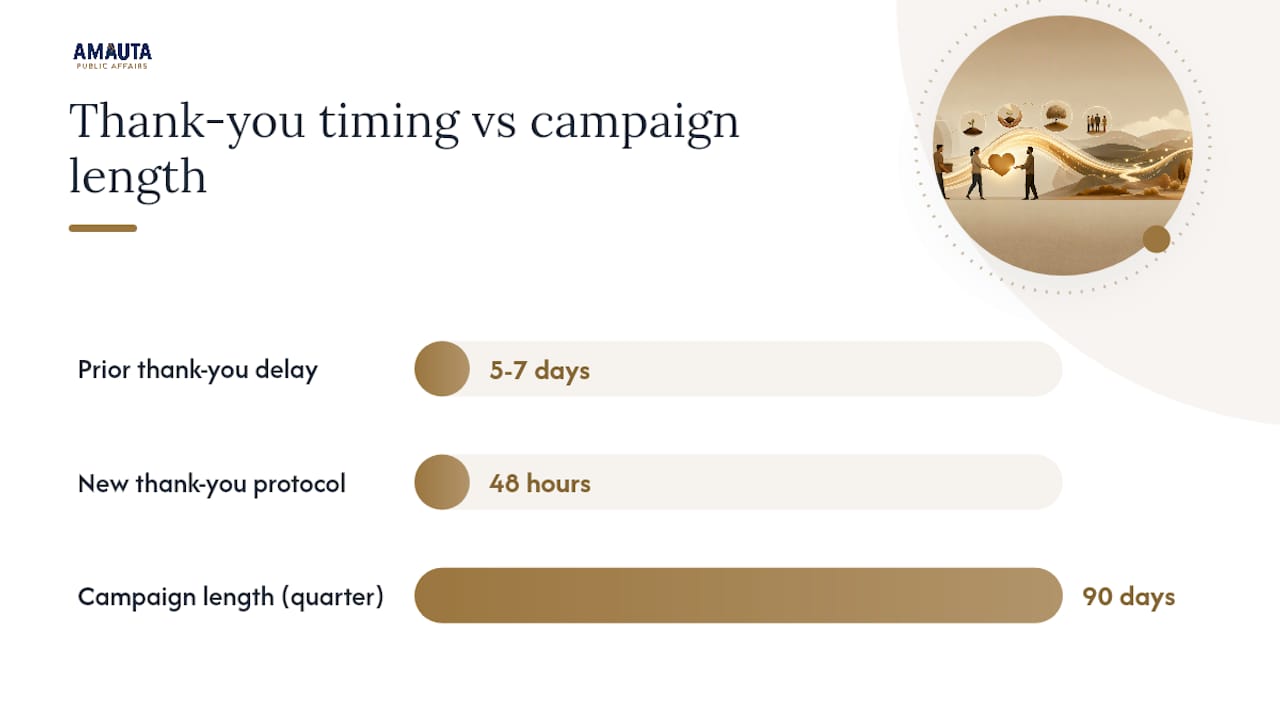
Donor polling shows that 18% of donors left because of poor communication, 13% because they were never thanked, and 9% because they did not remember giving. These are not fundraising failures. They are messaging failures with straightforward fixes.
Wrong: A generic auto-reply email sent three days after a gift, addressed “Dear Friend.” Right: A personalized email sent within 24 hours: “Maria, your $100 gift on Tuesday will cover two weeks of after-school tutoring for a student in our program.”
Set up a 48-hour thank-you protocol for every gift, regardless of size
Personalize with the donor’s name, gift amount, gift date, and a specific program outcome
Schedule a second touchpoint at 30 days: a brief impact update, not another ask
8. One-way communication with no feedback loop
One-way communication is a documented organizational error that reduces long-term credibility. When leaders broadcast without listening, they lose the signal that tells them whether messages are landing.
Add a two-question survey to your quarterly donor email: “What matters most to you about this work?” and “What would you like to hear more about?”
Create a simple feedback mechanism on your website (a short form or a dedicated email address)
Share what you heard in your next communication: “You told us you wanted more stories from the field. Here’s one.”
9. Overextending across too many channels
Consistency beats reach. A nonprofit that maintains a mediocre presence on six platforms will almost always underperform one that does two channels well. Overstretching spreads your team thin and produces inconsistent quality across the board.
Audit your current channels and identify the two or three where your primary audience is most active
Sunset or pause channels you cannot staff adequately
Redirect the saved time toward higher-quality content on your strongest platforms
10. Insufficient communications capacity and training
Many nonprofits treat communications as a secondary function, assigning it to staff who have other primary responsibilities. The result is reactive, inconsistent outreach that never builds momentum. Fragmented messages across teams are a direct consequence of under-resourced communications functions.
Designate one person as the communications lead, even if it is a partial role
Invest in a half-day annual training on plain-language writing and message consistency
Build a shared message library (approved phrases, impact stats, story summaries) that any staff member can pull from
A practical checklist and ready-to-use templates
The resources below are designed to be copied, adapted, and delegated. Use the checklist to assign ownership; use the templates to speed up production.
Prioritized action checklist
This week:
Run the five-second test on your homepage and most recent email
Confirm your thank-you protocol is set to 48 hours or less
Identify and remove one jargon term from your standard boilerplate
This month:
Draft or update your core message house (need, overview, how it gets done, vision)
Segment your email list into at least three audience groups
Add one measurable proof point to every active appeal
This quarter:
Audit all active channels for brand consistency
Conduct a 30-minute feedback session with three to five donors or volunteers
Review your communications capacity and identify one gap to address
Copy templates
Donor thank-you (within 48 hours):“[First name], thank you for your [gift amount] gift on [date]. Because of you, [specific outcome — e.g., ‘one student will receive tutoring support for the next month’]. We’ll keep you updated on the difference your generosity makes.”
Donor thank-you (major gift variant):“[First name], your [gift amount] commitment is making a direct difference for [population served]. [Specific program outcome]. We’re grateful for your trust in our work and will share a personal update on this program in [timeframe].”
Three-sentence elevator pitch template:“[Organization name] helps [specific population] in [geography] [achieve specific outcome]. We do this by [plain-language description of approach]. Last year, [measurable result].”
Plain-language program description:“[Program name] connects [who] with [what service] so they can [outcome]. It’s free and available to [eligibility]. To get started, [one clear next step].”
30–90–180 day engagement metrics table
Timeframe | KPI to Track | Evaluation Cadence | Target Signal |
30 days | Email open rate, click-through rate | Weekly | Baseline established |
30 days | Thank-you response time | Per gift | Under 48 hours |
90 days | Donor retention rate | Monthly | Improving trend |
90 days | Volunteer inquiry conversion | Monthly | Inquiry-to-orientation rate |
180 days | Referral conversions from partners | Quarterly | Increase from baseline |
180 days | Earned media placements | Quarterly | At least one per quarter |
Pro Tip: Before sending any new message to your full list, test two subject line or opening sentence variants on a 10% sample. A simple A/B split on 200 contacts takes under 30 minutes to set up in most email platforms and gives you real signal before you commit to the full send.
For a fuller public messaging checklist you can use across campaigns, Amautapublicaffairs maintains a practical resource aligned with these frameworks.
Ethical storytelling, consent, and governance every leader must know
The people your organization serves are not marketing assets. Sharing their stories without proper consent, or in ways that expose them to harm, violates their trust and can create legal and reputational risk. The principle is straightforward: mission before publicity.
Consent checklist
Before using any client or beneficiary story in communications, confirm:
Written consent is obtained, specific to the intended use (social media, press release, annual report, video)
The person understands they can withdraw consent at any time without affecting their services
Consent is stored securely and linked to the specific content it covers
The story has been reviewed by the person featured, or by a guardian if the person is a minor
Anonymization is used whenever the subject’s safety, immigration status, housing situation, or health could be compromised by identification
Sample consent fields to include in your form:
Full name and date
Description of the specific content (e.g., “a written story for our 2026 annual report”)
Channels where the content may appear
Whether the person’s real name will be used or a pseudonym
Signature and date of consent
Contact information for questions or withdrawal
Red flags that require immediate review
Consent obtained under pressure or as a condition of receiving services
Stories that identify minors by name, school, or neighborhood
Content that reveals a person’s address, immigration status, or medical history
Stories collected by staff without communications or legal review
A one-sentence governance reminder: your board should approve any policy governing the collection and use of beneficiary stories, and that policy should be reviewed annually. For guidance on ethical storytelling for public campaigns, Amautapublicaffairs has published a detailed framework.
When to fix messaging internally and when to hire outside help
Not every communications problem requires an outside consultant. Many of the errors in this article are fixable with existing staff, a clear brief, and a half-day of focused work. The decision point is usually capacity, not competence.
Outsourcing checklist: what to ask before signing
Can you show us two or three examples of messaging work for organizations similar to ours in mission and size?
How do you measure the effectiveness of a messaging engagement? What KPIs do you track?
What does a typical engagement deliver, and on what timeline?
Who on your team will work directly with us, and what is their background in nonprofit communications?
Do you have experience with [your specific audience segment or issue area]?
What does your contract cover, and what falls outside scope?
Red flags when evaluating vendors:
No clear measurement framework or KPIs offered
Reluctance to share references from nonprofit clients
Proposals that lead with tactics (social media posts, press releases) before understanding your audience and goals
Contracts with no defined deliverables or revision process
For organizations considering media outreach strategy as part of a broader communications investment, the same evaluation criteria apply: demand specificity on deliverables, measurement, and timeline before committing.
How a campaign-style approach prevents these mistakes in practice
A campaign-style messaging approach treats every communications effort the way a political or advocacy campaign treats voter outreach: with a defined audience, a tested core message, a clear ask, and a measurement cadence. For nonprofits, this approach consistently outperforms broad, unfocused communications because it forces the discipline that prevents most of the errors above.
Mini case illustration
A mid-sized workforce development nonprofit in the Midwest had strong program outcomes but stagnant donor retention. Their appeals led with organizational history and used program-specific jargon their donors did not recognize. Open rates on their quarterly email were below sector averages, and their thank-you emails went out five to seven days after gifts.
They applied a campaign-style approach over one quarter: built a core message house, rewrote their standard appeal to lead with a client story paired with a specific job placement rate, and set up a 48-hour thank-you protocol. They also reduced their active social channels from five to two.
At 90 days, their email open rates had improved, donor response to their year-end appeal increased, and staff reported spending less time rewriting copy because the message house gave them a shared starting point.
Adaptation tips for small teams:
A core message house can be drafted in a two-hour staff meeting using a shared document
For organizations serving vulnerable populations, keep all case stories anonymized by default and build a consent process before collecting any new stories
A campaign does not require a large budget. A clear message, a defined audience, and a consistent cadence are the prerequisites.
For a detailed framework on nonprofit advocacy campaign messaging, Amautapublicaffairs has published a step-by-step guide aligned with this approach.
Key Takeaways
The single most effective way to reduce nonprofit communication errors is to build a core message house, adopt a 48-hour thank-you protocol, and measure two KPIs at 30 and 90 days.
Point | Details |
Build a core message house | Draft four elements (need, overview, how it gets done, vision) to unify all outgoing communications. |
Send thank-yous within 48 hours | Personalize with donor name, gift amount, and a specific program outcome to reduce preventable donor attrition. |
Replace neediness with proof points | Anchor every appeal with one or two measurable outcomes (e.g., “300 families kept housed”) rather than broad pleas. |
Audit channels for consistency | Reduce to two or three active channels and confirm your mission statement matches across all of them. |
Amautapublicaffairs campaign approach | Amautapublicaffairs applies a campaign-style messaging framework, audience mapping, and measurement cadence to help nonprofits fix these errors systematically. |
The case for making messaging a board-level priority
Most nonprofit leaders understand that messaging matters. Fewer treat it as a governance responsibility. That gap is where the most persistent communication failures live.
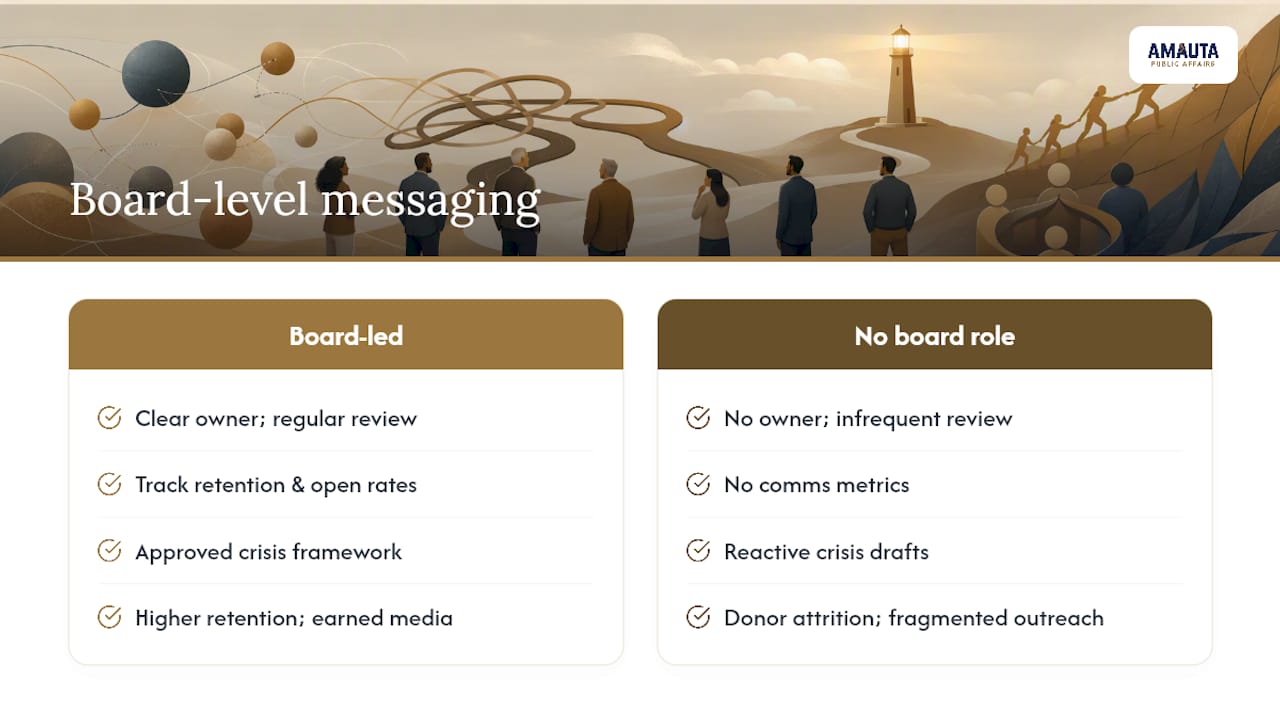
Messaging is not a marketing function that sits below the program work. It is the mechanism by which program work becomes visible, fundable, and replicable. When a board does not hold leadership accountable for communications consistency, the result is predictable: fragmented outreach, donor attrition, and a public narrative that never quite captures what the organization actually achieves.
The organizations that get this right share a common trait. They treat their core message house the way they treat their financial controls: as a foundational document that requires regular review, clear ownership, and board-level awareness. They measure donor retention and open rates with the same seriousness they apply to program metrics. And when they face a crisis, they respond from a pre-approved messaging framework rather than drafting under pressure.
Amautapublicaffairs has worked across community engagement, media relations, and campaign-style communications long enough to recognize that the leaders who invest in messaging infrastructure early spend far less time managing reputational damage later. The return on that investment is not abstract. It shows up in donor retention, in earned media, and in the clarity with which a community understands what an organization stands for.
How Amautapublicaffairs helps nonprofits close the messaging gap
Nonprofit leaders who have identified gaps in their messaging often face the same constraint: the internal capacity to fix them is limited, and the stakes of getting it wrong are high. Amautapublicaffairs offers a direct path from diagnosis to execution, without the overhead of a traditional agency retainer.
A typical engagement with Amautapublicaffairs delivers a communications diagnostic that identifies your highest-priority messaging gaps, a core message house built around your specific audience segments and program outcomes, and a 90-day rollout plan with a defined channel strategy, content cadence, and measurement framework. For organizations navigating a capital campaign, a policy advocacy push, or a community engagement process, the firm also provides media relations support and stakeholder communications tailored to the specific moment.
What sets this approach apart is the campaign-style discipline applied to every engagement: audience research before message development, human-led stories paired with proof points, and real-time refinement based on engagement data.
To learn more about how these public affairs services apply to your organization’s communications needs, or to request an initial diagnostic conversation, visit Amautapublicaffairs’s services page.
Useful sources and further reading
The sources below inform the recommendations in this article. Each is annotated to help you identify which sections of your own work they support most directly.
Core messaging guide for nonprofit leaders — Forthright Advising. A practical walkthrough of the core message house framework (need, overview, how it gets done, vision). Use this when building or updating your organization’s central messaging document.
Why Most Nonprofit Messaging Falls Flat — Prosper Strategies. Identifies four specific shifts that move nonprofit messaging from insider language to external resonance. Directly relevant to jargon reduction, audience tailoring, and proof point development.
5 communication errors that lose donors — Nonprofit Hub. Donor polling data on the specific communication failures that drive lapsed giving. Use this to build the case internally for investing in thank-you protocols and follow-up cadences.
Nonprofit communications: fundamental, strategic, and chronically underperforming — Nonprofit Quarterly. Documents systemic communications failures including one-way messaging and inconsistency. Useful for board presentations on why communications capacity deserves dedicated investment.
How to sharpen nonprofit messaging that moves — Building Momentum. Introduces the five-second test and a five-question framework for rapid message clarity checks. Practical for team workshops and quick audits.
6 common mistakes in nonprofit marketing — Taproot Foundation. Covers branding inconsistency, unclear niche, and lack of vision with avoidance strategies. Useful for organizations undergoing a brand refresh or preparing for a major campaign.
Commons-Watkins framework: measurable proof beats neediness — Philanthropy Opinion. Makes the case for replacing emotional appeals with specific impact metrics. Use this when training staff on how to write donor communications that build long-term confidence.
Nonprofit marketing services — Juicy Designs. An external partner resource for organizations that need visual identity and design support alongside their messaging work.
Recommended
Comments