
Storytelling for Nonprofit Public Campaigns: 2026 Guide

Storytelling for nonprofit public campaigns is the practice of blending personal, emotionally resonant narratives with data-driven evidence to engage stakeholders and motivate action. 88% of nonprofits operate on budgets under $500,000, which means most organizations cannot afford to let their impact go undocumented or undefined by outside voices. The good news is that narrative, done well, costs far less than paid media and delivers far more. When a campaign manager pairs a single compelling story with the right data point, the result builds both emotional connection and institutional credibility at once. That combination is what separates campaigns that move people from campaigns that merely inform them.
What are the core components of storytelling for nonprofit campaigns?
Effective nonprofit narrative techniques follow a layered structure, not a single emotional appeal. The most proven framework moves through three stages: a personal story that creates emotional engagement, technical evidence that grounds the claim in reality, and an economic or systemic argument that drives institutional decision-makers to act. Each layer serves a distinct function, and removing any one of them weakens the whole.
Stories create emotional conditions that make decisions feel imaginable. Data then provides the justification for allocating resources. Neither element works as well alone. A story without evidence reads as anecdote. Data without a human face reads as a spreadsheet. The two together create a case that is both felt and defensible.
Here is how to build that layered structure in practice:
Open with a specific person, not a category. Name the individual, describe the moment, and let the reader inhabit the situation. Avoid opening with statistics or mission statements.
Follow with one to three core data points. The One Number Method limits impact data to a small set of figures, preventing overload and keeping the human story at the center.
Close with the systemic argument. Translate the individual experience into a policy, funding, or community-level claim that decision-makers can act on.
Integrate a 3-act narrative arc. Establish the status quo, introduce the conflict or need, and present the resolution your organization enables. This structure is familiar to audiences and reduces cognitive friction.
Tailor each layer to the audience segment. Donors respond most to the personal story and the economic return. Policymakers respond most to the systemic argument backed by technical evidence.
Pro Tip: When planning your content calendar, map each story to a specific audience segment and identify which layer of the framework that segment needs most. A single story can be repurposed three ways by leading with a different layer for each audience.
Effective campaign storytelling also requires cross-disciplinary collaboration. Successful storytelling teams integrate staff from data analytics, communications, design, and program delivery to produce narratives that are technically sound and emotionally resonant. This is not a communications department task alone.

How can nonprofits gather and ethically use stories for campaign impact?
Authentic story collection is a prerequisite for credible advocacy. Nonprofits sit on a gold mine of stories that reveal behavioral patterns and systemic drivers, but most organizations lack the systems to collect, analyze, and share them responsibly. Building that infrastructure is not optional. It is the foundation of any campaign that claims to represent the people it serves.
Ethical storytelling practices include:
Informed consent as a non-negotiable first step. Every story subject must understand how their narrative will be used, where it will appear, and what control they retain over it.
Dignity-centered framing. Stories must highlight agency and leadership, not suffering or helplessness. Ethical storytelling preserves consent and avoids harmful stereotypes that reduce individuals to their worst moments.
Ongoing relationship, not extraction. Story subjects are partners, not sources. Follow up after publication, share results, and give them the opportunity to update or retract their narrative.
Internal story logs. Maintain a shared database where program staff can record stories as they encounter them, tagged by theme, geography, and policy relevance.
Staff training on trauma-informed interviewing. Program staff are often the first point of contact. Training them to gather stories safely and accurately reduces the burden on communications teams and improves story quality.
Limited staff capacity is the most common barrier to building this infrastructure. The practical solution is to embed story collection into existing program workflows rather than treating it as a separate communications task. A brief intake question, a short follow-up survey, or a structured debrief after a service interaction can generate usable narrative material without adding significant workload.
Pro Tip: Create a one-page story submission template for program staff. Ask for the person’s situation before your organization’s involvement, the specific change that occurred, and one quote in their own words. That structure produces 80% of what a communications team needs to build a full campaign narrative.
Connecting individual stories into patterns transforms isolated testimonials into evidence of systemic failure. That shift from anecdote to pattern is what makes storytelling a genuine instrument of advocacy power, not just a fundraising tool.
What storytelling techniques maximize engagement in digital campaigns?
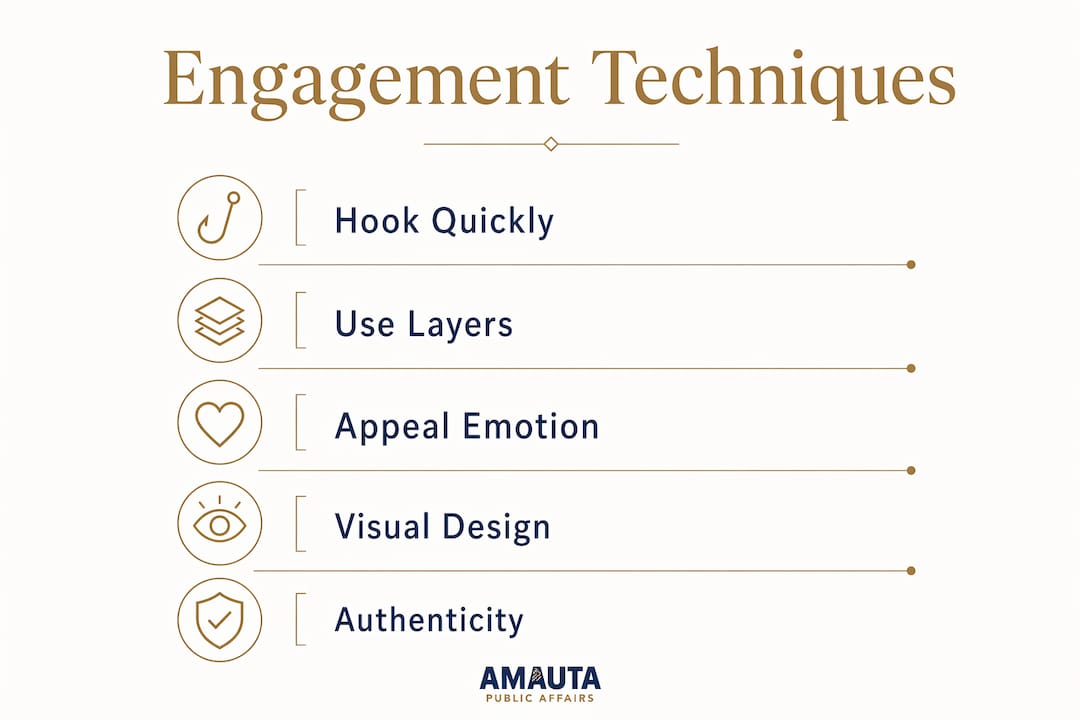
Digital campaign storytelling operates under a hard constraint: content creators have approximately 3 seconds to capture a stakeholder’s attention before they scroll past. That window demands that the most compelling element, whether a face, a number, or a single sentence, appears immediately. Burying the hook in a paragraph of context is a structural error, not a stylistic choice.
The table below compares four common digital storytelling formats by engagement strength and best use case:
Format | Engagement strength | Best use case |
Short video with personal story | Very high | Donor acquisition, social sharing |
Data visualization with one stat | High | Policy audiences, media outreach |
Photo essay with captions | Moderate | Community engagement, email campaigns |
Long-form written narrative | Moderate | Grant applications, major donor cultivation |
Visual design choices carry as much weight as the narrative itself. Campaigns that adopt familiar visual aesthetics, such as threat-level indicators or status graphics that audiences already use to make daily decisions, generate higher engagement than traditional branded marketing visuals. Familiarity reduces the cognitive effort required to process the message, which means more attention stays on the content.
Layered narratives also perform better when tailored to platform. A 60-second Instagram video leads with the personal story and ends with a single data point. A LinkedIn post for a policy audience leads with the systemic argument and links to a longer report. The underlying story is the same. The entry point changes based on where the audience is and what they are ready to receive.
Authenticity is the non-negotiable constraint across all formats. Staged or over-produced content signals inauthenticity to audiences who have grown skilled at recognizing it. The most effective digital stories use real voices, real settings, and real outcomes. For campaign outreach in 2026, the organizations gaining ground are those that treat their story subjects as co-creators rather than subjects.
How to measure and evaluate storytelling effectiveness in campaigns?
Measurement is what separates a storytelling program from a storytelling habit. Without evaluation, campaign managers cannot identify which narratives drive action, which formats underperform, or how to allocate limited resources in the next cycle.
The most useful metrics fall into three categories:
Engagement metrics: time on page, video completion rate, social shares, and comment sentiment. These indicate whether the story captured attention and resonated emotionally.
Conversion metrics: donation rate, petition signatures, event registrations, and email list growth. These measure whether the story motivated action.
Advocacy metrics: media pickups, policymaker meetings generated, and coalition partners gained. These track whether the narrative shifted the public or institutional conversation.
Qualitative feedback completes the picture that numbers alone cannot provide. Post-campaign interviews with donors, community members, and partner organizations reveal which story elements created the strongest connection and which felt forced or unconvincing. Campaign reporting frameworks that integrate both quantitative and qualitative data give campaign managers a full view of what worked and why.
The most common evaluation mistake is measuring reach instead of response. A post seen by 50,000 people that generates no action is less valuable than a post seen by 5,000 people that generates 200 donations. Reach is a vanity metric unless it converts. Build your evaluation framework around response, and use reach only as a diagnostic when response rates are low.
Findings from each campaign cycle should feed directly into the next planning phase. Treat evaluation as a feedback loop, not a final report. The advocacy campaign messaging that performs best in one cycle becomes the template for the next, refined by what the data reveals about audience behavior.
Key Takeaways
Effective storytelling for nonprofit public campaigns requires layered narratives that combine personal stories, targeted data, and systemic arguments to drive both emotional engagement and institutional action.
Point | Details |
Use the layered framework | Combine personal story, technical evidence, and economic argument for maximum campaign impact. |
Apply the One Number Method | Limit impact data to 1–3 core figures to keep narratives focused and prevent audience overload. |
Prioritize ethical collection | Build consent, dignity, and ongoing relationships into every story-gathering process. |
Design for 3 seconds | Lead with the most compelling element in digital content to capture attention before the scroll. |
Measure response, not reach | Track donations, signatures, and media pickups rather than impressions to evaluate true campaign impact. |
Why most nonprofit storytelling falls short of its potential
After working across public affairs campaigns for years, the pattern I see most often is not a lack of good stories. Nonprofits have extraordinary stories. The gap is almost always structural. Organizations treat storytelling as a communications function rather than a programmatic one, which means stories get collected sporadically, used once, and never analyzed for what they reveal about the populations being served.
The second mistake I see is the false choice between emotion and evidence. Campaign managers often feel they must pick a lane: either lead with data and risk losing the audience emotionally, or lead with story and risk losing credibility with institutional funders. That is a false constraint. The layered framework resolves it. The story opens the door. The data holds it open. The systemic argument walks the decision-maker through.
The third pattern is the hardest to fix: organizations that extract stories from vulnerable people without giving them meaningful control over the outcome. Beyond the ethical failure, this is also a strategic one. Audiences increasingly recognize when a story has been shaped for them rather than by the person living it. Authenticity is not a soft value. It is a measurable driver of trust and conversion.
My honest recommendation is to treat storytelling as a core organizational competency, not a campaign deliverable. That means training, systems, cross-team collaboration, and a commitment to evaluation. The nonprofits that build this infrastructure now will have a durable advantage in public engagement for years ahead. The media outreach strategies that amplify these stories only work when the underlying narrative architecture is sound.
— Ignacio
How Amautapublicaffairs helps nonprofits build campaign narratives that work
Nonprofit leaders who want to move from ad hoc storytelling to a repeatable, measurable campaign system have a clear next step available.
Amautapublicaffairs designs public affairs campaigns that integrate personal narratives with data visualization and community engagement, built specifically for organizations navigating complex public processes. The team brings together communications strategy, digital infrastructure, and real-time feedback systems to help nonprofits shape their own public narrative before external parties define it for them. Whether your campaign targets donors, policymakers, or community members, Amautapublicaffairs tailors the approach to your specific audience and goals. Connect with the team through the full services overview to see how a campaign-style approach applies to your organization’s storytelling needs.
FAQ
What is storytelling for nonprofit public campaigns?
Storytelling for nonprofit public campaigns is the practice of combining personal narratives with data and systemic arguments to engage stakeholders and drive advocacy action. It is a structured communication method, not simply sharing anecdotes.
Why does storytelling matter more than data alone in advocacy?
Stories create the emotional conditions that make decisions feel imaginable, while data provides the justification for resource allocation. Both are required for effective advocacy, and neither works as well without the other.
How do nonprofits collect stories ethically?
Ethical story collection requires informed consent, dignity-centered framing, and ongoing relationships with story subjects. Staff should be trained in trauma-informed interviewing, and story collection should be embedded in existing program workflows.
What metrics measure storytelling impact on donations?
The most direct metrics are donation rate, average gift size, and donor retention after a campaign. Engagement metrics like video completion rate and time on page indicate whether the story resonated before conversion.
How many data points should a nonprofit story include?
The One Number Method recommends limiting impact data to 1–3 core figures per narrative. More than three data points dilutes the emotional focus and reduces the story’s persuasive power.
Recommended
Comments