
Why Government Relations Strategy Matters in 2026

A government relations strategy is the structured approach organizations use to influence public policy at local, state, national, and global levels to advance their interests and shape community outcomes. Understanding why government relations strategy matters is no longer optional for public affairs professionals. Federal intervention in private commerce has expanded sharply since 2023, with legislation like the CHIPS Act, Inflation Reduction Act energy credits, and FTC antitrust guidelines moving faster than most corporate legal teams can track. Organizations that treat government relations as a core capability, not a reactive task, are the ones shaping policy rather than responding to it.
Why government relations strategy matters for policy influence
Government relations strategy is defined as a disciplined, organization-wide effort to align advocacy goals with policy priorities across all levels of government. The term “government affairs” is the recognized industry standard, though “government relations” is used interchangeably in practice. Both refer to the same function: building credible, sustained influence over the legislative and regulatory environment. Government relations done well is not transactional lobbying. It is statecraft, linking public purpose and private capability transparently and institutionally, treating evidence as currency and requiring bipartisan, process-respecting engagement.
The importance of government relations becomes clear when you consider what happens without it. Organizations that engage episodically, showing up only when a bill threatens their interests, lose credibility with legislative staff and miss the window when policy is actually being drafted. The organizations that win are those with dedicated internal capacity, clear policy priorities, and relationships built long before a crisis emerges.
What are the key components of an effective government relations strategy?
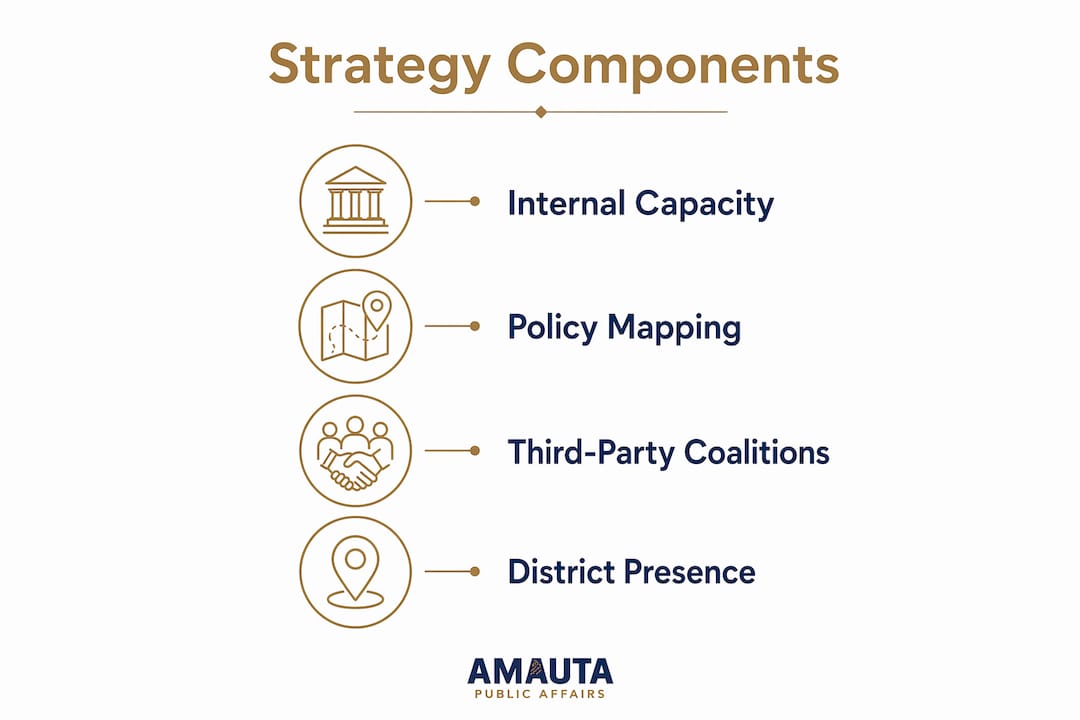
Effective federal lobbying in 2026 requires four structural elements working together: dedicated internal capacity, policy priority mapping, credible third-party coalitions, and consistent district-level presence. Each element reinforces the others.

1. Dedicated Internal Government Affairs Capacity
A government affairs function needs clear roles, defined ownership, and direct access to senior leadership. Companies like Alphabet and Caterpillar maintain in-house government affairs teams with staff who specialize in specific policy areas. This is not a part-time assignment for the general counsel. It is a full-time function with accountability metrics.
2. Policy Priority Mapping
Strategic planning aligns government affairs with organizational mission, reducing fragmentation and inefficient spending. Policy priority mapping means identifying which legislative and regulatory issues directly affect your organization’s operations, then ranking them by urgency and impact. This prevents the common failure of spreading advocacy resources too thin across too many issues.
3. Credible Third-Party Coalitions
Industry coalitions filing coordinated, data-backed comments demonstrate broad concern and carry more weight than isolated efforts. Hundreds of independently drafted comments signal a credible industry position to regulators. Mid-market manufacturers, for example, have used coordinated comment campaigns on EPA rulemakings to shift final rule language in ways that no single company could have achieved alone.
4. Consistent District-Level Presence
Quarterly visits to district offices and regular correspondence with legislative staff build the kind of durable relationships that matter when votes are close. Episodic contact undermines credibility and influence. Showing up only during a crisis signals that your organization views government relations as a fire extinguisher rather than a core function.
Pro Tip: Map your policy priorities to your organization’s three-year operational plan, not just the current legislative calendar. This forces alignment between advocacy goals and business strategy before a policy crisis forces it for you.
How does the current legislative environment affect government relations?
Federal policy now moves faster than most organizations can adapt to reactively. The CHIPS Act, IRA energy credits, and updated FTC antitrust guidelines represent a significant expansion of federal intervention in private commerce. Each of these policy shifts created winners and losers within months of passage, and the organizations that shaped their provisions were those already present in the room.
The table below shows the difference between active and reactive government relations approaches:
Factor | Active Engagement | Reactive Approach |
Policy timing | Shapes legislation during drafting | Responds after passage |
Regulatory risk | Anticipated and mitigated early | Discovered late, costly to address |
Credibility with staff | Built through sustained presence | Damaged by episodic contact |
Coalition strength | Pre-built and ready to deploy | Assembled under pressure, less credible |
Budget efficiency | Focused on priority issues | Spread thin across reactive responses |
The digital transformation of government operations also signals a changing policy execution environment. Full digitization of government services could generate substantial cost savings by reducing offline transactions at scale. That shift changes how organizations must engage with agencies, moving from paper-based comment processes to digital advocacy platforms and real-time monitoring tools.
Organizations that fail to engage strategically face regulatory uncertainty, missed funding opportunities, and reputational exposure. The benefits of government strategy are most visible in contrast to what reactive organizations experience: surprise rulemakings, unfavorable permit conditions, and exclusion from industry coalitions that shaped the outcome.
How to develop government relations within your organization
Building a government relations function that actually works requires more than hiring a lobbyist. It requires embedding government affairs into leadership decision-making and cross-functional operations. Here is how to develop government relations as an organizational capability:
Align advocacy goals with core strategy. Government relations objectives must connect directly to your organization’s mission and three-year priorities. If your organization is expanding into renewable energy infrastructure, your advocacy agenda should address permitting reform, grid interconnection policy, and federal tax credit continuity.
Build internal infrastructure with cross-functional ownership. Government affairs cannot sit in a silo. Legal, communications, finance, and operations teams all hold information that strengthens advocacy. A cross-functional government affairs committee, meeting monthly, keeps intelligence flowing in both directions.
Embed government relations in leadership decisions. Durable influence requires leadership anchoring government relations within broader enterprise strategy. When the CEO and board treat government affairs as a strategic function, resource allocation follows. When it is treated as a compliance task, it gets underfunded and isolated.
Monitor continuously and adapt to political climate shifts. Legislative calendars, committee assignments, and regulatory agency priorities change with elections and appointments. A government affairs team that monitors these shifts in real time can reposition advocacy efforts before a window closes.
Match advocacy communications to your audience. Congressional staff respond better to technical economic data and case studies than to generic talking points or receptions. Presence in the room when decisions are being drafted matters more than budget size.
Pro Tip: Avoid the “annual fly-in” trap. A single Washington visit per year signals low commitment. Replace it with a quarterly engagement calendar that includes district office visits, written correspondence, and participation in agency comment periods.
What are the benefits of a well-executed government relations strategy?
A well-executed government relations strategy delivers measurable returns across policy, reputation, and risk management. The benefits of government strategy extend well beyond winning a single vote.
Improved policy outcomes. Organizations with sustained government affairs programs consistently achieve more favorable regulatory language, permit conditions, and funding allocations than those without them.
Increased credibility with policymakers. Effective government relations professionals connect expertise to authority and embrace accountability for policy assumptions. Policymakers trust organizations that bring data, acknowledge tradeoffs, and engage across party lines.
Stronger risk anticipation. A government affairs team monitoring committee hearings and agency rulemaking calendars gives leadership 60–90 days of advance notice on regulatory changes. That window is the difference between proactive adaptation and costly compliance scrambles.
Enhanced public reputation and community trust. Organizations that engage transparently with government build credibility with community stakeholders as well. This matters especially for land use, energy, and infrastructure projects where community opposition can stall approvals for years.
Long-term bipartisan relationships. Government relations built on data and genuine engagement survives election cycles. Transactional relationships tied to a single party or administration do not.
How do real organizations implement government relations strategies?
The most instructive examples come from organizations that treat government affairs as a prerequisite for operational success, not an afterthought.
Alphabet maintains one of the largest in-house government affairs operations in the technology sector. Its teams engage simultaneously on antitrust policy, AI regulation, and broadband infrastructure across federal, state, and international levels. The function is integrated into product and policy decisions from the earliest stages, not consulted after the fact.
Caterpillar uses a combination of in-house government affairs staff and industry coalition participation to influence trade policy, infrastructure spending, and emissions regulations. Its advocacy is grounded in granular economic data showing the employment and supply chain impact of specific policy choices. That approach gives congressional staff exactly what they need to make the case internally.
Mid-market manufacturers have demonstrated that budget size is not the determining factor. Coordinating comments through industry coalitions is a powerful strategy that signals broad concern and increases regulatory influence. A coalition of 40 manufacturers filing independently drafted but coordinated comments on an EPA rule carries more weight than a single Fortune 500 company filing alone.
The common thread across these examples is leadership integration. Failing to integrate government relations with leadership results in well-managed but poorly chosen policies, causing inefficiency and organizational churn. The organizations that succeed treat government affairs as a strategic function with a seat at the leadership table.
Key takeaways
A government relations strategy succeeds when it is embedded in leadership, grounded in data, and sustained through consistent engagement rather than episodic crisis response.
Point | Details |
Define before you deploy | Map policy priorities to your organization’s core mission before building an advocacy agenda. |
Coalitions multiply influence | Coordinated, data-backed coalition comments carry more weight than isolated organizational efforts. |
Consistency builds credibility | Quarterly district office visits and regular correspondence outperform annual fly-ins every time. |
Leadership integration is non-negotiable | Government affairs isolated from leadership produces fragmented, inefficient influence. |
Data beats talking points | Congressional staff respond to technical economic evidence and case studies, not generic messaging. |
The quiet work that actually shapes policy
I have watched organizations spend significant resources on government affairs and still lose on the issues that mattered most. The pattern is almost always the same. Government relations was treated as a communications function rather than a strategic one. The team was skilled, but they were not in the room when the organization’s priorities were set. They were handed a position after the fact and asked to sell it.
The organizations that consistently achieve favorable policy outcomes do something different. They treat government affairs as a prerequisite for strategic planning, not a downstream function. Their government affairs leads sit in on budget discussions, product launches, and operational planning sessions. They flag regulatory risk before it becomes a crisis and identify policy opportunities before the window opens publicly.
There is also an ethical dimension here that professionals in this field should take seriously. Government relations done with discipline is statecraft. It strengthens democratic institutions when it is transparent, data-driven, and genuinely accountable. It weakens them when it is transactional, opaque, or tied to access rather than argument. The organizations I respect most in this space are the ones that engage bipartisanly, acknowledge the limits of their position, and build relationships based on credibility rather than campaign contributions.
Invest in sustained presence. Build your coalition before you need it. Bring data, not talking points. That is the work that actually shapes policy.
— Ignacio
How Amautapublicaffairs can help you build a winning strategy
Amautapublicaffairs brings a campaign-style discipline to government relations that most organizations cannot build internally on their own. Whether you need to develop a policy advocacy campaign from the ground up or integrate government affairs more deeply into your leadership structure, the team at Amautapublicaffairs delivers tailored strategies grounded in real community and legislative intelligence.
Services include coalition building, advocacy communications, community engagement, and media relations, all designed to build trust with policymakers and generate measurable public support for your priorities. Amautapublicaffairs evaluates your community landscape, maps your policy priorities, and refines messaging based on real-time feedback. If you are ready to move from reactive to proactive, connect with the team and start building the government relations function your organization needs.
FAQ
What is a government relations strategy?
A government relations strategy is a structured plan for influencing public policy at local, state, and federal levels to advance an organization’s mission and protect its operational interests. It includes policy priority mapping, coalition building, and sustained engagement with legislative and regulatory officials.
How does government relations differ from lobbying?
Government relations is a broader organizational capability that includes lobbying but also encompasses coalition building, regulatory monitoring, community engagement, and leadership integration. Lobbying is one tactical tool within a government relations strategy.
What are the core benefits of government strategy for organizations?
The core benefits include improved policy outcomes, stronger credibility with policymakers, earlier regulatory risk detection, and enhanced community trust. Organizations with sustained government affairs programs consistently achieve more favorable regulatory and legislative results than those without them.
How do you build a government relations function from scratch?
Start by aligning advocacy goals with your organization’s core mission, then build internal infrastructure with cross-functional ownership across legal, communications, and operations. Establish a quarterly engagement calendar with district offices and identify two to three coalition partners in your industry before your first major policy priority emerges.
Why does consistent engagement matter more than budget size?
Congressional staff and agency officials build trust through repeated, substantive contact over time. Episodic engagement signals low commitment and damages credibility. Organizations with modest budgets but disciplined quarterly engagement consistently outperform larger organizations that show up only during a crisis.
Recommended
Comments