
How Media Relations Strategy Works for Professionals

Media relations strategy is the structured process organizations use to build trusted relationships with journalists and earn meaningful coverage without paid placements. Understanding how media relations strategy works separates organizations that shape their own narratives from those that react to whatever coverage finds them. The core mechanism is relational: PR professionals earn journalist trust by making their jobs easier with timely, relevant, and reliable information. The process runs as a repeatable cycle covering research, targeting, messaging, spokesperson preparation, outreach, monitoring, and refinement. Organizations that treat this as a one-time campaign consistently underperform those that treat it as an ongoing discipline.
What are the core components of an effective media relations strategy?
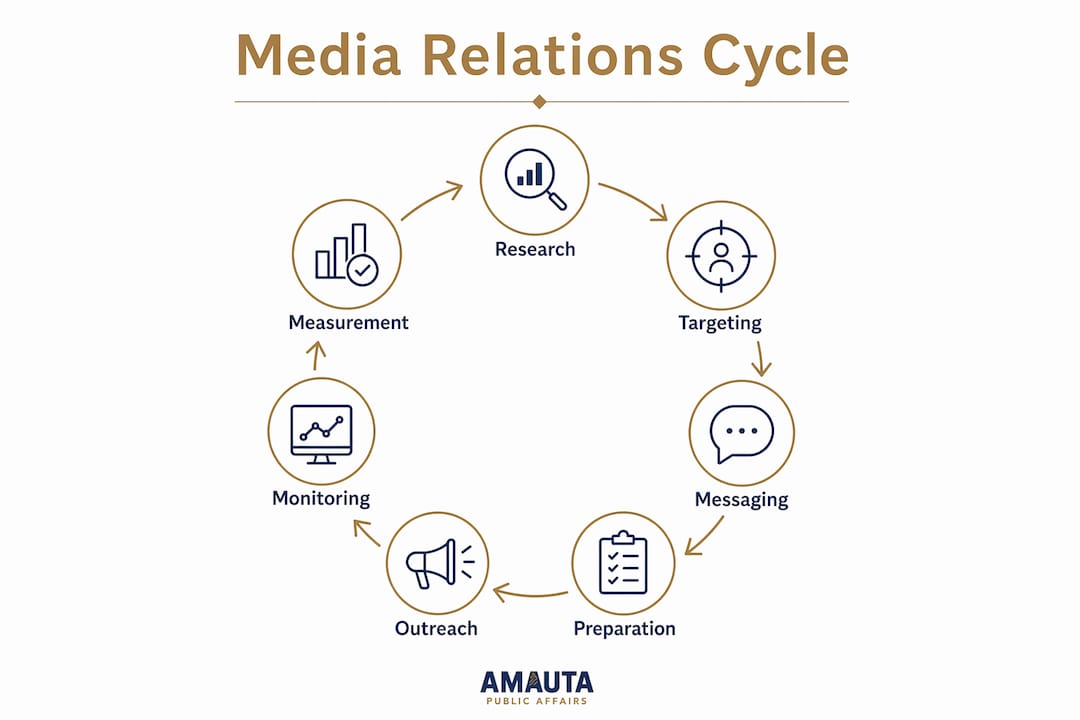
A practical media relations strategy functions as a repeatable cycle, not a linear checklist. Each phase feeds the next, and the entire system improves with every iteration. Here is how the cycle breaks down in practice.
1. Research and landscape analysis. Before any outreach begins, you map the media environment. This means identifying which outlets cover your sector, which journalists write about your specific issues, and what story angles have gained traction recently. Without this foundation, every subsequent step is guesswork.
2. Journalist targeting and list building. Targeting means scoring journalists by beat relevance, recent article history, outlet tier, and audience alignment. A tiered media list separates tier-one national outlets from regional and trade publications, allowing you to sequence outreach by priority and tailor your approach accordingly.
3. Crafting newsworthy messages. Messaging is not about what your organization wants to say. It is about what a journalist’s audience needs to hear. Every pitch should carry a clear story angle, a concrete hook, and supporting data or human interest that makes the story publishable.

4. Spokesperson preparation. Unprepared spokespeople produce weak or inaccurate coverage even when the initial pitch succeeds. Preparation involves briefing documents, anticipated Q&A, and rehearsed delivery of three core messages with supporting statistics.
5. Executing outreach. This is the actual pitch delivery, timed to journalist deadlines and formatted for their preferences. Personalization at this stage is not optional. Generic pitches are deleted.
6. Monitoring and post-publication review. After coverage appears, you track accuracy, message alignment, and audience reach. Post-publication monitoring for message accuracy and alignment, followed by collaborative correction handling with journalists, closes the loop and protects your credibility.
7. Measurement and refinement. Data from each cycle informs the next. What story angles landed? Which journalists responded? Where did messaging fall flat? Answering these questions turns each campaign into a learning asset.
Experienced teams codify this process into a media relations pack or SOP, including newsworthiness briefs, tiered media lists, pitch templates, and interview prep materials. This infrastructure prevents reinventing the wheel with every new campaign and dramatically reduces execution time.
Pro Tip: Build your media relations SOP before your first major pitch cycle. Having templated briefing documents, a tiered media list, and a pitch review checklist in place means your team executes faster and with fewer errors under deadline pressure.
How do media research and journalist targeting enhance strategic outreach?
Targeting is the single variable that most separates effective media communication from wasted effort. Sending a pitch to the wrong journalist is not just inefficient. It actively damages your reputation with that contact.
Media mapping is the process of building a scored database of journalists and outlets based on specific criteria. The most useful criteria include:
Beat alignment: Does this journalist regularly cover your sector or issue area?
Recent article history: Has this journalist written about adjacent topics in the last 90 days?
Outlet tier and reach: Is this a national publication, regional outlet, or trade journal? Each serves a different strategic purpose.
Audience demographics: Does the outlet’s readership match the stakeholders you need to influence?
Engagement patterns: Does this journalist actively engage with sources on LinkedIn or X (formerly Twitter)?
Maintaining your media list is as important as building it. Journalists change beats, move outlets, and leave the industry at a high rate. A list that was accurate six months ago may be 20 to 30 percent outdated today. Quarterly audits of your media database are not optional if you want your outreach to land.
The table below compares two approaches to journalist outreach to illustrate why targeting matters.
Approach | Method | Typical outcome |
Untargeted broadcast | Send identical pitch to 200 journalists | Low open rates, journalist complaints, damaged reputation |
Targeted outreach | Send personalized pitch to 20 scored journalists | Higher response rates, stronger relationships, better coverage quality |
Structured outreach cadence and media mapping elevate effectiveness by preventing wasted effort and perceptions of spam. The investment in targeting upfront pays compounding returns over time as your media list becomes a genuine relationship asset rather than a cold contact database. For organizations working in complex sectors like land use or energy infrastructure, where journalist relationships carry significant weight, this precision is especially critical. Amautapublicaffairs applies this same targeting discipline across its media relations work for clients navigating high-stakes public affairs environments.
What best practices guide messaging, pitching, and spokesperson preparation?
Messaging is where most media relations efforts succeed or fail. A pitch that does not carry a clear, newsworthy story angle will not be opened, regardless of how strong the underlying story is.
Effective pitches share four characteristics. They open with the story angle, not the organization’s background. They connect the story to the journalist’s specific audience. They include one concrete data point or human example that makes the story tangible. And they close with a clear, low-friction call to action, typically a request for a brief call or an offer to provide additional materials.
Subject lines deserve particular attention. Journalists receive hundreds of pitches per week. A subject line that reads like a press release headline will be ignored. Subject lines that reference a journalist’s recent work, pose a specific question, or lead with a surprising data point consistently outperform generic alternatives.
Spokesperson preparation is equally non-negotiable. High-stakes interview prep should be a 60-minute rehearsal with timed mock Q&A, focusing on refining message delivery and building spokesperson confidence under pressure. A standard session covers reporter background and outlet context, interview logistics, three core messages with supporting statistics, anticipated difficult questions, and a video recording for post-session review.
Common pitfalls to avoid include:
Sending jargon-heavy pitches that require the journalist to do interpretive work
Failing to anticipate hostile or off-topic questions in spokesperson prep
Pitching stories that serve the organization’s interests but offer no value to the journalist’s audience
Neglecting to track message pull-through, which is whether your key messages actually appear in the published coverage
Messages that combine factual claims with concrete behavioral guidance produce stronger persuasive impact. This means your pitch should not only state what your organization believes but also guide the journalist toward a specific, publishable story action.
Pro Tip: Record every mock spokesperson interview on video. Watching the playback reveals verbal tics, defensive body language, and message drift that neither the spokesperson nor the coach notices in real time. One review session typically produces more improvement than three additional rehearsals without recording.
How is execution and follow-up managed within a media relations strategy?
Execution discipline separates organizations that build genuine journalist relationships from those that burn through their media lists. The timing and cadence of outreach matter as much as the content of the pitch itself.
The following sequence reflects outreach cadence best practices that respect journalist time while maintaining consistent presence.
Initial pitch delivery. Send one personalized pitch per journalist. Timing matters: Tuesday through Thursday mornings tend to produce higher open rates than Monday or Friday sends. Avoid sending pitches the day before major news events in your sector.
First follow-up at five to seven days. If there is no response after five to seven days, send a single brief follow-up. This message should add new information or a fresh angle rather than simply restating the original pitch. A follow-up that says “just checking in” adds no value and signals a lack of preparation.
Second follow-up at seven to ten days, only if the email was opened. If tracking data shows the journalist opened the original pitch but did not respond, a second follow-up is warranted after seven to ten additional days. If the pitch was never opened, move on.
Pause and reassess. After two follow-ups with no response, pause outreach to that journalist for at least 30 days. Use that time to identify a stronger story angle or a more relevant hook before re-engaging.
Ongoing relationship maintenance. Between active pitches, maintain contact through non-pitch touchpoints: sharing a journalist’s published work on social media, responding thoughtfully to their public posts, or flagging a data source they might find useful. These micro-interactions build the relational foundation that makes future pitches land more effectively.
How do monitoring, measurement, and refinement improve media relations outcomes?
Measurement turns random pitching into a strategic media relations effort by tracking coverage volume, quality, and business impact metrics. Without measurement, you cannot distinguish between a strategy that is working and one that is simply generating activity.
The table below outlines the key metrics to track and their strategic purpose.
Metric | What it measures | Why it matters |
Coverage volume | Total mentions across outlets | Indicates outreach reach and journalist responsiveness |
Coverage quality | Outlet tier, placement prominence, story tone | Distinguishes meaningful coverage from noise |
Sentiment | Positive, neutral, or negative framing | Tracks narrative direction and identifies correction needs |
Share of voice | Your coverage versus sector peers | Benchmarks competitive positioning in media |
Message pull-through | Key messages appearing in published coverage | Confirms whether your narrative is actually landing |
Business impact | Referral traffic, lead quality, stakeholder inquiries | Connects media coverage to organizational outcomes |
Measurement should occur on a weekly cadence during active campaigns and monthly during maintenance periods. Weekly tracking allows rapid course correction: if a particular story angle is generating no responses after two weeks, you adjust before wasting additional outreach cycles on a dead end.
Post-publication monitoring serves a second purpose beyond metrics. It allows you to catch factual errors or misquotes quickly, enabling you to work with journalists on corrections before inaccurate information spreads. This kind of proactive accuracy management strengthens journalist relationships rather than damaging them, because it demonstrates that you are a reliable, detail-oriented source.
Key takeaways
A media relations strategy works because it replaces ad hoc pitching with a structured, measurable cycle that builds journalist trust, delivers targeted coverage, and improves with every iteration.
Point | Details |
Strategy is a repeatable cycle | Research, targeting, messaging, outreach, monitoring, and refinement must run continuously, not as a one-time campaign. |
Targeting determines efficiency | Scoring journalists by beat, outlet tier, and audience alignment prevents wasted effort and protects your media reputation. |
Spokesperson prep is non-negotiable | A 60-minute mock interview with video review builds confidence and prevents inaccurate coverage after a successful pitch. |
Outreach cadence protects relationships | One pitch per journalist per week, with two follow-ups maximum, respects journalist time and avoids being flagged as spam. |
Measurement closes the loop | Tracking message pull-through, sentiment, and business impact weekly turns each campaign into a learning asset for the next. |
Why most media relations efforts fall short before the pitch is even sent
After working across land use, energy infrastructure, and community engagement campaigns, the pattern I see most often is not a messaging problem. It is a preparation problem. Organizations invest significant time crafting a pitch and almost no time building the infrastructure that makes the pitch credible: a current, scored media list, a prepared spokesperson, and a measurement framework that tells you whether the strategy is actually working.
The relational dimension of media relations is also consistently underestimated. Journalists are not passive recipients of information. They are professionals with deadlines, audience obligations, and reputations to protect. The organizations that earn consistent, high-quality coverage are the ones that make a journalist’s job easier every single time they make contact, whether or not that contact results in a story.
I have also seen well-executed pitches collapse at the spokesperson stage. A journalist agrees to an interview, the spokesperson walks in unprepared, and the resulting coverage either misrepresents the organization’s position or buries the key message entirely. The 60-minute rehearsal protocol is not a luxury. It is the minimum viable preparation for any media engagement that carries reputational stakes.
One more observation worth naming: organizations that skip measurement are not just flying blind. They are also missing the most powerful argument for continued investment in media relations. When you can show that a coverage cycle drove a measurable increase in stakeholder inquiries or project support, the case for sustained commitment becomes self-evident. Without that data, media relations remains a line item that gets cut when budgets tighten.
For organizations working in crisis communication contexts, the same principles apply with higher stakes and compressed timelines. The teams that perform best under pressure are the ones that built their media relations infrastructure before the crisis arrived.
— Ignacio
How Amautapublicaffairs supports your media relations strategy
Amautapublicaffairs brings a campaign-style approach to media relations that goes beyond press release distribution. The team builds tiered media lists, develops story angles tailored to specific journalist beats, and conducts spokesperson preparation sessions designed for high-stakes public affairs environments. Whether you are launching a land use project, advancing an energy initiative, or managing a complex stakeholder communication challenge, Amautapublicaffairs provides the strategic outreach, messaging development, and measurement infrastructure your organization needs to earn credible coverage.
If you are ready to move from reactive communications to a structured media relations program that builds lasting journalist relationships and measurable public trust, connect with the team at Amautapublicaffairs. You can also explore the full range of public affairs services available to support your next campaign.
FAQ
What is media relations strategy?
Media relations strategy is the structured process of building trusted relationships with journalists to earn targeted, credible media coverage without paid placements. It operates as a repeatable cycle covering research, targeting, messaging, outreach, monitoring, and refinement.
How do you build media relations with journalists?
Building media relations requires consistent, relevant, and respectful contact over time. Journalists respond to sources who provide timely information, respect deadlines, and make their reporting easier rather than harder.
What metrics should you track in a media relations program?
Key metrics include coverage volume, outlet tier quality, sentiment, share of voice, message pull-through, and business impact indicators like referral traffic and stakeholder inquiries. Weekly tracking during active campaigns allows rapid strategy adjustment.
How often should you pitch a journalist?
Send one pitch per journalist per week, with a follow-up after five to seven days and a second follow-up after seven to ten days only if the original email was opened. After two unanswered follow-ups, pause outreach for at least 30 days.
Why does spokesperson preparation matter in media relations?
Unprepared spokespeople produce weak or inaccurate coverage even when the initial pitch succeeds. A 60-minute rehearsal session covering mock Q&A, core message delivery, and video review is the minimum preparation standard for high-stakes media appearances.
Recommended
Comments