
What Approval Risk Assessment Means for Land-Use Projects

Approval risk assessment is a structured evaluation of the likelihood that a proposed land-use, permitting, or development project will secure the regulatory sign-offs and community backing it needs to move forward. The deliverable a sponsor should expect is twofold: a likelihood profile that scores the project’s odds by jurisdiction and stakeholder group, and a prioritized list of mitigations tied to the risks most likely to cause delay or denial. Sponsors who commission this work early are not buying paperwork. They are buying time, and time on a permitting timeline is often the single most expensive variable a project has.
Two bodies of evidence support this as more than intuition. The EPA’s public participation guidance recommends tailored outreach plans scaled to community interest and burden, and peer-reviewed project management research shows that treating stakeholders as active partners, rather than as obstacles to manage around, raises the odds of acceptance. Amauta Public Affairs builds its practice on exactly this premise.
A properly scoped assessment typically answers:
Which permits, variances, and hearings does this project actually trigger?
Who are the stakeholders most likely to organize opposition, and why?
Where do political timing and incentive deadlines create pressure points?
What technical or equity concerns will regulators weigh most heavily?
Key Takeaways
Approval risk assessment works because it converts scattered stakeholder concerns and regulatory unknowns into a scored, documented plan that agencies, councils, and investors can act on.
Point | Details |
Definition and deliverable | It produces a likelihood profile plus prioritized mitigations, not just a compliance checklist. |
Five core data inputs | Stakeholder sentiment, zoning review, technical impacts, political timing, and EJ screening all feed the score. |
Engagement beats litigation | Comparative case research shows engagement-first projects achieve smoother, faster approvals. |
Timing matters most | Run the assessment at site selection, before rezoning notice, and after any material scope change. |
Amauta’s role | Amauta Public Affairs delivers scoping, engagement, and council-ready reporting as one coordinated engagement. |
Table of Contents
What Is Approval Risk Assessment Made Of? Core Components and Data Inputs
Understanding approval risk starts with knowing what data actually feeds the analysis. A thin assessment relies on a zoning map and a guess about public mood. A useful one pulls from five distinct streams, each answering a different question about whether the project will clear its approval gates.
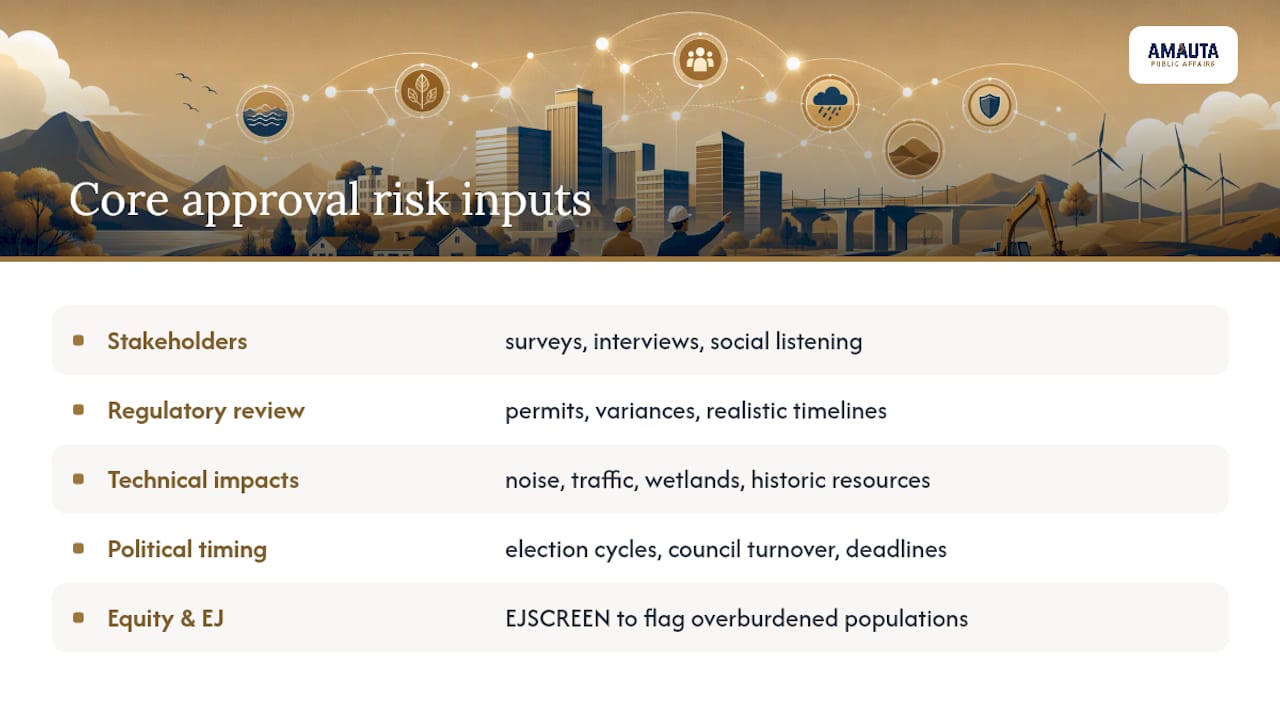
Stakeholder mapping and sentiment comes first, built through surveys, one-on-one interviews with civic and neighborhood leaders, and social listening across local forums and news coverage. This tells you who supports the project, who opposes it, and who is still persuadable.
Regulatory and zoning review catalogs every permit, variance, and conditional-use approval the project will need, along with realistic timelines for each. The HUD environmental assessment guide recommends checking zoning conformity, adjacent land uses, and existing permit records to flag compatibility problems before they surface in a hearing.
Technical impact areas matter because regulators weigh specific, well-documented categories: noise, traffic generation, wetlands and drainage, and cultural or historic resources. Vague reassurances on these points invite denial.
Political and timing risk covers election cycles, council turnover, and incentive deadlines that could evaporate if approval slips past a fiscal year.
Equity and environmental justice screening, using a tool like EPA’s EJSCREEN, identifies whether the project sits near a population that has historically carried a disproportionate share of environmental burden. That single data point often determines how intensive the public participation plan needs to be.

Skipping any of these five categories leaves a blind spot exactly where opposition tends to organize.
Why Approval Risk Assessment Matters: What Happens When You Skip It
Underestimating approval risk rarely fails quietly. It shows up as a denied permit, a moratorium, a lawsuit, or a financing partner walking away after months of favorable coverage evaporate overnight.
The measurable consequences tend to cluster into a few categories:
Permitting delays that push a project past a tax credit deadline or financing window.
Litigation from organized opposition groups, which can add years and legal fees regardless of the outcome.
Moratoria imposed by a city council responding to public pressure rather than technical merit.
Loss of state or federal incentives tied to a specific approval date.
Reputational damage that surfaces during due diligence on the next project in the same jurisdiction.
Comparative case research backs this up directly. A study comparing engagement-centered and litigation-focused approaches in infrastructure projects found that engagement-first strategies produced greater social legitimacy and measurably smoother approval paths than adversarial ones. Colorado’s own guidance on community-driven outreach makes a related point about sequencing.
Beginning meaningful engagement as early as site selection, rather than after a design is finalized, reduces the odds of permit denials, media backlash, and lawsuits compared with a top-down announcement approach.
A wind or solar project that opens with a public hearing instead of months of prior listening sessions tends to walk into exactly the kind of organized, well-prepared opposition that a risk assessment would have flagged in advance.
When Should You Run an Approval Risk Assessment?
Timing determines whether an assessment shapes a project or just documents its failure after the fact. Run one at these points:
Site selection. Before a parcel is under contract, screen it for zoning conflicts, EJ status, and known local sensitivities.
Pre-application due diligence. Before filing anything with an agency, confirm the full permit list and realistic timeline.
Rezoning or any approval requiring public notice. Public hearings invite organized response, so the assessment should precede the notice, not follow it.
After material design or scope changes. A change in height, capacity, or use category can reopen stakeholder objections that an earlier round had settled.
After a political shift. New council members, a change in mayoral priorities, or a neighboring project’s controversy can all shift your risk profile overnight.
Larger, multi-jurisdiction projects warrant a refresh roughly every six months through entitlement. Smaller commercial projects can often get by with an initial assessment plus one update before the public hearing stage.
How to Conduct an Approval Risk Assessment Step by Step
An approval risk evaluation works best as a repeatable sequence, whether your team runs it internally or asks a consultant to deliver it as a defined engagement.
Scope the assessment. Define which jurisdictions apply, what “success” looks like (a permit issued, a rezoning approved, a franchise renewed), and the hard deadlines driving the timeline.
Collect the data. Pull regulatory records, technical baselines (traffic counts, noise studies), EJSCREEN results, and a scan of local media and social sentiment.
Analyze and build a risk register. List every identified risk and score it on likelihood and consequence, a standard method borrowed from project risk management practice. Map each risk to the stakeholder group most connected to it.
Prioritize and design mitigations. Match your limited engagement budget to the highest-scoring risks first. A risk register only earns its keep when it changes where resources go.
Document findings in a council-ready packet. Agencies and elected bodies respond better to a clear administrative record than a slide deck. Include your engagement log, technical findings, and mitigation commitments in writing.
Monitor and set triggers. Define what political or community developments should trigger a reassessment, and set a communication cadence so stakeholders hear from you before they have to ask.
Pro Tip: Build your contingency budget around the risk register, not around a flat percentage. A project with three high-scoring risks concentrated in one neighborhood needs a different reserve than one with the same total risk score spread across five smaller issues.
Consultants who specialize in stakeholder communication strategies for land-use projects typically deliver this entire sequence as one engagement, which keeps the analysis, the mitigation design, and the documentation consistent rather than assembled from three separate vendors.
Turning Assessment Findings Into Permits, Plans, and Controls
An assessment that sits in a binder changes nothing. The findings only reduce risk once they’re built into the documents and controls that agencies, councils, and investors actually see.
Fold identified mitigations directly into permit conditions and environmental disclosures, so the commitments you made during outreach are the same ones an inspector checks later. Draft engagement commitments that are specific and documented: a named number of public meetings, a defined response window for community questions, a public log of concerns raised and how each was addressed. Vague promises to “engage the community” carry no weight in a contested hearing; a documented record does.
On the financial side, use the risk register to set contingency reserves and milestone-linked approvals, so capital isn’t released faster than the approval risk actually justifies. This also gives investors a clearer picture during diligence than a generic timeline slide.
The documentation itself becomes your best defense against litigation. A comparative case study on infrastructure approvals found that projects with a demonstrable, responsive engagement record fared better in both public acceptance and legal outcomes than those that only engaged after opposition had already organized.
How Amauta Public Affairs Operationalizes the Assessment
Amauta Public Affairs maps its core services directly onto each stage of the assessment: community engagement handles the stakeholder mapping and sentiment work, media relations manages the reputational exposure identified in the risk register, and digital advocacy sustains the documented engagement record regulators and councils want to see.
Stakeholder mapping and sentiment tracking feed directly into a scored risk register.
Media relations addresses reputational risk before it becomes a financing problem.
Digital advocacy keeps the engagement record current between hearings.
The campaign-style approach, adjusting messaging and tactics based on real-time feedback rather than a fixed plan set months in advance, is what keeps mitigation aligned with a risk profile that shifts as a project moves through entitlement. Read more on how community engagement strategy shapes project outcomes.
Point | Details |
Core service mapping | Engagement, media relations, and digital advocacy each address a distinct risk category. |
Iterative execution | Real-time feedback allows mitigation to adjust before a hearing, not after. |
Documentation focus | Every engagement action is logged for council-ready administrative records. |
What the Data Actually Tells Sponsors to Prioritize
Most advice on this topic treats community engagement as a courtesy step, something to check off after the technical work is done. The research doesn’t support that ordering. Engagement-first projects consistently outperform litigation-first ones on both acceptance and speed, which means engagement isn’t a soft add-on to the technical assessment. It’s a parallel track that should start on day one, not after the first objection surfaces.
The bigger misread I see in conventional guidance is treating equity screening as a legal compliance step rather than a risk-reduction tool. Running an EJSCREEN check isn’t about satisfying a checkbox. It’s about knowing, before you file anything, which communities will scrutinize this project hardest and why, so your mitigation budget goes where it will actually change the outcome.
If you take one thing from this: prioritize the documentation. A verbal commitment made in a community meeting is worth far less than the same commitment written into a permit condition. Sponsors who treat the risk register as a living document, not a one-time report, are the ones who walk into a contested hearing with a paper trail instead of a promise.
Get a Done-for-You Approval Risk Assessment
Amauta Public Affairs runs this entire process as a single engagement instead of a patchwork of separate vendors for outreach, media, and permitting support. Scoping, stakeholder mapping, regulatory review, and council-ready reporting happen under one coordinated team, which means fewer handoffs and a mitigation plan built by the same people who conduct the outreach.
A typical initial engagement runs through a full risk register, a prioritized mitigation plan, and a documentation framework your legal and government-affairs teams can hand directly to a permitting agency or city council. For land-use and entitlement work specifically, the Land Management team applies this same process to site-selection and rezoning timelines. Sponsors handling infrastructure or energy siting can also review examples in building support for data centers and energy projects.
Start by reviewing the full services overview and requesting a scoping call to see how the assessment would apply to your specific jurisdiction and timeline.
Frequently Asked Questions
What is approval risk assessment in simple terms? It’s an evaluation of how likely a land-use or development project is to win the permits and public support it needs, based on stakeholder sentiment, regulatory hurdles, and political timing.
Who typically orders an approval risk evaluation? Developers, project sponsors, local governments, and organizations pursuing energy, infrastructure, or commercial projects commission this work, usually before filing for permits or rezoning.
How is approval risk management different from a standard environmental review? An environmental review focuses on physical and regulatory impacts. Approval risk management adds the political, community, and timing dimensions that determine whether a technically sound project still faces delay or denial.
Can a small commercial project skip a formal assessment? Smaller projects can scale the process down, but skipping it entirely leaves teams blind to zoning conflicts or neighborhood opposition that could stall a permit at the last stage.
How often should the assessment be updated? Large or multi-jurisdiction projects benefit from a refresh roughly every six months through entitlement; smaller projects often need just one update before the public hearing stage.
Sources
Recommended
Comments