
How to Negotiate Green Conditions for Development Approvals

Developers can negotiate green conditions as part of discretionary approvals, and the single most effective first step is requesting a pre-application meeting with planning staff before any formal submission. That conversation shapes everything that follows: which conditions are likely, which are negotiable, and where the agency has genuine flexibility. Waiting until the draft environmental review to engage is one of the costliest mistakes a development team can make.
The strategic path forward involves three immediate actions:
Schedule a pre-application meeting with the planning department to surface likely conditions and identify the agency’s priorities before any design is locked in.
Commission targeted baseline studies (hydrology, habitat, GHG inventory) that give your team the technical credibility to propose alternatives rather than simply accept staff-drafted conditions.
Prepare a tradeable mitigation package aligned to municipal priorities, structured as performance-based offers rather than binary commitments, and backed by legal instruments such as Community Benefit Agreements (CBAs) or recorded covenants.
Under CEQA in California and NEPA at the federal level, discretionary approvals carry the broadest scope for negotiated conditions. Ministerial permits, by contrast, leave almost no room for negotiation. Knowing which process governs your project determines how much leverage you actually have. Amautapublicaffairs works with development teams at exactly this juncture, mapping the political and regulatory terrain before the first formal submission.
Table of Contents
How planning approvals and environmental review create the conditions you will face
A step-by-step negotiation playbook from pre-application to final conditions
Legal and contractual instruments to capture negotiated green conditions
The documents and monitoring package that win credibility in negotiations
Why green conditions are a design problem, not just a compliance problem
AMAUTA Public Affairs brings negotiation strategy to your entitlement process
How planning approvals and environmental review create the conditions you will face
The approval process is not a single gate. It is a sequence of decision points, each of which can generate new conditions or modify existing ones. Understanding who holds authority at each stage is prerequisite to any negotiation strategy.
Phase | Who exercises authority | Typical condition types |
Pre-application | Planning staff, environmental reviewers | Informal guidance, scope of studies required |
Draft EIR/EA (CEQA/NEPA) | Lead agency, environmental team | Mitigation measures, alternatives analysis |
Public comment period | Community, NGOs, state agencies | Amplified demands, additional mitigation |
Planning commission hearing | Commissioners, elected officials | Site-specific conditions, design modifications |
Final permit / entitlement | City/county council, state agencies | Binding conditions, recorded instruments |
CEQA (California Environmental Quality Act) governs discretionary approvals in California and requires agencies to identify and mitigate significant environmental impacts. NEPA (National Environmental Policy Act) applies to federal actions and federally funded projects, requiring environmental assessments (EAs) or full environmental impact statements (EISs). Both statutes create the legal framework within which conditions are drafted and attached to approvals.
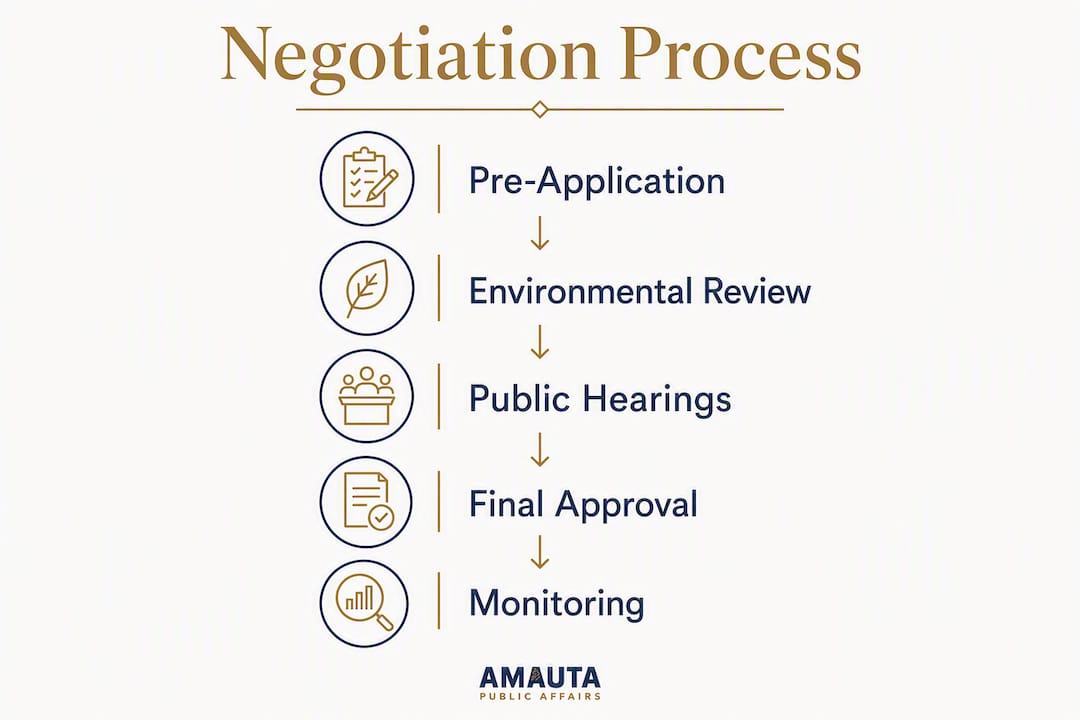
A critical distinction: conditions can appear as permit requirements, mitigation measures in a mitigation monitoring and reporting program (MMRP), or binding covenants recorded against the property. Each carries different enforceability, different timelines, and different remedies for noncompliance. A permit condition can sometimes be modified through an administrative process; a recorded covenant runs with the land and binds future owners. Knowing which instrument an agency prefers to use, and why, is foundational to any negotiation.
Local governments also leverage broad authority under health, welfare, and safety mandates to attach site-specific conditions well beyond standard zoning codes. That authority is real, and challenging it legally is possible but often counterproductive, carrying political and schedule costs that outweigh any procedural win.
What green conditions actually look like on the ground
Green and environmental conditions span a wide range of performance obligations. Some are binary: a habitat set-aside either exists or it does not. Others are performance-based, giving developers flexibility in method as long as measurable outcomes are met. Knowing the difference shapes how you negotiate each one.
Stormwater management and treatment: Low-impact development (LID) measures such as bioswales, permeable paving, or detention basins; typically measured against a volume or flow-rate standard (e.g., treat the first inch of runoff on-site).
Habitat protection and offsets: Preservation acreage, species credits, or off-site mitigation ratios; often expressed as a ratio of impacted acres to preserved or restored acres.
GHG reduction and energy requirements: Operational GHG reduction targets (e.g., percentage below a baseline), all-electric building requirements, or renewable energy procurement commitments; Chicago’s Sustainable Development Policy uses a point-based menu system where new construction must achieve 100 points.
Construction-phase mitigation: Noise decibel limits, dust suppression protocols, restricted construction hours, and haul-route restrictions; typically tied to monitoring reports submitted to the agency.
Local hiring and procurement: Percentage of construction labor from a defined geographic area, apprenticeship program participation, or local business procurement targets.
Monitoring and public reporting: Quarterly or annual reports submitted to the lead agency, sometimes with public posting requirements and third-party verification.
Perpetual maintenance covenants: Long-term obligations for open space, habitat areas, or stormwater infrastructure that survive project completion and bind future owners.
For high-conflict projects, politically driven condition lists can grow dramatically. One Pennsylvania township attached an extensive condition list to a data center approval, covering noise limits, buffer zones, water restrictions, and perpetual reporting obligations. That kind of list is not unusual when community opposition is high and elected officials need to demonstrate responsiveness. Early community engagement strategies are the most reliable way to prevent that escalation.
A step-by-step negotiation playbook from pre-application to final conditions
Pre-application: lay the groundwork before the clock starts
The pre-application phase is where the most leverage exists and where most development teams underinvest. Commission targeted baseline studies early: a hydrology report, a biological resources assessment, and a GHG inventory give your team the technical foundation to propose alternatives rather than react to staff-drafted conditions. Map stakeholders before the first public meeting, identifying which community groups, elected officials, and agencies will have the most influence over the final conditions.

Prepare an initial mitigation package that maps your proposed measures to the municipality’s stated priorities. If the city’s general plan emphasizes climate resilience, lead with your GHG and energy commitments. If the council has been vocal about local hiring, put a local workforce commitment on the table early. Alignment with municipal priorities is the single most effective way to build staff credibility before the formal review begins.
Environmental review phase: shape the mitigation before it hardens
Milestone | Developer action | Goal |
Notice of Preparation (NOP) | Submit scoping comments; propose study scope | Narrow the range of alternatives analyzed |
Draft EIR/EA released | Submit technical comments; propose performance-based alternatives | Replace prescriptive conditions with measurable outcomes |
Public comment period | Coordinate stakeholder letters; address community concerns proactively | Reduce amplified demands at hearings |
Response to Comments | Negotiate MMRP language directly with staff | Lock in enforceable, measurable mitigation measures |
Planning commission hearing | Present community benefit package; address remaining concerns | Secure commission support with a clear public value narrative |
During the environmental review phase, submit draft mitigation language rather than waiting for the agency to draft it. Agencies often accept well-crafted developer-proposed language, particularly when it is technically sound and measurable. Propose performance-based alternatives wherever possible: “reduce operational GHGs by 30% below baseline” is preferable to “install solar panels on all roof surfaces” because it preserves design flexibility.
Pro Tip: Offer phased implementation tied to occupancy triggers. A condition that requires full stormwater compliance before certificate of occupancy is far less burdensome than one requiring it before grading permits. Phased triggers protect cash flow while giving the agency credible assurance that obligations will be met.
Hearings and final conditions: the political dimension
By the time a project reaches a planning commission hearing, the technical record is largely set. What shifts outcomes at hearings is the political and community narrative. Bring organized community support, not just technical consultants. Elected officials respond to constituent voices, and a well-prepared public affairs effort can convert a contentious hearing into a straightforward approval. Know when to bring legal counsel: complex CBAs, binding covenants, and multi-jurisdictional approvals all require attorney review before any instrument is signed. Amautapublicaffairs’s stakeholder communication strategies are designed for exactly this phase, coordinating technical, legal, and political messaging into a single coherent presentation.

What to offer agencies: levers that win concessions
Effective negotiation requires understanding what municipalities actually value, then structuring offers that deliver that value in ways the agency can defend publicly. Framing sustainability commitments as shared value rather than compliance costs makes agencies more receptive and can unlock concessions like density bonuses or expedited review.
Agency priority | Developer lever | Likely concession |
Climate resilience | On-site GHG reduction, all-electric design, renewable procurement | Reduced operational monitoring frequency |
Stormwater / water quality | LID measures exceeding code minimums | Reduced habitat offset ratio |
Community economic benefit | Local hiring commitment, apprenticeship participation | Phased implementation of capital-intensive conditions |
Long-term enforcement certainty | Monitoring bond, third-party verification, public reporting | Reduced upfront mitigation capital requirement |
Habitat protection | Off-site conservation easement, species credits | Reduced on-site setback or buffer requirements |
Fiscal relief | Infrastructure contributions, maintenance endowment | Expedited permit processing |
The most durable concessions come from offers that give the agency something it can point to publicly. A monitoring bond is more persuasive than a verbal commitment because it is visible, enforceable, and requires no ongoing staff oversight. A local hiring commitment with a defined percentage and a reporting mechanism is more credible than a general statement of intent.
Pro Tip: Structure offers in tiers. Present a baseline package that meets code minimums, then offer enhanced commitments in exchange for specific concessions (phased conditions, reduced offset ratios, or expedited processing). Tiered offers give staff a clear path to recommend approval and give elected officials a visible public benefit to champion.
Community Benefit Agreements can formalize these commitments. In some jurisdictions, CBAs are becoming mandatory prerequisites: Queensland’s 2025 planning rules require binding CBAs with local councils before major renewables projects can even lodge a planning application. While U.S. jurisdictions have not uniformly adopted that requirement, the trend toward pre-application commitments is accelerating in politically sensitive markets.
Legal and contractual instruments to capture negotiated green conditions
Negotiated commitments are only as durable as the legal instruments that capture them. Verbal agreements with planning staff have no enforceability. The following instruments are the standard toolkit for making green conditions binding, predictable, and transferable.
Mitigation agreement: A bilateral contract between the developer and the lead agency specifying mitigation measures, performance standards, reporting cadence, and remedies for noncompliance. Preferred when conditions are complex or phased.
Recorded covenant / CC&R: A restriction recorded against the property title that runs with the land and binds future owners. Used for perpetual obligations such as habitat preservation, open space maintenance, or stormwater infrastructure.
Development agreement: A statutory instrument (available in California under Government Code §65864 et seq. and in many other states) that vests entitlements and locks in conditions for a defined term, providing schedule and cost certainty for both parties.
Community Benefit Agreement (CBA): A legally binding contract between the developer and community organizations or the municipality specifying public benefits (local hiring, affordable housing, park improvements) in exchange for community support or expedited processing.
Maintenance and monitoring bonds: Financial guarantees (surety bonds or letters of credit) that ensure mitigation obligations are funded even if the developer defaults or transfers the project.
For every instrument, an enforceability checklist should confirm: clear performance standards with measurable metrics, defined reporting cadence and format, explicit remedies for noncompliance, assignment and transfer rules, and reopener clauses tied to regulatory change or technology shifts. ConsensusDocs 310 provides a standardized contractual framework that introduces the Green Building Facilitator (GBF) role to coordinate sustainability obligations and reduce disputes across project phases.
Contracts frequently fail to allocate rights to tax credits, carbon offsets, and other incentives, which leads to downstream disputes among owners, tenants, and lenders. Explicit allocation of who may claim incentives, offsets, and credits must be written into the agreement before execution. Developers carrying property developer insurance should also confirm that monitoring bonds and environmental indemnities are coordinated with their coverage structure to avoid gaps.
How green conditions change your schedule and budget
Green conditions add cost and time at every phase of a project. The categories below are where development teams most often underestimate exposure.
Baseline studies and technical reports typically add 60–120 days to the pre-application phase, depending on the complexity of the site and the number of resource areas requiring assessment. Biological surveys have seasonal windows that can extend this timeline further.
Design modifications driven by conditions (setbacks, LID infrastructure, habitat buffers) affect both construction cost and leasable or sellable area. Performance-based conditions give design teams more flexibility to optimize; prescriptive conditions do not.
Permitting delays caused by contested conditions or public opposition can extend the entitlement timeline by months. The political dynamics that produce an extensive condition list do not resolve quickly, and each additional condition requires staff review, legal analysis, and often a revised environmental document.
Monitoring and reporting are ongoing costs that extend well beyond project completion. Third-party verification, annual reporting, and public posting requirements add administrative overhead that should be budgeted from the outset, not treated as a post-construction afterthought.
Bonds and financial guarantees require capital or credit capacity. A monitoring bond sized to cover five years of remediation costs can be a material line item for mid-size projects. Phasing bond requirements to project milestones (rather than requiring full bonding at entitlement) is a negotiable point worth pursuing early.
The practical sequencing principle: commit capital to baseline studies and pre-application engagement before any other mitigation expenditure. Those investments shape the conditions you receive. Spending on monitoring infrastructure before conditions are finalized is premature and often wasted.
The documents and monitoring package that win credibility in negotiations
Agencies grant more flexibility to development teams that arrive with a credible, technically sound package. The following documents are the minimum required to negotiate from a position of strength.
Targeted environmental baseline studies: Site-specific assessments for each resource area likely to generate conditions (biological resources, hydrology, air quality, GHG, cultural resources). Generic regional studies do not substitute for site-specific data.
Performance standards for mitigation: Measurable targets expressed as outcomes (e.g., “reduce operational GHG emissions by 30% below a 2019 baseline”) rather than prescriptive methods. Performance standards give agencies confidence and give developers flexibility.
Monitoring plan: Identifies the responsible party, monitoring frequency, metrics, reporting format, public access provisions, third-party verification protocol, and funding source. A well-drafted monitoring plan reduces agency uncertainty and often reduces the stringency of conditions.
Draft mitigation agreement language: Submitting draft legal language signals that the developer is prepared to be held accountable and reduces the agency’s drafting burden. Agencies are more likely to accept developer-proposed language when it is technically precise and includes clear remedies.
Incentive allocation schedule: A table identifying which party (developer, tenant, lender, or future owner) holds rights to tax credits, carbon offsets, and renewable energy certificates. Resolving this before entitlement prevents the disputes that ConsensusDocs 310 and legal practitioners consistently flag as a primary source of post-approval litigation.
A community reputation management checklist should accompany the technical package, ensuring that the public-facing narrative about the project’s environmental commitments is consistent with the legal language being negotiated behind the scenes.
Common pitfalls, red flags, and when to walk away
Red flags in the negotiation process
Certain behaviors and conditions signal that a negotiation is heading toward a bad outcome. Recognizing them early creates options; ignoring them produces schedule disasters and litigation.
Refusing to engage at pre-application is the most common developer error. Agencies that receive no pre-application contact tend to draft conditions conservatively, covering every conceivable risk. The resulting condition list is harder to negotiate down than one shaped by early dialogue.
Ignoring political and community dynamics converts technical disagreements into political battles. Poorly handled public opposition can amplify demands and require media and public affairs interventions to reset negotiations, at significant cost and delay. Proactive public perception management is far less expensive than reactive damage control.
Accepting vaguely worded perpetual obligations is a contractual trap. A condition requiring the developer to “maintain habitat in good condition in perpetuity” with no defined metric, no monitoring protocol, and no remediation trigger is an open-ended liability. Never accept a perpetual obligation without a measurable standard and a defined remediation process.
Agreeing to unenforceable performance metrics creates a different problem: conditions that look reasonable on paper but cannot be verified in practice invite future disputes and potential permit revocation.
Escalation pathways when negotiations stall
Administrative appeals to the planning commission or city council are the first escalation option when staff-level negotiations produce unacceptable conditions. Council-level negotiation often introduces political considerations that can work in a developer’s favor when the project has visible community benefits. Judicial remedies (mandamus, writ proceedings) are available but should be treated as a last resort: challenging conditions on legal grounds risks political backlash and reputational damage that can stall approvals even when the legal argument is sound. A strategic public affairs campaign, coordinated with media relations and community engagement, often resets the negotiating dynamic more effectively than litigation.
Case study: a negotiated outcome that worked
A mixed-use infill project in a mid-size California city illustrates how the playbook translates into practice. The site included a seasonal drainage feature and marginal habitat for a state-listed species, triggering both CEQA review and coordination with the California Department of Fish and Wildlife.
Pre-application phase (months 1–4): The development team commissioned a biological resources assessment and a hydrology study before submitting any formal application. The biological assessment identified the species presence and quantified the impact footprint, giving the team a defensible basis for proposing a mitigation ratio rather than accepting the agency’s default. The team also engaged a public affairs advisor to map community stakeholders and identify which neighborhood groups were likely to raise concerns at hearings.
Negotiated offer: The developer proposed a phased habitat restoration program: a conservation easement covering 1.5 acres of off-site habitat, funded through a monitoring bond sized to cover five years of restoration management. In exchange, the team requested that on-site setback requirements be reduced from 100 feet to 50 feet, recovering approximately 8,000 square feet of developable area. The team also offered a local hiring commitment covering 30% of construction labor, which the city council had publicly prioritized.
Hearing and final approval: The public affairs effort organized letters from three neighborhood associations and a local business coalition, framing the project’s local hiring commitment and habitat restoration as concrete community benefits. The planning commission approved the project with 12 conditions rather than the 27 in the initial staff report. The monitoring bond was structured with a phased funding schedule tied to construction milestones, reducing upfront capital requirements.
Outcome: The negotiated package reduced the developer’s upfront mitigation capital, improved political support at the council level, and produced an enforceable monitoring regime with clear metrics and a defined remediation trigger. The public affairs engagement, coordinated through Amautapublicaffairs’s land management services, was credited by the project team as the factor that converted a contentious hearing into a straightforward approval.
Key Takeaways
Negotiating green conditions successfully requires pre-application engagement, performance-based mitigation offers, and enforceable legal instruments, supported by coordinated public affairs strategy.
Point | Details |
Start before the formal application | Pre-application meetings with planning staff are where the most leverage exists and where conditions are most malleable. |
Use performance-based conditions | Measurable outcome standards preserve design flexibility and are more defensible than prescriptive method requirements. |
Capture commitments in legal instruments | Mitigation agreements, recorded covenants, CBAs, and monitoring bonds make negotiated conditions enforceable and transferable. |
Manage political dynamics proactively | Early public affairs engagement prevents community opposition from escalating into expanded condition lists and hearing delays. |
Engage Amautapublicaffairs early | Amautapublicaffairs provides stakeholder mapping, community engagement, and strategic messaging to support negotiated entitlement outcomes. |
Why green conditions are a design problem, not just a compliance problem
The conventional framing of green conditions as regulatory burdens to minimize misses the more important strategic reality. Conditions are negotiating currency. A developer who arrives at a pre-application meeting with a credible mitigation package is not just complying with process; they are shaping the terms of the deal. The agency’s job is to protect the public interest. The developer’s job is to make that protection as specific, measurable, and predictable as possible, because vague obligations are the ones that generate litigation, cost overruns, and reputational damage.
What most development teams underestimate is the degree to which political and community dynamics drive the technical outcome. A planning commission that is under constituent pressure will add conditions regardless of the technical record. The Harvard Graduate School of Design’s research on negotiated entitlements consistently shows that projects achieving win-win outcomes do so through transparency, community engagement, and a clear public value narrative, not through technical arguments alone. The Salesforce Transit Center, King’s Cross, and the Elizabeth Line all succeeded because developers treated public benefit as a design input, not an afterthought.
The practical implication: invest in public affairs strategy at the same stage you invest in environmental baseline studies. Both shape the conditions you receive. One without the other leaves significant value on the table.
AMAUTA Public Affairs brings negotiation strategy to your entitlement process
When green conditions threaten project economics or timelines, the gap between a workable outcome and an unmanageable one is usually a matter of strategy, not technical merit. Amautapublicaffairs works with developers and land-use professionals to close that gap, combining pre-application stakeholder mapping, targeted community engagement, media relations, and drafting support for CBAs and mitigation agreements into a single coordinated effort.
The firm’s land management services are built specifically for the entitlement process: identifying which conditions are negotiable, structuring offers that align with municipal priorities, and building the community and political support that converts contentious hearings into approvals. For energy, infrastructure, and commercial development projects where green conditions carry material cost and schedule risk, that kind of integrated strategy is what separates projects that close on time from those that stall in extended review.
To discuss how Amautapublicaffairs can support your next entitlement, visit the services page or reach out directly to schedule a project assessment.
Authoritative sources and when to consult counsel
The following references provide primary guidance on the processes, instruments, and standards discussed in this article.
Municipal planning department guidance: Contact the planning department in your project’s jurisdiction for local discretionary review procedures, condition templates, and pre-application meeting protocols. Most major cities publish planning approval guides online; Los Angeles City Planning is one example of a publicly available resource.
CEQA resources: The California Natural Resources Agency publishes the CEQA Guidelines (14 CCR §15000 et seq.); the Governor’s Office of Planning and Research (OPR) maintains technical advisories on mitigation monitoring and reporting programs.
NEPA resources: The Council on Environmental Quality (CEQ) publishes NEPA regulations (40 CFR Parts 1500–1508) and implementation guidance for federal and federally funded projects.
ConsensusDocs 310: The ConsensusDocs 310 green building addendum provides standardized contract language for sustainability obligations, the GBF role, and incentive allocation.
Harvard GSD on negotiated entitlements: The Harvard Graduate School of Design’s research on win-win development through negotiated entitlements provides case study evidence on what makes these agreements succeed.
Hahn Loeser on green construction contracts: Allocating the Risks and Benefits of Green Construction covers contractual allocation of incentives, credits, and offsets.
When to retain counsel or a public affairs advisor: Engage legal counsel before signing any CBA, development agreement, or recorded covenant. Retain a public affairs advisor at the pre-application stage for projects with significant community opposition, multi-jurisdictional approvals, or conditions that carry material long-term financial obligations. For projects where green conditions include binding financial commitments over multiple years, both legal and public affairs support are prerequisites, not optional add-ons.
This article provides general informational guidance on development approvals and negotiation strategy. It is not legal advice. Confirm current regulations, procedures, and requirements with the relevant planning authority or a qualified attorney for your specific project and jurisdiction.
Recommended
Comments