
How Environmental Messaging Campaigns Work: 2026 Guide

Environmental messaging campaigns are defined as strategic communications that link ecological issues to personal, financial, and community consequences in order to shift public opinion and behavior. Understanding how environmental messaging campaigns work is the prerequisite for any advocate, marketer, or policy official who wants to move audiences from awareness to action. A Rockefeller Foundation study surveying 83,971 adults across six democracies found that climate messaging tied to everyday consequences increases public support by at least 9 points. That single finding reframes what environmental advocacy actually is: not a science lecture, but a relevance exercise.
How environmental messaging campaigns work: the evidence-based principles
The most effective environmental communication tactics share one structural feature. They connect ecological problems to consequences people already care about, such as health costs, household bills, and local weather disruptions.
The Rockefeller Foundation research identified three message frames that consistently outperform generic climate appeals:
Everyday human consequences. Messaging that names rising utility costs and extreme weather events as direct results of environmental degradation increases support across partisan lines.
Pollution framing. Framing climate change as pollution makes the issue feel 10–20% more manageable and reduces political polarization across G7 countries.
Additive benefits framing. Campaigns that present clean energy as delivering energy independence, lower costs, and local resilience outperform campaigns built around restrictions, bans, or emissions targets.
The pollution frame deserves special attention. When communicators describe the root cause simply as dirty air or contaminated water rather than “climate change,” the issue shifts from abstract policy debate to a solvable local problem. That shift is not semantic. It changes who feels addressed by the message.
“Words matter. Framing environmental issues around everyday human consequences, rather than distant scientific projections, is the single most reliable way to expand the coalition of support across political lines.” — Rockefeller Foundation / Potential Energy study, 2025
Effective environmental communication also activates moral obligation and personal relevance, which amplifies audience responsiveness. When a message makes someone feel that the issue touches their family, their neighborhood, or their wallet, engagement rises sharply.
How does message framing affect audience engagement?
Message framing is the single most studied variable in environmental communication research. The choice between positive and negative framing produces measurably different outcomes in both short-term engagement and long-term behavior change.

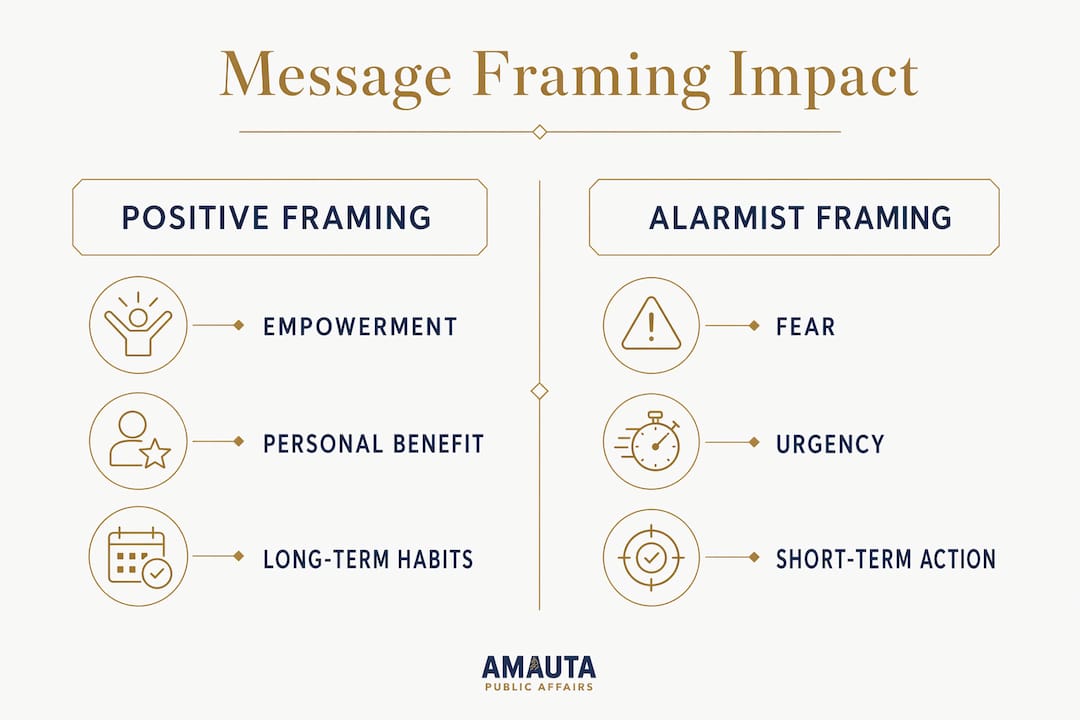
Positive framing, which emphasizes empowerment, societal benefits, and personal rewards, is more effective than alarmist approaches for building lasting habits. Alarmist messaging often triggers psychological avoidance. When audiences feel overwhelmed by the scale of a problem and see no clear personal role, they disengage rather than act.
Experimental research published in 2025 and 2026 identified three framing types with distinct effects:
Economic Gain framing motivates audiences who prioritize financial outcomes, particularly when tied to specific numbers such as monthly savings on energy bills.
Behavioral Impact framing works well for audiences who already hold pro-environmental values, reinforcing the connection between individual action and collective outcomes.
Anthropomorphic framing, which attributes human qualities to nature or ecosystems, generates emotional engagement but works best when paired with a clear call to action.
A critical and often overlooked variable is the audience’s baseline sustainability awareness. Prior knowledge predicts responsiveness to positive messaging. Audiences with higher sustainability awareness respond more strongly to empowerment frames, while lower-awareness audiences respond better to concrete, consequence-based messages. Skipping this assessment is one of the most common and costly mistakes in campaign design.
Pro Tip: Before selecting a message frame, use a brief audience survey or a Sustainability Awareness Index assessment to segment your audience. A frame that works for an engaged environmental group may fall flat with a general consumer audience.
Emotional engagement also interacts with channel context. A message that resonates on a podcast may need significant reworking for a paid search ad, where brevity and specificity dominate. Tailoring the emotional register to the platform is not optional. It is a prerequisite for performance.
Are educational campaigns or financial incentives more effective?
The answer is both, but in different contexts and with different longevity profiles. A systematic review synthesizing 51 studies and 5 meta-analyses found that educational campaigns achieve 57% effect retention at 24 months, outperforming financial incentives in persistence and resistance to behavior rebound. Financial incentives produce faster initial behavior change but tend to fade once the incentive is removed.
The practical implications for campaign designers are significant:
Use financial incentives to generate early adoption and visible momentum.
Layer educational content on top to build the values and knowledge that sustain behavior after the incentive ends.
Measure both short-term conversion and 12-month retention to get an accurate picture of true campaign impact.
Reserve financial incentives for high-friction behaviors, such as major appliance replacement, where the upfront cost barrier is the primary obstacle.
The research also shows that combined educational and financial approaches yield the largest pro-environmental behavior effects, with a combined effect size of g = 0.64 across meta-analyses. That figure represents a meaningful and replicable improvement over either approach used alone.
Intervention type | Short-term effect | 24-month retention | Best use case |
Financial incentives only | High | Low | High-friction, one-time behaviors |
Educational campaigns only | Moderate | 57% | Habit formation, values-based change |
Combined approach | Highest | Highest | Broad behavior change programs |
The table above reflects a consistent pattern across the research literature. Financial incentives are a catalyst, not a foundation. Educational campaigns build the foundation. The most cost-effective programs use both in sequence.
How can timing and channel selection maximize campaign impact?
Timing is a force multiplier in environmental communication. A well-framed message delivered at the wrong moment produces a fraction of its potential impact. The Sierra Club’s campaign pivot from abstract climate crisis language to household utility bills illustrates this precisely. By aligning campaign delivery with the fall-winter energy cost season, when consumers actively worry about heating bills, the campaign achieved a 164% increase in click-through rate compared to generic keyword targeting. That result came from timing and framing working together, not from a larger budget.
Channel selection follows a similar logic. The right channel depends on where your audience is making decisions, not where your organization is most comfortable.
Google Search. Keyword optimization tied to high-relevance seasonal windows captures audiences at the moment of active concern. Generic environmental keywords underperform against specific, cost-related search terms.
Social media. Visual storytelling and short-form video perform best when the message is emotionally resonant and the call to action is immediate and low-friction.
Streaming audio (Spotify and similar platforms). Audio ads work well for building awareness and framing, particularly when targeting commuters and younger demographics who are difficult to reach through traditional display.
Geo-targeting. Campaigns tied to local environmental events, such as a regional air quality alert or a utility rate increase, generate higher engagement than national campaigns with no local anchor.
Pro Tip: Apply mobile-first design principles to every creative asset. The majority of digital ad impressions are now served on mobile devices. A message that requires scrolling or zooming to read loses its audience before it delivers its claim.
Continuous optimization is not a post-campaign activity. It is a campaign-phase discipline. Real-time performance data from platforms like Google Ads allows communicators to shift budget toward the highest-performing message variants within days, not months. Amautapublicaffairs applies this approach across its environmental advocacy campaigns, treating each campaign as a living system rather than a fixed plan. For a deeper look at media outreach mechanics, the environmental media outreach tactics resource covers channel-specific execution in detail.
Consulting resources on maximizing campaign engagement through timing and digital optimization offer additional frameworks for practitioners who want to pressure-test their channel mix before launch.
Key Takeaways
Environmental messaging campaigns succeed when they connect ecological issues to immediate personal consequences, use evidence-based framing, and match channel selection to audience behavior patterns.
Point | Details |
Lead with personal consequences | Messages tied to health costs, utility bills, and local weather increase public support by at least 9 points. |
Use pollution framing to reduce polarization | Describing climate issues as pollution makes them feel 10–20% more manageable across partisan audiences. |
Combine education with incentives | Combined approaches produce the largest behavior change effects, with a g = 0.64 effect size across meta-analyses. |
Assess audience awareness first | Baseline sustainability knowledge predicts which message frame will perform, making pre-campaign assessment critical. |
Time campaigns to high-relevance windows | Aligning delivery with seasonal cost concerns can increase click-through rates by 164% compared to generic targeting. |
What practitioners get wrong about environmental communication
The most persistent mistake I see in environmental campaigns is the assumption that more information produces more action. Practitioners load messages with data, scientific terminology, and policy detail, then wonder why engagement stalls. The research is unambiguous: effective campaigns balance facts, emotion, timing, and personalization rather than maximizing all of them simultaneously. Trying to do everything at once produces messages that feel cluttered and impersonal.
The Sierra Club’s pivot to household bills is the clearest recent proof of this principle. Shifting from distant environmental threats to immediate financial impacts did not require a new budget or a new audience. It required a new frame. That reframe produced measurable engagement gains because it answered the question every audience member is silently asking: “Why does this matter to me, right now?”
My honest view is that the field still underinvests in audience segmentation. Communicators treat “the public” as a single entity when it is actually a collection of groups with different awareness levels, different values, and different triggers. A message built for an already-converted environmental advocate will alienate a skeptical swing voter. The stakeholder communication strategies that work in land use projects apply equally here: know your audience before you build your message.
The practitioners who consistently outperform their peers are not the ones with the biggest budgets. They are the ones who test early, read the data honestly, and adjust without ego. That discipline, applied to framing, timing, and channel selection, is what separates campaigns that move numbers from campaigns that simply run.
— Ignacio
Amautapublicaffairs: built for environmental campaign strategy
Environmental communication is not a one-size-fits-all discipline. Amautapublicaffairs designs tailored campaign strategies for environmental advocates, land use clients, and public policy teams who need messaging that moves real audiences, not just impressions.
The agency’s approach combines community landscape assessment, media relations, and digital advocacy into a single, results-driven program. Every campaign is refined in real time based on performance data, so clients see continuous improvement rather than a fixed deliverable. For organizations ready to build campaigns grounded in evidence and executed with precision, the full range of consulting services is available for review. Amautapublicaffairs also supports clients through the nonprofit advocacy messaging process for organizations building their first structured campaign.
FAQ
What is environmental advocacy in a campaign context?
Environmental advocacy is the organized effort to shift public opinion, policy, or behavior in favor of environmental protection. In a campaign context, it uses structured messaging, channel selection, and audience targeting to achieve measurable outcomes.
What makes an environmental messaging campaign effective?
Campaigns that connect environmental issues to personal consequences, such as health costs or utility bills, consistently outperform abstract appeals. The Rockefeller Foundation study found this approach increases public support by at least 9 points across tested democracies.
How long do the effects of environmental campaigns last?
Educational campaigns achieve 57% effect retention at 24 months, according to a systematic review of 51 studies. Combined educational and financial incentive approaches produce the highest long-term retention rates.
How does framing affect the impact of environmental campaigns?
Positive framing that emphasizes empowerment and personal benefits outperforms alarmist messaging for long-term habit formation. Pollution framing reduces political polarization by making environmental problems feel concrete and solvable.
How do you promote sustainability through digital channels?
Geo-targeting, seasonal keyword optimization, and mobile-first creative design are the most reliable digital tactics. The Sierra Club’s campaign demonstrated that aligning delivery with high-relevance timing windows can increase click-through rates by 164% over generic approaches.
Recommended
Comments