
Civic Engagement Campaign: A Guide for Organizers

A civic engagement campaign is defined as a structured, collective process where individuals or groups take coordinated action to influence social or political outcomes and strengthen democratic participation. These campaigns range from small neighborhood initiatives to large-scale national coalitions, including professional NGOs and grassroots networks. The critical distinction between a civic campaign and general awareness work is the focus on measurable behavior change. Registering voters, filling seats at public hearings, or mobilizing residents to submit public comments are the real targets. Understanding what a civic engagement campaign actually requires separates organizers who build lasting impact from those who generate noise.
What is a civic engagement campaign, and what makes it effective?
A civic engagement campaign is effective when it targets specific, countable behaviors rather than vague awareness goals. Calls-to-action framed as simple, achievable tasks are 2–3 times more effective than broad appeals to “get involved.” That gap matters enormously when you are working with limited budgets and volunteer capacity.
The definition of civic engagement extends beyond voting. Effective campaigns address a spectrum of participation: attending town halls, signing petitions, joining advisory boards, or contacting elected officials. Each of these behaviors is countable, trackable, and meaningful.
Successful campaigns share several defining characteristics:
A clear theory of change. Every campaign must define who holds authority, what pressure points exist, and what sequence of behaviors leads to the desired outcome. Fuzzy goals cause messaging to drift and reduce impact.
Achievable, specific calls-to-action. “Attend the March 15 city council meeting” outperforms “support your community.” Specificity removes the friction that stops people from acting.
Tracking and evaluation mechanisms. Campaigns that measure behavior change, not just impressions or likes, can course-correct in real time.
Transparency about goals and processes. Transparency is both an ethical and practical necessity in crowded information environments. Communities that trust your motives share data, show up, and recruit others.
Pro Tip: Build a one-page “campaign contract” that states your goals, methods, and how you will report results back to the community. Sharing this document at the first public meeting builds credibility faster than any press release.
How do digital and social media platforms shape modern civic campaigns?
Digital platforms do not create civic interest from scratch. Social media is most effective at mobilizing individuals who already have interest in the topic. That finding reframes how organizers should think about digital strategy: platforms amplify existing motivation rather than generate new motivation.
The practical implication is that digital campaigns work best as a second layer, not a first contact. Your first contact with a disengaged resident should happen through trusted community channels, local events, or anchor organizations. Digital tools then sustain and scale that initial connection.
Outreach method | Primary strength | Key limitation |
Door-to-door canvassing | Builds personal trust | High cost per contact |
Community town halls | Creates dialogue | Reaches already-engaged residents |
Social media campaigns | Scales quickly | Effective mainly with interested audiences |
Gamified digital workshops | Reduces friction for “silent citizens” | Requires design investment |
Trusted anchor organization partnerships | Accesses excluded communities | Depends on relationship quality |
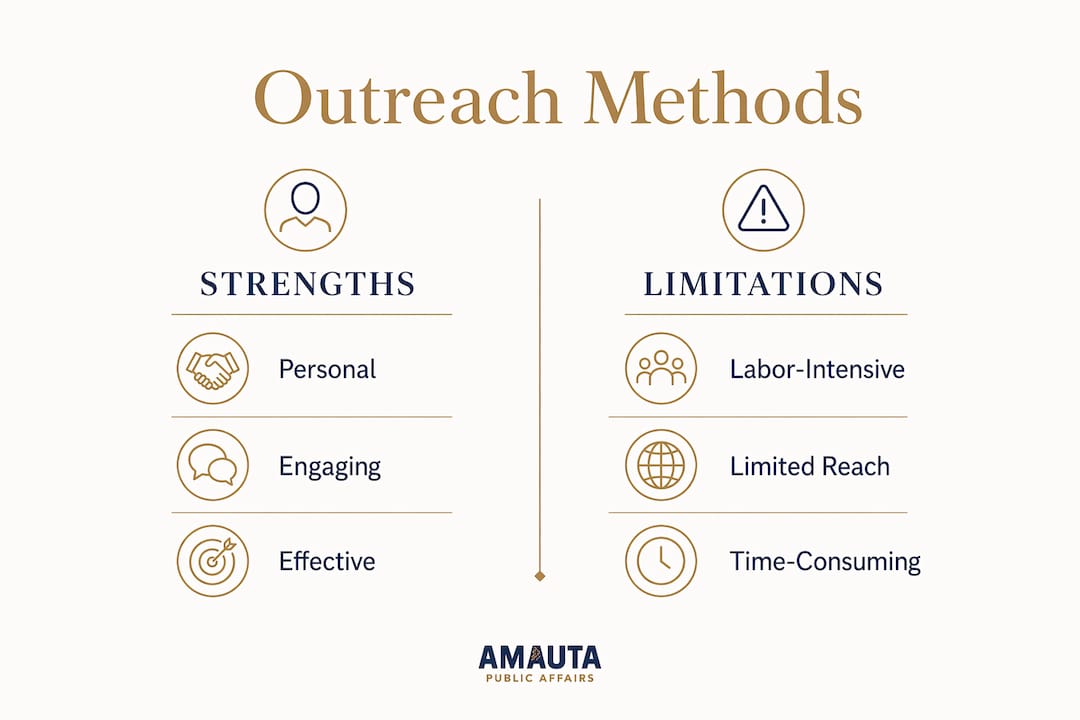
Gamified digital workshops represent one of the most underused tools in civic organizing. Gamification and daily-life framing lower barriers for non-activist citizens by connecting participation to familiar, low-stakes activities. A workshop that asks residents to rank neighborhood priorities on a digital map feels less intimidating than a formal public hearing. The result is broader participation from people who would never attend a city council meeting.

Structural disengagement remains a real challenge. Digital access gaps, language barriers, and historical distrust of government institutions all limit the reach of online campaigns. Organizers who plan digital campaigns for organic growth must account for these gaps from the start, not as an afterthought. Pairing digital outreach with in-person touchpoints consistently produces stronger participation rates than either channel alone.
How do you reach historically excluded communities in civic campaigns?
Equity is not optional in civic campaign design. Community outreach must prioritize equity principles to avoid reinforcing the same disparities the campaign aims to address. Generic broad-reach advertising tends to reach people who are already engaged, leaving historically excluded populations further behind.
The most reliable pathway to underrepresented communities runs through trusted anchor organizations. Churches, community health clinics, cultural associations, and neighborhood schools already hold the trust that civic campaigns spend months trying to build. Partnering with trusted local institutions is the fastest way to access communities that have learned to distrust top-down outreach.
Practical steps for equity-centered engagement include:
Map existing community networks before designing outreach. Identify which organizations already serve your target populations and approach them as co-designers, not distribution channels.
Build citizen advisory boards that include representatives from underrepresented groups. Formal advisory boards incentivize inter-group collaboration and create linking capital between residents and decision-makers.
Translate materials into lived realities. Abstract political language about “democratic participation” means little to a resident worried about rent or school safety. Frame campaign asks around the specific, tangible outcomes that matter to each community.
Compensate community partners fairly. Asking anchor organizations to do outreach work without resources extracts labor from communities that are already under-resourced.
Pro Tip: Conduct a “community landscape audit” before launching. Map which groups are absent from existing civic processes, identify the organizations they trust, and design your first outreach meeting around their schedules and locations, not yours.
The importance of civic participation grows precisely in communities where structural exclusion has been most severe. Campaigns that treat equity as a design principle, rather than a communications add-on, produce more durable participation and stronger political outcomes.
How do you design, implement, and measure a civic engagement campaign?
Running a civic campaign requires a clear sequence of decisions before any outreach begins. The community engagement strategy starts with mapping authority: who makes the decision you want to influence, who influences that decision-maker, and what conditions must change for the decision to go your way.
A practical campaign design follows this sequence:
Define the behavior change target. Name the specific action you want people to take, the number of people you need to take it, and the deadline. “500 residents submit public comments by april 30” is a campaign goal. “Raise awareness” is not.
Map your theory of change. Identify the chain of events between your campaign actions and the policy or social outcome you seek. This map prevents scope creep and keeps messaging focused.
Segment your audience. Divide your community into already-engaged supporters, persuadable residents, and structurally disengaged populations. Each segment needs a different channel, message, and ask.
Select channels based on segment, not preference. Door-to-door canvassing reaches disengaged residents. Social media reaches activated supporters. Anchor organization partnerships reach excluded communities.
Set tracking metrics before launch. Count behaviors, not impressions. Track meeting attendance, petition signatures, voter registrations, and public comment submissions.
Metric type | Example | What it measures |
Behavior change | Voter registrations completed | Direct campaign impact |
Participation depth | Meeting attendance rate | Sustained engagement |
Network growth | New anchor organization partners | Reach expansion |
Feedback quality | Community survey responses | Message resonance |
Feedback loops are the mechanism that separates campaigns that improve from campaigns that repeat mistakes. After each event or outreach push, collect structured feedback from participants and non-participants alike. Non-participants tell you more about barriers than participants do. Use that data to adjust your channel mix, message framing, and ask structure before the next phase.
Advocacy communications for civic leaders consistently show that campaigns willing to revise their approach mid-cycle outperform those that execute a fixed plan from start to finish. Rigidity is the most common cause of campaign stagnation.
Key Takeaways
A civic engagement campaign succeeds when it targets specific, measurable behaviors, reaches excluded communities through trusted partners, and uses real-time feedback to refine its approach at every stage.
Point | Details |
Define behavior change targets | Name the exact action, the number of people needed, and the deadline before launching. |
Build equity into campaign design | Partner with trusted anchor organizations to reach communities excluded from standard outreach. |
Use digital tools as amplifiers | Social media works best with already-interested audiences; pair it with in-person touchpoints for broader reach. |
Track behaviors, not impressions | Measure meeting attendance, petition signatures, and registrations rather than likes or page views. |
Apply feedback loops continuously | Collect structured feedback after each outreach phase and adjust channel mix and messaging before the next. |
What I’ve learned about civic campaigns that most guides won’t tell you
The most common failure I see in civic campaigns is not poor execution. It is a poorly defined goal dressed up as a mission statement. Organizers spend weeks crafting messaging around abstract concepts like “civic renewal” or “democratic values” while the community they want to reach is focused on a broken streetlight or an unresponsive landlord. The gap between those two realities is where campaigns go to die.
The campaigns that actually move people connect the abstract to the immediate. A voter registration drive framed around “protecting democracy” gets modest results. The same drive framed around “making sure your neighborhood gets its fair share of the city budget” gets people off their couches. That is not cynicism. That is understanding how motivation works.
I have also watched organizations invest heavily in digital tools while neglecting the anchor institution relationships that would have multiplied their reach tenfold. A well-designed gamified workshop or a polished social media campaign cannot substitute for the trust that a local church or community health clinic has built over decades. Digital tools work best when they extend relationships that already exist, not when they try to create them from scratch.
The organizers who build lasting civic power treat transparency as a competitive advantage. When you tell a community exactly what you are asking for, why you are asking for it, and what you will do with their participation, you remove the skepticism that stalls most campaigns before they gain momentum. Trust is not a soft outcome. It is the infrastructure that every other campaign tactic runs on.
— Ignacio
How Amautapublicaffairs supports your civic engagement work
Amautapublicaffairs brings a campaign-style approach to civic engagement that goes beyond standard community outreach. The team evaluates your community landscape, identifies key stakeholders and pressure points, and builds messaging strategies grounded in the behavior-change principles that produce real results.
Whether you are managing a land use approval, a public infrastructure project, or a policy advocacy effort, Amautapublicaffairs designs and executes engagement programs that build genuine community trust. Services include community engagement design, media relations, and digital advocacy, all calibrated to your project’s specific needs and timeline. Explore the full range of campaign design services to see how a structured, evidence-based approach can move your project forward.
FAQ
What is a civic engagement campaign?
A civic engagement campaign is a structured, collective effort to influence social or political outcomes through coordinated public action. Campaigns range from local neighborhood initiatives to national coalitions and focus on measurable behavior change rather than awareness alone.
How do you measure the success of a civic campaign?
Success is measured by tracking specific behaviors such as voter registrations, meeting attendance, petition signatures, and public comment submissions. Impression counts and social media reach are secondary metrics that do not reflect actual civic impact.
Why do civic campaigns fail to reach excluded communities?
Generic broad-reach advertising tends to reach already-engaged residents and bypasses historically excluded populations. Campaigns that partner with trusted local anchor organizations and tailor messaging to lived realities consistently achieve broader and more equitable participation.
How does gamification help civic engagement?
Gamified workshops and digital tools reduce the friction that stops non-activist citizens from participating by connecting civic tasks to familiar, low-stakes activities. This approach is especially effective for reaching “silent citizens” who would not attend a formal public hearing.
What is a theory of change in a civic campaign?
A theory of change maps the sequence of events between your campaign actions and the policy or social outcome you seek. It identifies who holds authority, what pressure points exist, and what specific behaviors must change for your campaign goal to be achieved.
Recommended
Comments