
Business Community Engagement Platforms Compared: 2026 Guide

For developers, local governments, and nonprofits navigating U.S. land-use and infrastructure approvals, the fastest route to predictable entitlements is a campaign-style community engagement consultant that combines targeted stakeholder outreach, measurable KPIs, and real-time digital feedback loops. When you compare community engagement solutions for land-use projects, this model consistently outperforms both standalone facilitation services and digital-only approaches because it shapes the public record before filings become visible, coordinates supporter testimony at hearings, and generates the granular outcome data that agencies and elected officials respond to.
Three reasons this model delivers:
Faster approvals: Campaign-style consultants track days-to-permit as a live KPI, adjusting outreach tactics when momentum stalls rather than waiting for a hearing to surface opposition.
Fewer resubmittals: Proactive stakeholder mapping identifies friction points before the application is filed, reducing the back-and-forth that extends timelines by weeks or months.
Coordinated hearing turnout: Organized supporter testimony gives decision-makers a balanced public record, not just the vocal opposition that shows up by default.
To request a project scoping call with Amautapublicaffairs, visit the services page.
Table of Contents
How do you evaluate and vet community engagement consultants?
The Public Affairs Council recommends selecting firms with direct expertise in your project type and notes growing client preference for boutique firms that offer specialized digital and grassroots capabilities. Use the checklist below as your procurement framework.
Evaluation criteria:
Documented experience with your specific project type (rezoning, energy, infrastructure, commercial)
Named team bios with public affairs or planning credentials — not just a firm overview
Measurable KPIs offered in the proposal (days-to-permit, resubmission rate, hearing turnout)
Demonstrated local government and agency relationships in your jurisdiction
Digital advocacy capability and integration with your project management or CRM tools
Clear data security and privacy protocols for stakeholder data
Training and onboarding support for your internal team
Interview questions to ask every candidate:
Can you provide a case study for a project of this type and scale in a comparable jurisdiction?
What was the days-to-permit outcome on your last three contested approvals?
Will you provide two named client references who can confirm those outcomes?
How does your team integrate with our PM or CRM system during the engagement?
Who specifically will lead day-to-day work — and what is their background?
Red flags that warrant walking away:
No project-type case studies, only general firm credentials
KPIs described vaguely (“improved community relations”) with no quantified baseline
Subcontractor-only delivery with no named lead consultant
Resistance to defining deliverables and timelines in the contract
Vendor scoring rubric:
Criterion | Weight | Score (1–5) | Weighted Score |
Experience with project type | 30% | — | — |
Local government relationships | 20% | — | — |
Technical integration capability | 15% | — | — |
Multiply each score by its weight and sum the column to generate a comparable vendor score across your shortlist.
Which service model fits your project?
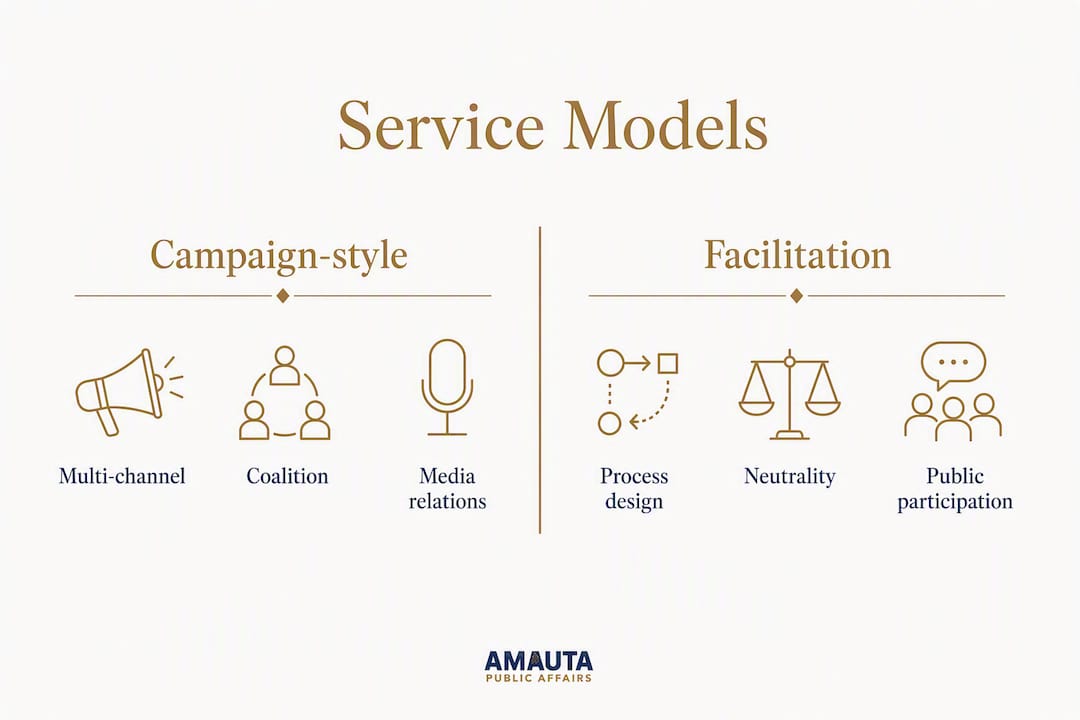
Public engagement consultants differ by discipline and approach; agencies often hire multiple consultants to cover gaps across facilitation, advocacy, and digital outreach. Understanding each model prevents paying strategy rates for administrative work.

Campaign-style public affairs deploys multi-channel stakeholder campaigns, media relations, coalition building, and digital advocacy in parallel. It is the right model for contested rezonings, large infrastructure projects, and any approval where organized opposition is likely. The consultant functions as a campaign manager: setting message strategy, mobilizing supporters, and tracking outcomes in real time.
Facilitation focuses on process design and neutral public participation. It fits planning processes where the agency needs structured dialogue between competing interests, such as general plan updates or community benefit negotiations. Facilitation alone rarely moves a contested entitlement forward because it does not build proactive support.
Digital-first engagement centers on platform-driven outreach, online surveys, and feedback loops. It works well for routine permitting with low controversy, or as a complement to campaign-style work when the project area is geographically dispersed.
Project type | Recommended model | When to pair models |
Contested rezoning or land-use amendment | Campaign-style public affairs | Add digital-first for large geographic reach |
Large energy or infrastructure project | Campaign-style public affairs | Add facilitation for formal public participation requirements |
General plan update or community benefit negotiation | Facilitation | Add digital-first for broader input collection |
Routine commercial permitting | Digital-first or facilitation | Rarely needs campaign-style unless opposition emerges |
Because filings can become public record on submission in many U.S. jurisdictions, engaging a campaign-style consultant during plan drafting lets you tell the project’s story proactively. Waiting until after filing means spending resources on defensive communications rather than building the narrative.
What case studies and KPIs should you request from vendors?
Vetting land-use consultants requires requesting project-type case studies and references that confirm whether the consultant reduced days-to-permit or avoided resubmittals. A case study that only describes activities without outcomes tells you nothing about impact.
Case study template — request this format from every candidate:
Project type, jurisdiction, and approximate timeline
Consultant’s specific role (lead, support, subcontractor)
Tactics deployed (stakeholder mapping, coalition outreach, media, digital advocacy)
Measurable outcomes: days-to-permit saved, resubmittals avoided, hearing turnout composition, sentiment shift
Named reference contact who can confirm the outcomes
KPIs to demand in any engagement proposal:
Days-to-permit (baseline vs. actual)
Number of resubmissions avoided
Public hearing turnout: supporter-to-opponent ratio
Earned media placements and sentiment tracking
Timeline adherence against project milestones
Stakeholder response rate on digital outreach
Reference validation checklist:
Ask the reference to confirm the specific outcome claimed in the case study.
Cross-check filing dates and hearing minutes in the relevant municipal public records.
Verify the consultant’s named team members appear in staff reports or hearing records.
Ask whether the consultant delivered on time and within the agreed fee structure.
Pro Tip: Ask each reference this exact question: “Can you point me to a specific public record, hearing minute, or permit filing that confirms the timeline or resubmittal outcome the consultant described?” A reference who can answer that question with a document number is worth far more than one who offers general praise.
How do consultants charge, and what contract terms protect you?
Consultants often use milestone-based or defined-fee structures for entitlement campaigns, with full approval campaigns frequently carrying six-figure budgets — consultant fees representing a fraction of the total approvals spend. Understanding fee models before you negotiate protects your budget and your timeline.
Common fee models:
Fixed project fee: Best for well-scoped campaigns with defined deliverables and a clear hearing schedule.
Milestone payments: Ties disbursements to completed phases (discovery, outreach launch, hearing, follow-up). Reduces financial risk if the project stalls.
Retainer plus performance bonus: Appropriate for multi-year infrastructure projects where scope evolves; the bonus aligns consultant incentives with approval outcomes.
Hourly for scope creep: Useful as a defined add-on rate in the contract, not as the primary structure.
Contract clauses to negotiate:
Defined deliverables with acceptance criteria for each phase
Timeline milestones with written notice requirements for delays
Reporting cadence: weekly status updates and a post-hearing KPI summary
IP and data ownership: all stakeholder data and creative assets belong to the client
Termination for convenience with a 30-day notice period
Confidentiality covering project strategy and stakeholder lists
The Institute for Local Government advises explicitly defining deliverables, timelines, and communication responsibilities — and clarifying which tasks belong to agency staff so consultants are not set up to fail.
Project phase | Typical duration |
Discovery and stakeholder mapping | 2–4 weeks |
Outreach design and message testing | 2–3 weeks |
Public hearings and testimony coordination | 1–4 weeks |
Post-hearing follow-up and reporting | 2–3 weeks |
Pro Tip: Budget a contingency of 15–20% of the consultant fee for extended hearings, media response cycles, or appeals. These are the most common sources of unplanned cost, and a contract that defines the hourly rate for out-of-scope work prevents disputes when they arise.
How Amautapublicaffairs runs campaign-style engagement for land-use projects
Amautapublicaffairs approaches every land-use and infrastructure project as a campaign-style engagement challenge, not a compliance exercise. The firm’s core capabilities span the full approval lifecycle:
Campaign strategy and stakeholder mapping: Identifying supporters, neutrals, and opponents before the first filing, then prioritizing outreach accordingly.
Digital advocacy and real-time feedback: Deploying digital channels to mobilize supporters and adjusting messaging based on live sentiment data.
Media relations: Earned media placement and narrative management to shape the public record before and during the hearing process.
Coalition building: Organizing community voices so decision-makers hear a representative perspective, not just organized opposition.
Permitting support: Coordinating with agency staff and navigating administrative processes to reduce resubmittals and keep timelines on track.
Integration with client PM and CRM tools: Reporting stakeholder engagement data in formats that connect to the client’s existing project management workflow.
Client outcomes Amautapublicaffairs measures include reduced days-to-permit against baseline, lower resubmittal rates, and balanced public hearing turnout. The firm tracks these KPIs in real time and adjusts campaign tactics when the data signals a shift in community sentiment.
Amautapublicaffairs provides project-type case studies on request. To discuss your project and receive a tailored scoping memo, connect with the team.
Key Takeaways
Campaign-style community engagement, contracted with clear KPIs and milestone-based fees, is the most reliable path to predictable approvals for land-use and infrastructure projects in the United States.
Point | Details |
Engage consultants early | Public affairs involvement during plan drafting shapes the narrative before filings become public record. |
Demand measurable KPIs | Require days-to-permit baselines, resubmittal rates, and hearing turnout data in every proposal. |
Use milestone-based contracts | Milestone payments tied to defined deliverables protect your budget if the project scope shifts. |
Validate with public records | Cross-check vendor case study claims against municipal hearing minutes and permit filing dates. |
Amautapublicaffairs | Offers campaign-style engagement with real-time feedback, KPI reporting, and permitting support for land-use and infrastructure projects. |
The case for getting in early — and staying data-driven
Most project teams treat community engagement as a late-stage requirement: something you activate when opposition surfaces or a hearing date is set. That instinct is understandable, but it is also the single most expensive mistake in the entitlement process.
By the time organized opposition has formed a coalition, drafted talking points, and shown up at a planning commission meeting, the project team is playing defense. Every dollar spent on reactive communications is a dollar that could have built proactive support. The Public Affairs Council frames this clearly: the firms that deliver the most value are those that combine granular local knowledge with modern digital capabilities, not those that arrive at the hearing with a slide deck.
What the data-driven campaign model adds is accountability. When a consultant tracks days-to-permit as a live metric and adjusts outreach based on real-time sentiment, the engagement stops being a soft activity and becomes a measurable input to the approval timeline. That shift changes how project teams budget for public affairs, how they evaluate consultant performance, and how they report outcomes to boards and investors.
The firms worth hiring are the ones who will hand you a KPI dashboard at the end of the engagement, not a summary of meetings attended.
Amautapublicaffairs can review your project now
For developers and public agencies that need a clear path through a contested or complex approval, Amautapublicaffairs delivers campaign-style community engagement with the measurable outcomes that move projects forward. The firm’s approach combines stakeholder mapping, digital advocacy, media relations, and permitting coordination into a single, integrated campaign — with KPI reporting built in from day one.
A scoping call with Amautapublicaffairs produces a discovery memo that outlines the community landscape, identifies key stakeholders, and recommends a campaign approach matched to your project type and timeline. Project-type case studies are available on request.
Three steps to get started:
Request a scoping call and share your project documents.
Receive a scoping memo with a stakeholder landscape assessment and fee estimate.
Review a matched case study from a comparable project type before signing.
For land management and land-use projects specifically, visit the land management services page.
Authoritative U.S. resources for validating vendor claims
Use these primary sources to cross-check case study claims, confirm local relationships, and set procurement standards:
International Association for Public Participation (IAP2): The professional standard for public participation practice in the United States; use IAP2’s Spectrum of Public Participation to evaluate whether a consultant’s proposed approach matches your project’s engagement goals.
Institute for Local Government: Publishes practical guidance on contracting public engagement consultants, including deliverable definitions and accountability frameworks.
Public Affairs Council: Trusted source for evaluating government affairs and public affairs firm selection criteria, including boutique vs. full-service firm tradeoffs.
To confirm a vendor’s claimed outcomes, request the specific permit application number or hearing docket from their reference, then pull the public record directly. A consultant whose case study cannot be cross-checked in public records is a consultant whose claims cannot be verified.
Recommended
Comments