
The Role of Email Advocacy Campaigns for Nonprofits
- ibarragan7
- Jul 14
- 8 min read

Email advocacy campaigns are defined as coordinated outreach efforts that mobilize supporters to contact decision-makers through personalized, action-oriented messages. The role of email advocacy campaigns goes far beyond simple outreach. According to 2026 M+R benchmark data, advocacy emails outperform fundraising emails by a factor of 28, generating a 2.3% click-through rate compared to 0.59% for fundraising messages. That gap is not a rounding error. It signals that your supporters are far more ready to act on a cause than to open their wallets on demand. For nonprofit leaders and community organizers, understanding this distinction is the prerequisite for building campaigns that actually move people and policy.
What is the role of email advocacy campaigns in nonprofit outreach?
Email advocacy campaigns convert passive subscribers into active participants. They ask supporters to sign petitions, contact legislators, share personal stories, or call local officials. That shift from passive to active is where real influence begins.
Advocacy emails generate a 2.3% click-through rate and a 1.4% response rate, roughly 28 times higher than fundraising email benchmarks. That level of engagement means your list is not just reading. They are responding, clicking, and completing actions that carry political weight.

The influence compounds when you consider legislative impact. One personalized email to a legislator carries the equivalent weight of 10 to 50 generic form letters. That ratio reflects how legislative staff actually process constituent contact. Volume matters, but authenticity matters more.
Beekeeper Group research shows that 84% of people respond to a personal ask from a friend, compared to 61% for an organization’s social media post. Email sits closer to that personal ask than any other digital channel. When your message lands in someone’s inbox with their name, their representative’s name, and a clear action, it feels direct. That directness drives results.
How do advocacy emails compare to other digital communication methods?
The performance gap between advocacy emails and other outreach methods is significant and measurable. The table below shows how key engagement metrics differ across common communication channels.
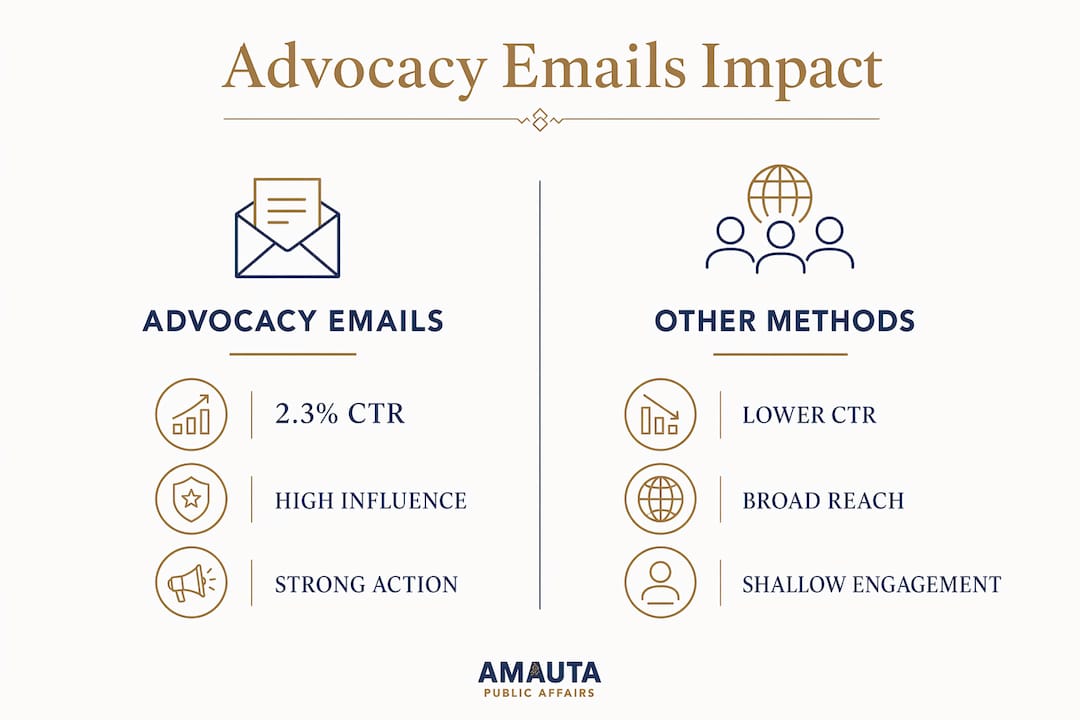
Communication method | Click-through rate | Legislative influence | Supporter action rate |
Advocacy email | 2.3% | High (10–50x form letters) | 1.4% response rate |
Fundraising email | 0.59% | Minimal | Low |
Social media post | Variable | Very low | 61% respond to org posts |
Generic form letter | N/A | Minimal (filtered out) | Low |
Phone call | N/A | Very high (100–1,000 voters) | Requires higher friction |
Form letters are increasingly filtered out by legislative staff because of their uniformity and sheer volume. A personalized email breaks through that filter. A phone call breaks through even more forcefully. Legislative staff report that 10 calls in an hour attracts staff attention, while 50 calls in a single day pulls senior teams into meetings. Email advocacy works best when it feeds into that escalation pathway, moving supporters from clicking to calling.
Social media reaches broad audiences but generates shallow engagement. Organic posts rarely prompt a constituent to contact their representative. Email, by contrast, delivers a specific ask to a specific person at a specific moment. That specificity is what makes it the most reliable channel for advocacy communications in the nonprofit sector.
How to design and execute effective email advocacy campaigns
Effective email advocacy starts with speed and ownership. Rapid-response workflows outperform pre-planned evergreen content because they capture supporter energy when interest is highest. Devon Bhakta of Common Cause has documented how breaking news moments create windows of high engagement that close within hours. Organizations that have a designated owner, pre-approved message templates, and a clear approval chain can publish a campaign within two hours of a news event. Those that do not miss the window entirely.
Pro Tip: Assign one person to own rapid-response email campaigns. Give them authority to send within a defined word count and topic range without waiting for full committee approval. Speed is the asset.
Beyond speed, authenticity separates high-performing campaigns from noise. Successful email advocacy integrates AI-driven and interactive tools that guide supporters in crafting unique messages, combining personalization with low barriers to participation. The goal is not to write the message for your supporter. The goal is to give them a framework and let their voice come through.
The most effective campaign formats include:
Share your story campaigns: Supporters describe how a policy issue affects their daily life. These messages carry the highest legislative weight because they are impossible to replicate at scale.
Video message campaigns: Short, personal video appeals from constituents to legislators. Rare enough to stand out, personal enough to land.
Interactive letter tools: Platforms that pre-populate a letter with the supporter’s name, location, and representative, then invite them to add two to three sentences in their own words before sending.
Segmented list campaigns: Messages tailored by geography, issue interest, or giving history. A supporter in a swing district receives a different ask than one in a safe seat.
Balancing advocacy and fundraising in the same email is possible but requires discipline. Lead with the advocacy ask. Place any fundraising appeal after the action is complete. Mixing the two asks in the opening paragraph reduces completion rates for both.
What role does follow-up play in email advocacy success?
The initial advocacy action is the beginning of a relationship, not the end of a transaction. About 80% of people research the issue further after taking an advocacy action. That post-action curiosity is a window your follow-up emails must fill.
A well-designed advocacy ladder moves supporters through progressively deeper commitments. The stages below reflect how that progression works in practice:
Sign a petition or send a pre-written email. Low friction. High volume. This is the entry point for new supporters.
Send a personalized email to a legislator. Moderate friction. Requires the supporter to add their own words. Carries 10 to 50 times the influence of a form letter.
Make a phone call to a legislative office. High friction. Requires real-time action. Carries the weight of 100 to 1,000 voters per call.
Attend a town hall or constituent meeting. Very high friction. Reserved for your most committed advocates. Creates direct, face-to-face relationships with decision-makers.
Become a super advocate. These supporters recruit peers, lead local chapters, and represent the organization in media or legislative settings.
Gamification accelerates movement up this ladder. Tracking and displaying how many actions a supporter has completed, or showing a progress bar toward a campaign goal, increases repeat participation. Identifying super advocates through engagement data lets you make targeted asks that feel personal rather than broadcast.
The donation connection is real and measurable. About 0.34% of subscribers who complete an advocacy action donate on the immediate follow-up page. That number sounds small, but across a list of 50,000 active advocates, it represents meaningful revenue. Treating advocacy as a fundraising funnel, rather than a separate program, changes how you allocate resources and measure success.
Many nonprofits undervalue advocacy as a relationship-building tool. Organizations that treat advocacy as their primary engagement channel consistently outperform those that lead with fundraising asks. The data supports this reordering of priorities.
How do you measure the impact of email advocacy campaigns?
Measurement in email advocacy requires tracking more than open rates. The metrics that matter most connect email activity to real-world outcomes.
Metric | What it measures | Strategic use |
Click-through rate | Percentage of recipients who click the action link | Benchmarks email content and subject line effectiveness |
Advocacy action completion | Percentage who complete the full ask | Measures campaign effectiveness and friction levels |
Conversion to donation | Percentage who donate after completing an action | Tracks advocacy-to-fundraising pipeline value |
Legislative contact volume | Total emails, calls, or letters sent to officials | Quantifies political pressure generated |
Repeat action rate | Supporters who act on multiple campaigns | Identifies super advocates for targeted outreach |
Segmenting your list by engagement history is the single most effective way to improve all of these metrics simultaneously. A supporter who has completed three advocacy actions in the past six months responds differently than a first-time subscriber. Sending them the same message wastes the relationship you have already built. For a detailed look at how messaging decisions affect these numbers, the nonprofit advocacy messaging guide published by Amautapublicaffairs breaks down the data by campaign type and audience segment.
Technology platforms that automate segmentation, track action completions, and generate real-time reporting remove the manual burden from small teams. The right platform does not replace human judgment. It gives your team the data to make better decisions faster. For a structured approach to outreach workflows, the step-by-step campaign outreach guide offers a practical framework for building these systems. Understanding what is advocacy campaigning at a structural level also helps teams align their measurement framework with their campaign goals from the start.
Key Takeaways
Email advocacy campaigns are the highest-engagement channel available to nonprofits, generating 28 times more response than fundraising emails while building the legislative influence and donor relationships that sustain long-term impact.
Point | Details |
Advocacy emails outperform fundraising emails | A 2.3% click-through rate versus 0.59% makes advocacy the stronger engagement channel. |
Personalization multiplies legislative influence | One tailored email carries the weight of 10 to 50 generic form letters with legislative staff. |
Rapid-response workflows capture peak engagement | Campaigns launched within hours of a news event reach supporters when their motivation is highest. |
Follow-up converts advocates into donors | About 0.34% of supporters who complete an advocacy action donate on the immediate follow-up page. |
Measurement must go beyond open rates | Track action completions, legislative contact volume, and repeat participation to assess real impact. |
Why authenticity is the only metric that scales
After working across dozens of nonprofit advocacy programs, the pattern I keep seeing is this: organizations invest heavily in list size and almost nothing in message quality. They send templated emails to 100,000 subscribers and wonder why their legislative contacts feel invisible. The answer is not more volume. The answer is more authenticity.
Legislative staff are not fooled by mass campaigns dressed up as personal outreach. They have seen every variation of the pre-written letter. What they remember is the constituent who described a specific experience in their own words, or the caller who knew the bill number and could explain why it mattered to their neighborhood. That kind of contact is rare. That rarity is exactly what makes it powerful.
The rapid-response piece is where I see the most wasted opportunity. Breaking news creates a 24-to-48-hour window when supporters are emotionally engaged and ready to act. Organizations without a clear rapid-response communication structure miss that window every time. By the time the email goes through three rounds of approval, the news cycle has moved on and the moment is gone.
The organizations that sustain advocacy impact over years are the ones that treat every email as the start of a longer conversation. They follow up. They educate. They escalate asks gradually. They recognize their super advocates and give them meaningful roles. That long-term thinking is what separates a campaign from a movement.
— Ignacio
How Amautapublicaffairs supports your email advocacy program
Amautapublicaffairs brings a campaign-style approach to nonprofit digital advocacy, combining rapid-response workflows, list segmentation, and integrated communication strategies that move supporters from first click to sustained engagement.
The team at Amautapublicaffairs designs advocacy email programs built around your organization’s specific community, issue set, and legislative targets. From pre-approved message frameworks that enable same-day deployment to data-driven segmentation that matches the right ask to the right supporter, every element is calibrated for measurable impact. If your current email program is generating activity without generating influence, the advocacy and digital services offered by Amautapublicaffairs provide the structure and expertise to close that gap.
FAQ
What is the difference between advocacy emails and fundraising emails?
Advocacy emails ask supporters to take a political or civic action, such as contacting a legislator or signing a petition. They generate a 2.3% click-through rate, roughly 28 times higher than fundraising emails, making them the stronger engagement channel.
How much influence does one personalized email have on a legislator?
One personalized email to a legislator carries the equivalent influence of 10 to 50 generic form letters. Legislative staff actively filter out mass form letters, so authentic, individualized messages carry significantly more weight.
How often should nonprofits send advocacy emails?
Frequency should follow the news cycle and campaign calendar rather than a fixed schedule. Rapid-response campaigns sent within hours of a relevant news event consistently outperform pre-planned evergreen content because they reach supporters when engagement is highest.
Do advocacy emails lead to donations?
About 0.34% of supporters who complete an advocacy action donate on the immediate follow-up page. Treating advocacy as the entry point to a fundraising relationship, rather than a separate program, increases both advocacy participation and donation conversion over time.
What metrics matter most for email advocacy campaigns?
Prioritize advocacy action completion rates, legislative contact volume, and repeat participation rates. Click-through rates provide a baseline, but the metrics that reflect real-world influence are the ones that count actions taken outside the inbox.
Recommended
Comments